Natalie Ferro Lozano
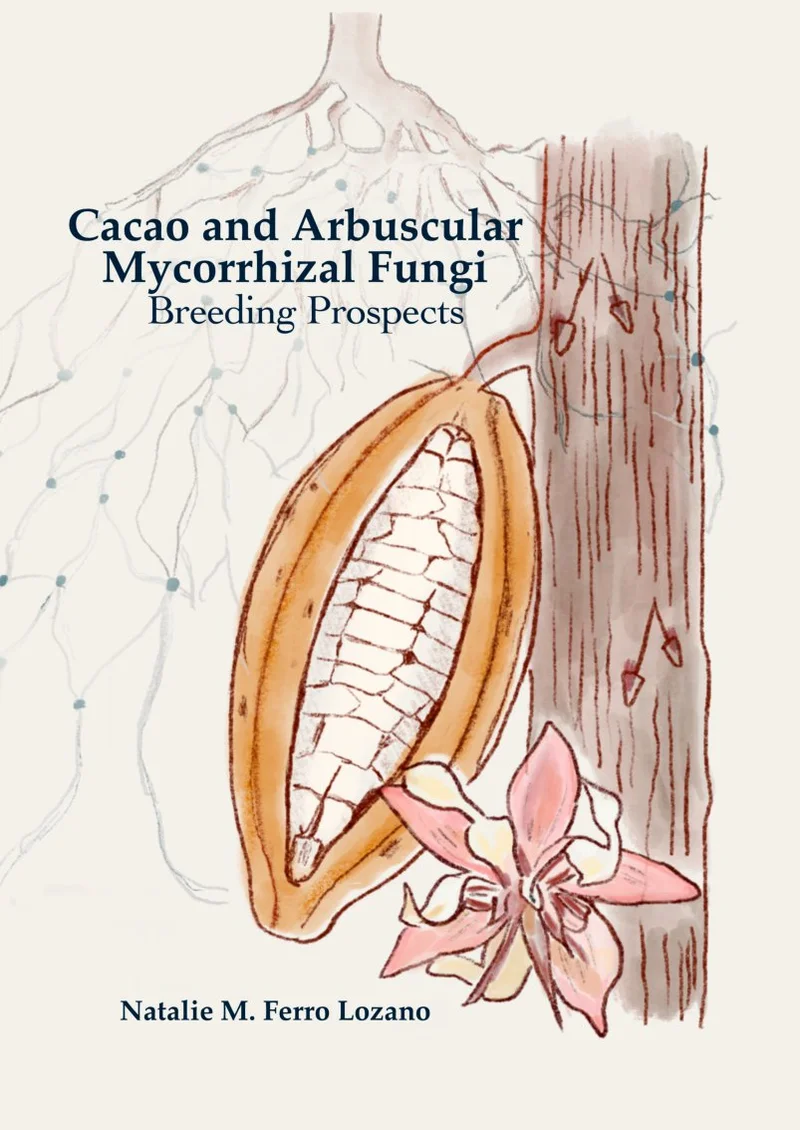


Cacao and Arbuscular Mycorrhizal Fungi
This story starts with invisible threads in the soil, that are connected to almost all plants through the roots. These beings are called Mycorrhizal Fungi, in particular these ones I’ll tell you about are called Arbuscular Mycorrhizal Fungi (AMF), because of the arbuscules, tree-like structures they make inside the root. These beings associate with almost(!) all plants on Earth, since 400 million years ago, and even helped change the atmosphere of the Earth by helping plants colonize all land ecosystems (that’s right, before there were only aquatic plants). These beings help the plants in many ways. By extending the reach of their roots they can acquire more nutrients and water that the plant needs, and the relationship itself prepares the plant to fight off natural enemies. I study these beings and their association with the cacao trees. These cacao trees only grow in the tropics, in jungle-like ecosystems, and produce cacao beans, from which a wonderful treat is produced. This treat, chocolate, nourishes the heart and the soul. People love so much eating chocolate, that they eat in many forms, mixtures with other flavors, and even make sculptures with them. But now, there is a problem with the cacao cultivation. The humans, our kind, have stopped caring for the Earth, in the quest of survival, or at least most of them. They, or should I say ‘we’, found a way of producing a lot of food, but it meant to cut down a lot of forest, use toxic chemicals to kill the insects that want to eat all the food we produce, and give mineral nutrients in excess to the plants so they are extra-large. This way of producing food, in addition to many other ways of living, have increased the temperature on our Earth and now the climate is changing… Seasons are shifting, and plants, along with other organisms on earth, are trying to find a new rhythm of living with the Earth. In finding this new rhythm, trees lose their fruits, because weather conditions are not ideal, either by too much or too little rain or heat. This has caused a scarcity of cocoa and therefore of chocolate. I thought… may be in these helpful relationships of plants with the AMF we can find the key to help the plants find the new rhythm with the Earth. Me and others with me, went on a journey to answer some questions, and think of what could help. During the first chapter of this journey, we went to these cacao farms and investigated the cacao trees growing in two different regions of Panama: Bocas del Toro and Herrera. In our expedition we looked at the genetic code in these trees and found that trees in Bocas del Toro were of very mixed ancestry, with all ten major genetic groups, while in Herrera there were mainly two groups, Amelonado and Criollo. We also learned if these farmers sowed seeds or used a technique called grafting, to develop new trees. Grafting is to mix two different trees, one aboveground (scion) with another belowground (rootstock), into one. More than half of the trees in Bocas del Toro and only a fourth in Herrera were grafted. We noticed that nitrogen and the level of acidity (pH) in the soil were associated with genetic differences across all trees. As we moved to the next chapter, we thought about the AMF. Which are the species associated with these trees? Does the cacao tree genetics, root architecture, or even the environment shapes these AMF communities? We found the genus Glomus to be dominant across all samples, and we did not see differences in the AMF communities between regions, even though they varied in many environmental characteristics. The aboveground (scion) genetics of the plant, root nutrient (nitrogen and phosphorus) concentration, elevation, and available phosphorus in the soil were associated with shaping the species in AMF communities. We also found specific AMF species associated with these key variables. In the last chapter of our journey, we grew some of the cacao trees from the first chapter, selfed progenies of three productive and sturdy trees to be precise, with four AMF soils from the second chapter and with a non-AMF soil, to observe how the root traits and growth of the seedling trees, changed with different AMF communities. We found great differences in plant growth between AMF soils, plant progenies and interactive effects between these, so some progenies (S1-60) responded stronger than others to a particular AMF treatment (H3). For root traits, root nitrogen and root diameter were different between progenies and AMF, and for root tissue density and specific root length we found these to be different only between AMF soils, particularly with and without AMF. After this whole journey, we had a lot to reflect about. We learned not only about cacao and AMF, but also about the people and culture involved. We understood the need farmers have for stronger social and economic structure that supports them to develop and apply available technologies for their plants, farm and resulting product. This new structure would guide cacao breeding, working with the farmers, to improve yield and product quality, while also ensuring fair wages that provide a dignified lifestyle for farmers.
| Publicatiedatum | 11 mei 2026 |
| Universiteit | Wageningen University |
| Auteur | Natalie Ferro Lozano |
| Order nummer | 18666 |