Francoise Dekker
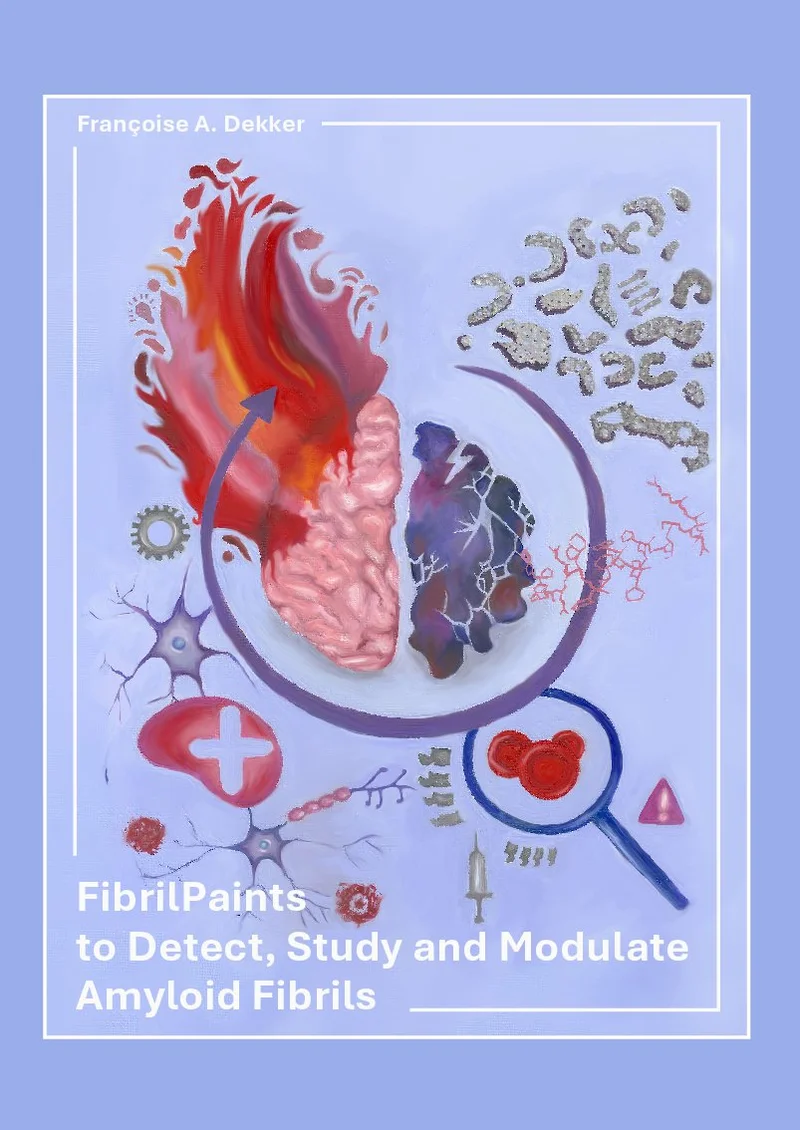


FibrilPaints to Detect, Study and Modulate Amyloid Fibrils
Neurodegenerative diseases are characterized by the progressive loss of neurons and the subsequent decline in cognitive and motor functions. Examples include Alzheimer’s (AD), Parkinson’s (PD), and Huntington’s Disease (HD). These diseases affect different brain regions and present distinct clinical features. Despite these differences, they share a common pathological hallmark: the formation of amyloid fibrils. These fibrils arise from normally functioning proteins, such as Aβ and Tau in AD, α-synuclein in PD, and Huntingtin in HD, which adopt β-sheet–rich conformations and stack into highly ordered structures. This thesis introduces the FibrilPaint family and a new measurement system, the FibrilRuler Test. FibrilPaint peptides bind selectively to amyloids. They can be extended with functional motifs to signal for degradation or for tracking. The FibrilRuler Test determines the length of fibrils by measuring the hydrodynamic radius (Rh) using flow-induced dispersion analysis (FIDA). Together, we use these tools to detect, study, and influence fibrils. Chapter 1 reviews amyloid formation in both neurodegenerative and systemic diseases, highlighting shared molecular features and diagnostic challenges. Chapter 2 presents proof-of-principle studies: FibrilPaint1 binds recombinant and patient-derived Tau fibrils and the FibrilRuler Test quantifies their length in solution. Chapter 3 explores whether FibrilPaints can also be used to modulate amyloids to signal for degradation. FibrilPaint20 recruits CHIP, an E3 ubiquitin ligase, to label Tau fibrils for proteasomal degradation. In Chapter 4, we repeat this set-up for Huntingtin fibrils, which are structurally unrelated to Tau. While Tau is partially processed this way, similar targeting of Huntingtin fibrils does not lead to efficient degradation highlighting structural differences in their processing. Chapter 5 assesses the sequence determinants of amyloid binding across FibrilPaint variants, identifying a conserved core motif that retains cross-amyloid recognition. Chapter 6 expands the FibrilRuler assay to α-synuclein, and shows that conformation matters less for determining fibril length from Rh after the initial layers have been incorporated. Chapter 7 outlines a translational roadmap. It proposes the FibrilRuler Test as a fluid-based diagnostic tool, especially for PD, where current biomarkers fall short. The test’s ability to measure fibril length could provide a readout of disease stage, thereby support early diagnosis and therapeutic monitoring. Finally, Chapter 8 reflects on the broader significance of these findings. Amyloid formation lies at the heart of disease onset and progression, making it a critical target for intervention. The FibrilRuler Test offers a new parameter to better understand the fundamental principles of aggregation. FibrilPaints may serve as a modular tool to detect them for diagnosis or target them for therapeutic intervention. This is timely, as amyloids are once again being validated as clinically actionable targets.
| Publicatiedatum | 14 juli 2026 |
| Universiteit | Universiteit Utrecht |
| Auteur | Francoise Dekker |
| ISBN nummer | 9789039380833 |