Zhou Fang
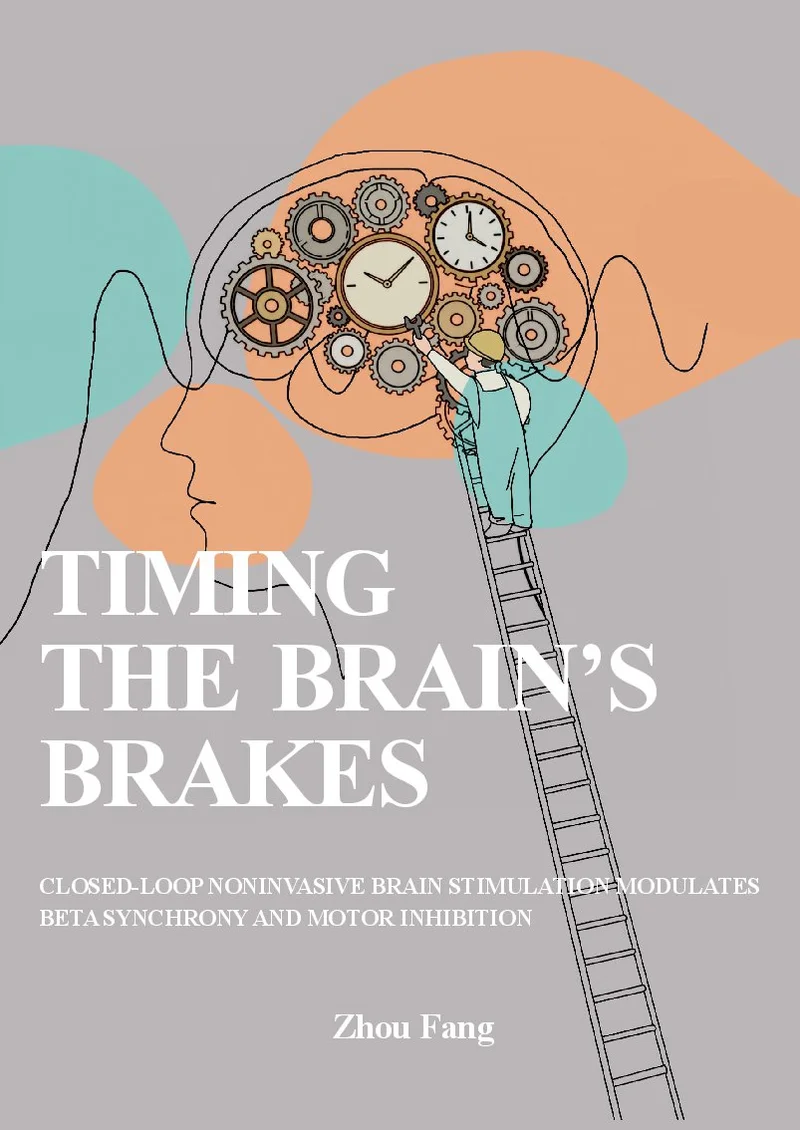


TIMING THE BRAIN’S BRAKES
Motor inhibition is a core executive control function that allows rapid cancellation or suppression of intended actions in response to a dynamic environment. Neurophysiological research has established that inhibitory processes are governed by the fronto-basal ganglia network, in which beta-band oscillations (13-30 Hz) have been consistently correlated with tuning this ”braking” mechanism. Elevated beta power is associated with the maintenance of the status quo and the suppression of movement, while a drop in beta power is necessary to initiate movement. Yet beta oscillations are not simply a tonic marker of inhibition. The theoretical framework of communication through coherence proposes that excitability and effective communication fluctuate across the oscillatory cycle. This raises the mechanistic possibility that motivates the first part of the dissertation: inhibition may depend not only on the magnitude of beta activity, but also on when, within the beta cycle, control signals arrive and propagate through the network. This dissertation tests this idea by combining phase-resolved behavioral analysis with transcranial alternating current stimulation to causally probe whether beta phase is functionally relevant for motor inhibition. When beta oscillations become pathological, the inhibitory system malfunctions by locking behavior into a persistent brake state. Parkinson’s disease provides a clear clinical example of this failure mode: exaggerated beta synchronization in cortico-basal ganglia loops is linked to bradykinesia and rigidity. Treatments that reduce this pathological beta activity, such as dopaminergic medication and deep brain stimulation (DBS), often relieve symptoms. At the same time, both approaches have obvious downsides. Medication can bring unwanted side effects, such as emotional changes, and lose effectiveness for some patients over time, while DBS, although effective, is highly invasive and requires surgery. Transcranial alternating current stimulation (tACS), in contrast, is a noninvasive brain stimulation technology delivering weak oscillating current through scalp electrodes that can bias membrane potentials and influence spike timing, allowing it to interact with ongoing cortical rhythms. A limitation arises from the nature of tACS entrainment, meaning that with long stimulation, it can reinforce rhythms rather than interrupt them. In Parkinson’s disease, where the goal would be to relieve excessive beta synchrony, entraining the rhythm could be the opposite of what is needed. This motivates a different strategy: neurostimulation that adapts to the brain in real time, timing anti-phase perturbations to the instantaneous beta rhythms to cancel excessive beta oscillations. This idea sets up the second part of the dissertation, which develops and tests a closed-loop, phase-adaptive tACS system that tracks ongoing rhythms and delivers stimulation dynamically to reshape neural synchronization and motor inhibition. Chapter 2 Chapter 2 provides the first causal probe of whether inhibitory efficacy depends on when, within the beta cycle, a stop signal is presented. We applied 20 Hz tACS over the pre-supplementary motor area (preSMA) to entrain endogenous beta rhythms, creating a predictable temporal structure. Stop signals were then presented at specific, equidistant phases of this entrained cycle (e.g., peak, trough, rising flank, falling flank). Consistent with the ”Communication through Coherence” hypothesis, the results revealed that inhibitory performance is not static but fluctuates sinusoidally. Participants were significantly faster and more successful at inhibiting their movements when the stop signal occurred at the trough of the entrained beta oscillation. Conversely, performance degraded when the signal arrived at the peak. This provides the causal evidence that the efficacy of a ”stop” command depends on the timing of its arrival relative to the brain’s excitability cycle in the beta band. Importantly, the magnitude of this phase dependence is strongest when stimulation is well matched to each participant’s individual beta frequency, further supporting the conclusion that the phase of beta oscillations is causally involved in successful motor inhibition. Chapter 3 Having established that a ”preferred phase” for inhibition exists, Chapter 3 explored the dynamic nature of this gating mechanism. In biological systems, such as the rodent hippocampus during navigation, neural firing often shifts systematically relative to the oscillatory cycle—a phenomenon known as phase precession. We questioned whether similar dynamics exist in human cognitive control, particularly when the system is under pressure. By analyzing the single-trial relationship between the beta phase and behavioral outcomes, we discovered a dissociation between successful and failed inhibition. During successful stops, the optimal phase remained stable. However, during failed stop attempts, the preferred phase exhibited a precession. Interestingly, by applying a 20 Hz tACS, the preferred phase of failed-stop shifted continuously across the cycle, while it stays stable for the successful-stop trials. The impact of this result is twofold. First, it suggests that the inhibitory network does not operate with a single static optimal phase but can exert a phase precession in a state dependent manner. During an error-prone stage, the neural network attempts to adapt by sliding its temporal window of excitability. Second, it supports the idea that rhythmic stimulation can participate in driving these systematic dynamic shifts and reshape temporal coding. In a broader interpretation, repeatedly biasing the system toward specific phase states could support structured experience gain, where temporally favorable network configurations are reinforced through repeated pairing with inhibitory demands. Chapter 4 Transitioning to the second motivation of this dissertation, the development of therapeutic interventions for pathological synchrony, Chapter 4 implemented a closed-loop strategy. To test whether we could non-invasively modulate the ”braking” mechanism, we developed a real-time system that traces the ongoing cortical beta phase by electroencephalography (EEG), triggering tACS with precise timing. We tested in-phase stimulation (aimed at enhancing the rhythm) against anti-phase stimulation (aimed at cancelling the rhythm via destructive interference). Our results revealed that anti-phase stimulation successfully suppressed beta synchronization and, critically, impaired behavioral inhibition (slowing down the stopping process). In contrast, in-phase stimulation stabilized motor outputs. This chapter provides the strongest evidence to date that we can bidirectionally modulate human inhibitory executive control by targeting endogenous oscillatory beta phase. This strategy offers a mechanistic blueprint for noninvasively treating conditions characterized by excessive beta, such as Parkinson’s disease. Chapter 5 Chapter 5 addressed a crucial boundary condition for the phase-dependent closed-loop tACS: the duration of stimulation. As noted, prolonged open-loop stimulation risks entraining the very rhythm that it seeks to disrupt. Here, we systematically varied the duration of stimulation trains while measuring cortico-muscular coherence (CMC) over the primary motor cortex. We found that brief pulses (1–2 seconds) of anti-phase stimulation were significantly more effective at suppressing neural synchrony than longer durations. When anti-phase stimulation was applied for 5 seconds, the suppressive effect diminished, suggesting that entrainment eventually overrides the phase cancellation. This finding establishes the duration as a vital parameter for clinical device design to effectively desynchronize a pathological network. Chapter 6 The transition from theoretical possibility to experimental reality requires overcoming substantial technical hurdles. Chapter 6 serves as a methodological guideline, detailing the engineering principles required for a phase-dependent closed-loop tACS system. The chapter lays out the sources of delay and variability across the full pipeline, including signal acquisition, causal filtering, computation, and stimulator onset. In this work, we also review concrete approaches for real-time phase estimation and prediction. In doing so, Chapter 6 ensures that the experimental results of this dissertation are robust and replicable, laying the groundwork for the next generation of adaptive neuromodulation devices. Discussion and conclusion Across the dissertation, the findings converge on a coherent account of how beta phase contributes to inhibitory executive control. First, inhibitory efficacy varies across the beta cycle, consistent with the communication through coherence theory in which control signals are more likely to propagate effectively through fronto-basal ganglia circuitry at specific phases. Second, under error-prone conditions, rhythmic stimulation can help drive the optimal phase advancing across the beta circles, pointing to a mechanism through which repeated phase biasing could support sequential learning and experience-dependent tuning. Third, closed-loop tACS can be precisely timed to reinforce or disrupt beta synchrony by tracking its ongoing phase, enabling bidirectional modulation of both, neural dynamics and inhibition performances. Fourth, the impact of disruption from anti-phase tACS is bounded by practical constraints, including stimulation duration. Finally, phase-dependent closed-loop tACS requires rigorous engineering and explicit validation that the intended phase is precisely delivered. In sum, the dissertation provides mechanistic and technical evidence that phase-specific closed-loop tACS can serve both as a tool for causal inference in experimental brain research and as a route toward non-invasive precision neurostimulation intervention. This advances the translational promise of tACS by outlining a path toward clinically credible neuromodulation that is personalized, non-invasive, and adaptive to the patient’s neural state, with particular relevance for disorders such as Parkinson’s disease.
| Publicatiedatum | 29 juni 2026 |
| Universiteit | Universiteit Maastricht |
| Auteur | Zhou Fang |
| ISBN nummer | 978-94-6534-493-5 |