Jing Wang
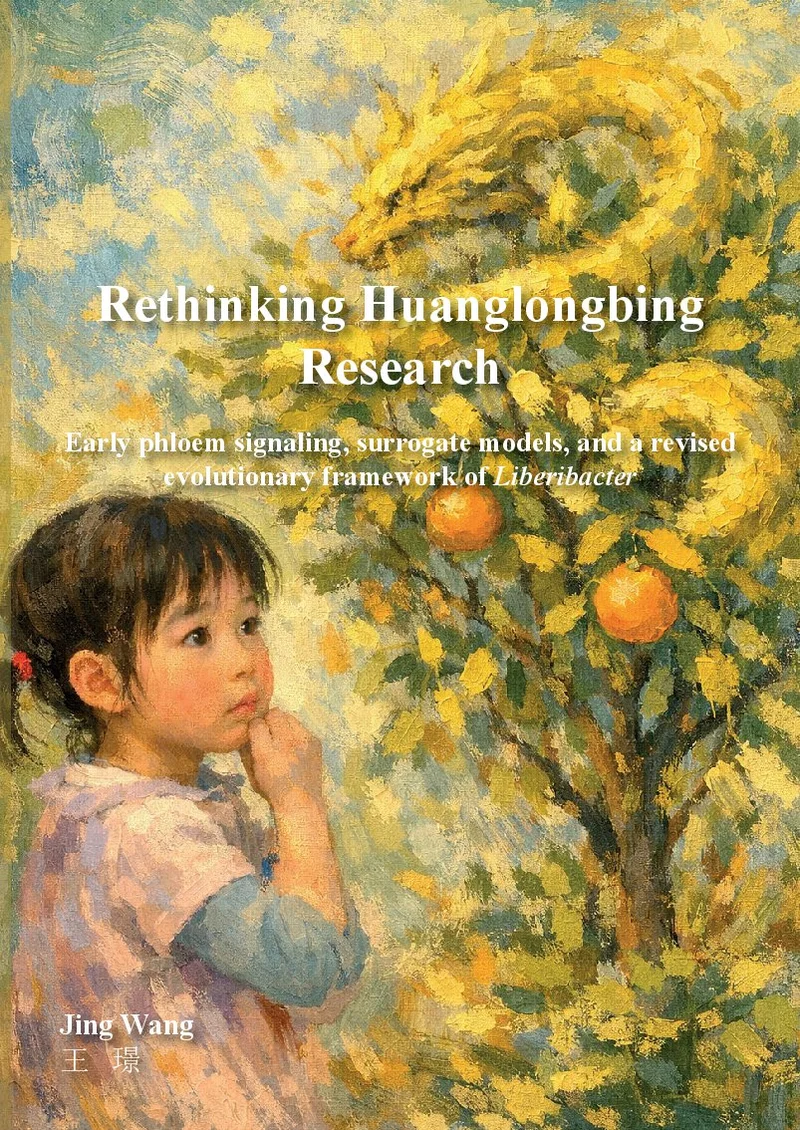


Rethinking Huanglongbing Research
Huanglongbing (HLB), or citrus greening disease, is one of the most devastating threats to global citrus production. It is caused by the phloem-limited bacterium Candidatus Liberibacter asiaticus (CLas), transmitted by the Asian citrus psyllid (Diaphorina citri). The disease leads to phloem blockage, leaf chlorosis, fruit deformation, and eventually tree death. Despite decades of research, progress in understanding the molecular basis of CLas–host interactions has been limited by three major constraints: the unculturable nature of CLas, the lack of synchronized infection systems for early-stage studies, and the absence of tractable in planta models for gene function or drug validation. In this thesis, I aimed to address these challenges by developing new experimental methods and proposing new mechanistic perspectives that together advance our understanding of CLas biology and HLB pathogenesis. In Chapter 1, I introduce the historical background, epidemiology, and biological characteristics of Candidatus Liberibacter asiaticus and HLB, summarizing why progress in this field has been slow. I outline the three major bottlenecks in HLB research—the lack of a culturable bacterium, the absence of synchronized early-stage infection systems, and the challenges of studying phloem-specific responses in whole-leaf samples—as well as the limitations of current control strategies. This chapter establishes the conceptual and technical gaps that motivate the development of new methodologies throughout the thesis. In Chapter 2, we developed a modified micrografting (MiG) system that allows rapid and synchronized infection of citrus seedlings using buds from HLB-symptomatic scions. This system achieved systemic CLas invasion within 40 days—significantly faster than conventional grafting or psyllid-mediated inoculation. Using laser-capture microdissection (LCM) of phloem tissues followed by RNA sequencing,we generated the first phloem-specific early-stage transcriptome of citrus responding to CLas. Through this approach, we identified 75 previously unreported early-responsive genes. These genes not only provide insight into early host responses but also represent promising infection-inducible promoters for targeted antimicrobial applications. In Chapter 3, I analyzed 79 pairs of homologous genes shared between CLas and the symbiotic megaplasmid pSymA of Sinorhizobium meliloti (Sme)to explore how CLas has evolved its gene regulation compared to its free-living relatives. By constructing dual-promoter reporter fusions and expressing them in the Sme–Medicago nodule system, I visualized promoter activities in planta. I found that none of the homologous pairs displayed an identical expression pattern. CLas promoters were often active in infection threads and symbiosomes, while their pSymA counterparts were weak or inactive. These results indicate that the regulatory networks of CLas have diverged profoundly from those of rhizobia, likely reflecting adaptation to a stable intracellular phloem niche. In Chapter 4, I used the Sme–Medicago root nodule symbiosis as a heterologous model to study the CLas transcription factor RpoH, a key regulator of stress responses, to enable in planta functional testing of CLas genes. Deletion of RpoH in Sme caused severe defects in nodule development. Complementation with CLas RpoH partially restored nodule formation, demonstrating functional conservation between the two species. Importantly, the previously identified inhibitor rosiglitazone maleate reversed this complementation effect and also suppressed CLas titers in infected citrus seedlings. I thus established a tractable in planta screening platform for CLas functional assays and drug evaluation, providing a valuable bridge between molecular studies and applied disease control. In Chapter 5, I performed large-scale phylogenomic analyses of over 1,600 α-proteobacterial genomes using the most conserved AMPHORA housekeeping genes. My results showed that Liberibacter species are nested within the genus Rhizobium, rather than forming a separate lineage. This contrasts with earlier studies, which used faster-evolving gene sets and were likely affected by long-branch attraction. The refined phylogenetic placement implies that Liberibacter represents a specialized, genome-reduced Rhizobium lineage that independently adapted to intracellular life in phloem and psyllid hosts. This evolutionary insight not only clarifies the taxonomic position of CLas, but also supports the use of Rhizobium-based systems as surrogates for its study. Together, these studies provide a framework linking molecular mechanisms, experimental models, and evolutionary context. By establishing a rapid and synchronized infection system, developing in planta surrogate models, and redefining the evolutionary roots of CLas, I have contributed both practical tools and conceptual advances to the study of HLB. The MiG–LCM approach enables discovery of early defense markers and inducible promoters; the rhizobium-based systems allow gene functional testing and inhibitor screening; and the phylogenetic reconstruction places CLas within the Rhizobium genus. Collectively, this work opens new directions for functional genomics, molecular pathology, and targeted engineering of HLB resistance in citrus, paving the way toward sustainable management of HLB and other phloem-limited bacterial diseases.
| Publicatiedatum | 13 mei 2026 |
| Universiteit | Wageningen University |
| Auteur | Jing Wang |