Share this project
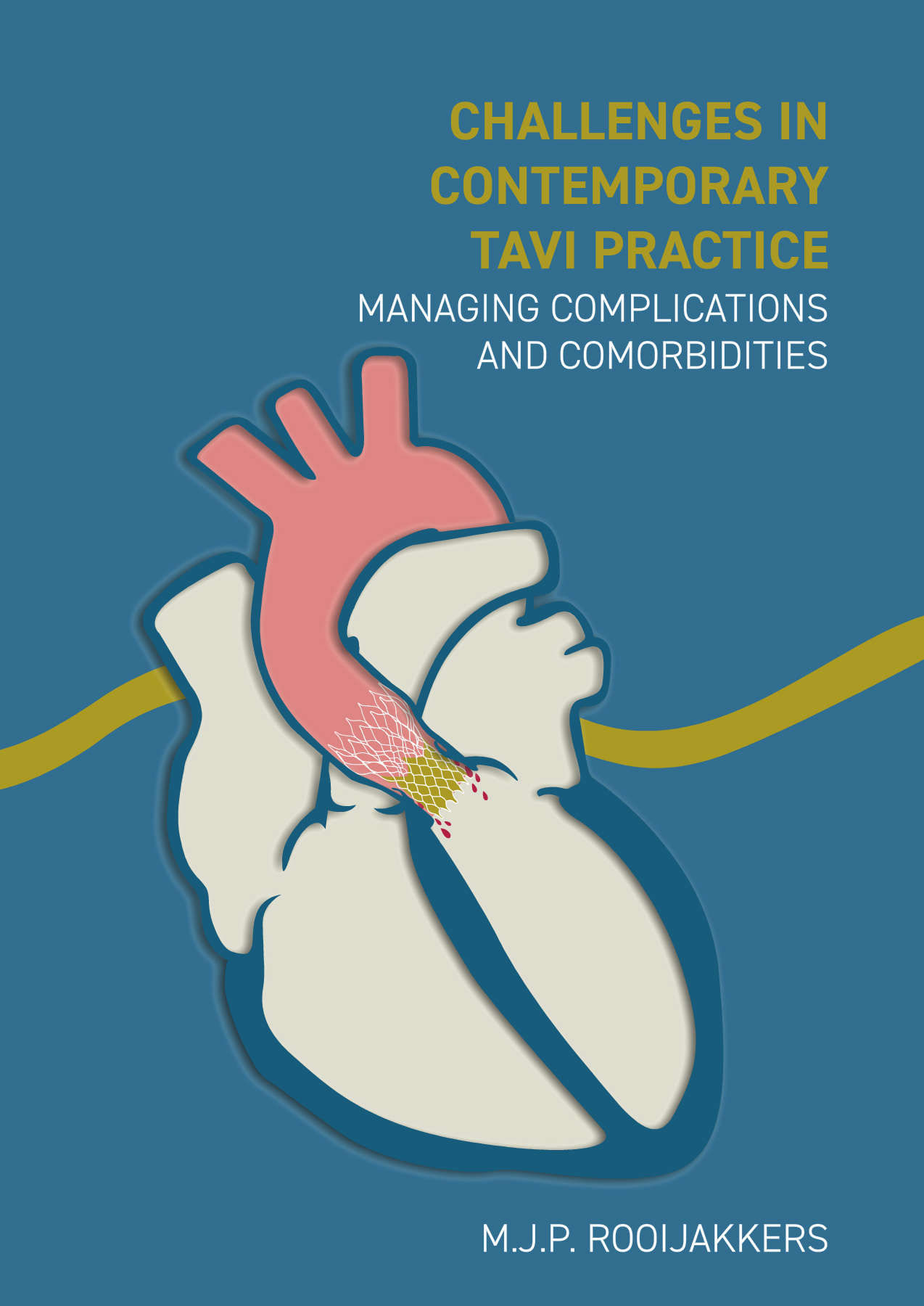
Max Rooijakkers
Radboud Universiteit
Publication date: 10 januari 2025
University: Radboud Universiteit
ISBN: 978-94-6510-370-9
CHALLENGES IN CONTEMPORARY TAVI PRACTICE
Summary
REFERENCES
1. Otto CM, Nishimura RA, Bonow RO, Carabello BA, Erwin JP, 3rd, Gentile F, et al. 2020 ACC/AHA Guideline for the Management of Patients With Valvular Heart Disease: A Report of the American College of Cardiology/American Heart Association Joint Committee on Clinical Practice Guidelines. J Am Coll Cardiol. 2021;77(4):450-500.
2. Vahanian A, Beyersdorf F, Praz F, Milojevic M, Baldus S, Bauersachs J, et al. 2021 ESC/EACTS Guidelines for the management of valvular heart disease. Eur Heart J. 2022;43(7):561-632.
3. Tamburino C, Bleiziffer S, Thiele H, Scholtz S, Hildick-Smith D, Cunnington M, et al. Comparison of Self-Expanding Bioprostheses for Transcatheter Aortic Valve Replacement in Patients With Symptomatic Severe Aortic Stenosis: SCOPE 2 Randomized Clinical Trial. Circulation. 2020;142(25):2431-42.
4. Kalogeropoulos AS, Redwood SR, Allen CJ, Hurrell H, Chehab O, Rajani R, et al. A 20-year journey in transcatheter aortic valve implantation: Evolution to current eminence. Front Cardiovasc Med. 2022;9:971762.
5. Okuno T, Tomii D, Heg D, Lanz J, Praz F, Stortecky S, et al. Five-year outcomes of mild paravalvular regurgitation after transcatheter aortic valve implantation. EuroIntervention. 2022;18(1):33-42.
6. Sá MP, Jacquemyn X, Van den Eynde J, Tasoudis P, Erten O, Sicouri S, et al. Impact of Paravalvular Leak on Outcomes After Transcatheter Aortic Valve Implantation: Meta-Analysis of Kaplan-Meier-derived Individual Patient Data. Struct Heart. 2023;7(2):100118.
7. Crouch G, Tully PJ, Bennetts J, Sinhal A, Bradbrook C, Penhall AL, et al. Quantitative assessment of paravalvular regurgitation following transcatheter aortic valve replacement. J Cardiovasc Magn Reson. 2015;17(1):32.
8. Orwat S, Diller GP, Kaleschke G, Kerckhoff G, Kempny A, Radke RM, et al. Aortic regurgitation severity after transcatheter aortic valve implantation is underestimated by echocardiography compared with MRI. Heart. 2014;100(24):1933-8.
9. Frick M, Meyer CG, Kirschfink A, Altiok E, Lehrke M, Brehmer K, et al. Evaluation of aortic regurgitation after transcatheter aortic valve implantation: aortic root angiography in comparison to cardiac magnetic resonance. EuroIntervention. 2016;11(12):1419-27.
10. Rooijakkers MJP, Stens NA, van Wely MH, van der Wulp K, Rodwell L, Gehlmann H, et al. Diastolic delta best predicts paravalvular regurgitation after transcatheter aortic valve replacement as assessed by cardiac magnetic resonance: the APPOSE trial. Eur Heart J Cardiovasc Imaging. 2023;24(8):1072-81.
11. Abdel-Wahab M, Abdelghani M, Miyazaki Y, Holy EW, Merten C, Zachow D, et al. A Novel Angiographic Quantification of Aortic Regurgitation After TAVR Provides an Accurate Estimation of Regurgitation Fraction Derived From Cardiac Magnetic Resonance Imaging. JACC Cardiovasc Interv. 2018;11(3):287-97.
12. Patsalis PC, Konorza TF, Al-Rashid F, Plicht B, Riebisch M, Wendt D, et al. Incidence, outcome and correlates of residual paravalvular aortic regurgitation after transcatheter aortic valve implantation and importance of haemodynamic assessment. EuroIntervention. 2013;8(12):1398-406.
13. Jilaihawi H, Chakravarty T, Shiota T, Rafique A, Harada K, Shibayama K, et al. Heart-rate adjustment of transcatheter haemodynamics improves the prognostic evaluation of paravalvular regurgitation after transcatheter aortic valve implantation. EuroIntervention. 2015;11(4):456-64.
14. Sinning JM, Hammerstingl C, Vasa-Nicotera M, Adenauer V, Lema Cachiguango SJ, Scheer AC, et al. Aortic regurgitation index defines severity of peri-prosthetic regurgitation and predicts outcome in patients after transcatheter aortic valve implantation. J Am Coll Cardiol. 2012;59(13):1134-41.
15. Sinning JM, Stundl A, Pingel S, Weber M, Sedaghat A, Hammerstingl C, et al. Pre-Procedural Hemodynamic Status Improves the Discriminatory Value of the Aortic Regurgitation Index in Patients Undergoing Transcatheter Aortic Valve Replacement. JACC Cardiovasc Interv. 2016;9(7):700-11.
16. van Wely M, van der Wulp K, Rooijakkers M, Vart P, Morshuis W, van Royen N, et al. Aortic Regurgitation Index Ratio Is a Strong Predictor of 1-Year Mortality After Transcatheter Aortic Valve Implantation Using Self-Expanding Devices. Semin Thorac Cardiovasc Surg. 2021;33(4):923-30.
17. Modolo R, van Mourik M, El Bouziani A, Kawashima H, Rosseel L, Abdelghani M, et al. Online Quantitative Aortographic Assessment of Aortic Regurgitation After TAVR: Results of the OVAL Study. JACC Cardiovasc Interv. 2021;14(5):531-8.
18. von Elm E, Altman DG, Egger M, Pocock SJ, Gøtzsche PC, Vandenbroucke JP. The Strengthening the Reporting of Observational Studies in Epidemiology (STROBE) statement: guidelines for reporting observational studies. Lancet. 2007;370(9596):1453-7.
19. Modolo R, Chang CC, Onuma Y, Schultz C, Tateishi H, Abdelghani M, et al. Quantitative aortography assessment of aortic regurgitation. EuroIntervention. 2020;16(9):e738-e56.
20. Abdelghani M, Tateishi H, Miyazaki Y, Cavalcante R, Soliman OII, Tijssen JG, et al. Angiographic assessment of aortic regurgitation by video-densitometry in the setting of TAVI: Echocardiographic and clinical correlates. Catheter Cardiovasc Interv. 2017;90(4):650-9.
21. Rooijakkers MJP, El Messaoudi S, Stens NA, van Wely MH, Habets J, Brink M, et al. Assessment of paravalvular regurgitation after transcatheter aortic valve replacement using 2D multi-velocity encoding and 4D flow cardiac magnetic resonance. Eur Heart J Cardiovasc Imaging. 2024;25(7):929-36.
22. Tateishi H, Campos CM, Abdelghani M, Leite RS, Mangione JA, Bary L, et al. Video densitometric assessment of aortic regurgitation after transcatheter aortic valve implantation: results from the Brazilian TAVI registry. EuroIntervention. 2016;11(12):1409-18.
23. Hartlage GR, Babaliaros VC, Thourani VH, Hayek S, Chrysohoou C, Ghasemzadeh N, et al. The role of cardiovascular magnetic resonance in stratifying paravalvular leak severity after transcatheter aortic valve replacement: an observational outcome study. J Cardiovasc Magn Reson. 2014;16(1):93
24. Pencina MJ, D’Agostino RB, Sr., D’Agostino RB, Jr., Vasan RS. Evaluating the added predictive ability of a new marker: from area under the ROC curve to reclassification and beyond. Stat Med. 2008;27(2):157-72.
25. Carroll JD, Mack MJ, Vemulapalli S, Herrmann HC, Gleason TG, Hanzel G, et al. STS-ACC TVT Registry of Transcatheter Aortic Valve Replacement. J Am Coll Cardiol. 2020;76(21):2492-516.
26. Sellers RD, Levy MJ, Amplatz K, Lillehei CW. Left retrograde cardioangiography in acquired cardiac disease: technic, indications and interpretations in 700 cases. Am J Cardiol. 1964;14:437-47.
27. Abdelghani M, Soliman OI, Schultz C, Vahanian A, Serruys PW. Adjudicating paravalvular leaks of transcatheter aortic valves: a critical appraisal. Eur Heart J. 2016;37(34):2627-44.
28. Heidenreich PA, Bozkurt B, Aguilar D, Allen LA, Byun JJ, Colvin MM, et al. 2022 AHA/ACC/HFSA Guideline for the Management of Heart Failure: A Report of the American College of Cardiology/American Heart Association Joint Committee on Clinical Practice Guidelines. Circulation. 2022;145(18):e895-e1032.
29. Abdelshafy M, Serruys PW, Tsai TY, Revaiah PC, Garg S, Aben JP, et al. Quantitative aortography for assessment of aortic regurgitation in the era of percutaneous aortic valve replacement. Front Cardiovasc Med. 2023;10:1161779.
30. Modolo R, Chang CC, Abdelghani M, Kawashima H, Ono M, Tateishi H, et al. Quantitative Assessment of Acute Regurgitation Following TAVR: A Multicenter Pooled Analysis of 2,258 Valves. JACC Cardiovasc Interv. 2020;13(11):1303-11.
31. Wang R, Kawashima H, Gao C, Mou F, Li P, Zhang J, et al. Comparative Quantitative Aortographic Assessment of Regurgitation in Patients Treated With VitaFlow Transcatheter Heart Valve vs. Other Self-Expanding Systems. Front Cardiovasc Med. 2021;8:747174.
32. Tateishi H, Miyazaki Y, Okamura T, Modolo R, Abdelghani M, Soliman OII, et al. Role of Computed Tomography in Planning the Appropriate X-Ray Gantry for Quantitative Aortography of Post-transcatheter Aortic Valve Implantation Regurgitation. Circ J. 2018;82(7):1943-50.
SUPPLEMENTAL DATA
Supplemental material related to this article can be found in the online version: https://www.ahajournals.org/doi/full/10.1161/JAHA.124.
Assessment of paravalvular regurgitation after transcatheter aortic valve replacement using 2D multi-velocity encoding and 4D flow cardiac magnetic resonance
Maxim J.P. Rooijakkers
Saloua El Messaoudi
Niels A. Stens
Marleen H. van Wely
Jesse Habets
Monique Brink
Laura Rodwell
Daniel Giese
Rob J. van der Geest
Niels van Royen
Robin Nijveldt
Published in European Heart Journal – Cardiovascular Imaging
ABSTRACT
Aims
To compare the novel 2D multi-velocity encoding (venc) and 4D flow acquisitions with the standard 2D flow acquisition for the assessment of paravalvular regurgitation (PVR) after transcatheter aortic valve replacement (TAVR) using cardiac magnetic resonance (CMR)-derived regurgitant fraction (RF).
Methods and results
In this prospective study, patients underwent CMR 1 month after TAVR for the assessment of PVR, for which 2D multi-venc and 4D flow were used, in addition to standard 2D flow. Scatterplots and Bland-Altman plots were used to assess correlation and visualize agreement between techniques. Reproducibility of measurements was assessed with intraclass correlation coefficients. The study included 21 patients (mean age ± SD, 80 ± 5 years, 9 men). The mean RF was 11.7 ± 10.0% when standard 2D flow was used, 10.6 ± 7.0% when 2D multi-venc flow was used, and 9.6 ± 7.3% when 4D flow was used. There was a very strong correlation between the RFs assessed with 2D multi-venc and standard 2D flow (r = 0.88, P < 0.001), and a strong correlation between the RFs assessed with 4D flow and standard 2D flow (r = 0.74, P < 0.001). Bland-Altman plots revealed no substantial bias between the RFs (2D multi-venc: 1.3%; 4D flow: 0.3%). Intra-observer and inter-observer reproducibility for 2D multi-venc flow were 0.98 and 0.97, respectively, and 0.92 and 0.90 for 4D flow, respectively.
Conclusion
Two-dimensional multi-venc and 4D flow produce an accurate quantification of PVR after TAVR. The fast acquisition of the 2D multi-venc sequence and the free-breathing acquisition with retrospective plane selection of the 4D flow sequence provide useful advantages in clinical practice, especially in the frail TAVR population.
2D multi-venc flow CMR
Intraclass correlation coefficients 2D multi-venc flow
• Intra-observer reproducibility: 0.98 (0.96-0.99)
• Inter-observer reproducibility: 0.97 (0.91-0.99)
Standard 2D flow vs. 2D multi-venc flow
• Correlation between regurgitant fractions: r = 0.88, p < 0.001
• Mean difference between regurgitant fractions: 1.3%
Standard 2D flow CMR
Intraclass correlation coefficients standard 2D flow
• Intra-observer reproducibility: 0.97 (0.88-0.99)
• Inter-observer reproducibility: 0.99 (0.93-0.99)
Standard 2D flow vs. 4D flow
• Correlation between regurgitant fractions: r = 0.74, p < 0.001
• Mean difference between regurgitant fractions: 0.3%
4D flow CMR
Intraclass correlation coefficients 4D flow
• Intra-observer reproducibility: 0.92 (0.81-0.97)
• Inter-observer reproducibility: 0.90 (0.76-0.96)
Graphical Abstract
See also these dissertations

Toby van Gastelen
Structure-Preserving Data-Driven Methods for Modeling Turbulent Flows
19 mei 2026
TU Eindhoven
Open Ebook
Ton Winkelmolen
Molecular insights into the role of VRS5 in tillering and lateral spikelet development in barley
12 juni 2026
Wageningen University
Open Ebook
Selcuk Peker
Gamma Knife Radiosurgery for Skull Base Tumors
10 juni 2026
Universiteit Maastricht
Open Ebook
Tonny Manalal
Reimagining petrochemical clusters by defossilising chemical building blocks
18 mei 2026
Overig
Open Ebook

Cora De Gol
Microbial stabilization and protein functionality of plant-based liquids using pulsed electric fields
17 juni 2026
Wageningen University
Open Ebook
We print for the following universities