Yulia Rosa Saharman
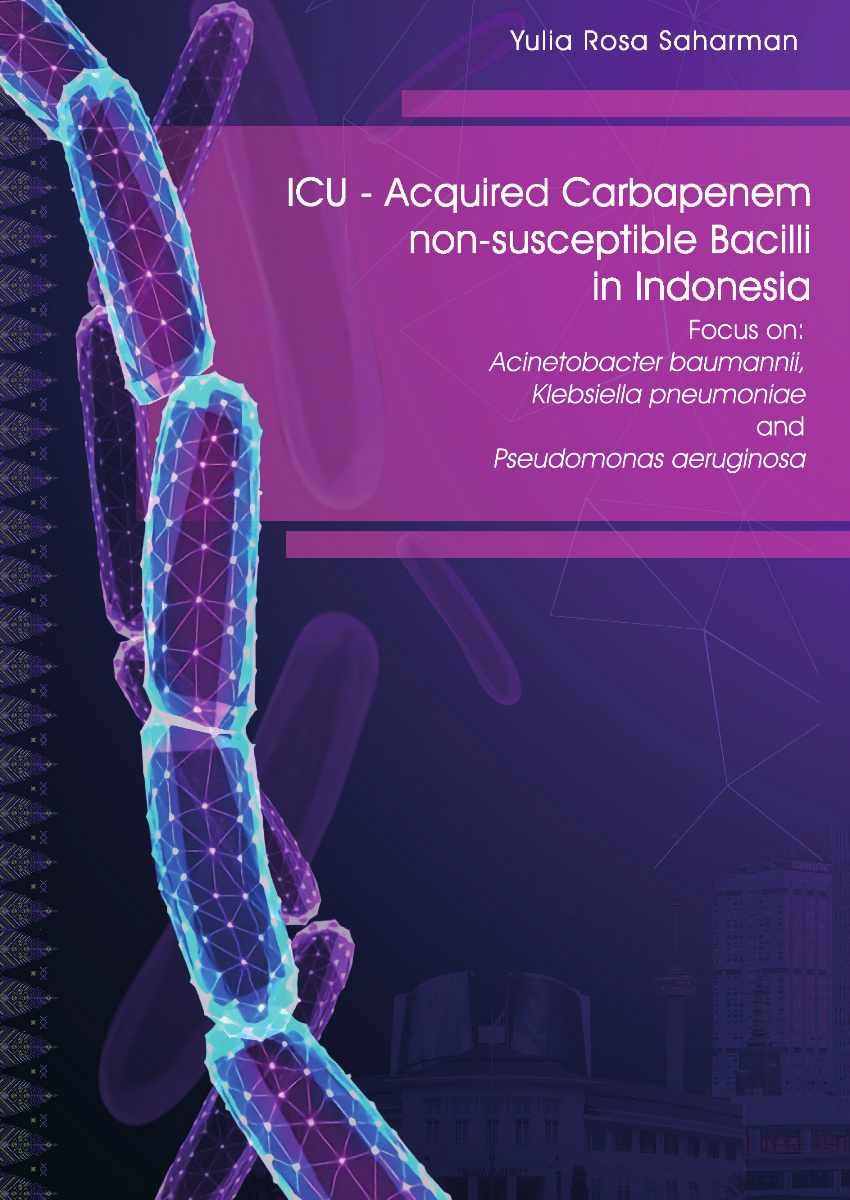


ICU-acquired Carbapenem-non-susceptible Bacilli in Indonesia
Resistentie van bacteriën voor antimicrobiële middelen is wereldwijd een toenemend probleem. Met name de carbapenem-ongevoelige Gram-negatieve bacteriën vormen één van de grootste bedreigingen voor de wereldgezondheid, vooral in lage- en middeninkomenslanden. Indonesië is volgens de Wereldbank een land met een laag-midden inkomen, het is tevens het vierde dichtstbevolkte land ter wereld. Op het moment dat deze studie begon waren er zeer beperkt gegevens bekend over het voorkomen van dergelijke resistente stammen in Indonesië. In het algemeen is er een verhoogd risico op verspreiding van resistente bacteriën in ziekenhuizen, en dan vooral op intensieve zorgafdelingen (“intensive care units”, IC’s). Resistente bacteriën worden daar meer dan elders uitgeselecteerd door frequent gebruik van breedspectrum antibiotica, zoals de carbapenems; in lager-middeninkomenslanden gebeurt dat vaak zonder een klinische microbiologische diagnose (1). Om deze situatie te verbeteren zijn goede lokale microbiologische data nodig. In hoofdstuk 2 van dit proefschrift wordt een overzicht van de literatuur gepresenteerd die gaat over op de IC verkregen infecties in dergelijke landen. Uit de beperkt beschikbare gegevens bleek dat het spectrum van pathogenen op IC’s in laag-middeninkomenslanden anders is dan in hoge-inkomenslanden: resistente Acinetobacter baumannii, Pseudomonas aeruginosa en Klebsiella pneumoniae worden vaker gevonden. In dit proefschrift hebben we de moleculaire epidemiologie en resistentiemechanismen van de drie genoemde soorten bacteriën bestudeerd op twee IC's in het National Referral Hospital in Jakarta, Indonesië: carbapenem-ongevoelige A. baumannii, P. aeruginosa en K. pneumoniae. Allereerst werd de uitgangssituatie onderzocht. Daarna werd een pakket van haalbare maatregelen ontworpen om het vóórkomen en de verspreiding van deze bacteriën op IC's te verminderen en dit pakket werd geïmplementeerd als interventie. Hieronder worden de belangrijkste bevindingen samengevat en besproken aan de hand van de doelstellingen van het onderzoek. Doelstelling 1: Een inzicht verkrijgen in de epidemiologie en de fenotypische en genetische kenmerken van carbapenem-ongevoelige stammen van A. baumannii, P. aeruginosa en K. pneumoniae in twee IC’s in Jakarta voorafgaand aan de interventie. Er werden 412 patiënten geïncludeerd in deze eerste fase van het onderzoek, 188 patiënten werden opgenomen op de IC voor volwassenen (IC-V) en 224 op de IC van de spoedeisende hulp afdeling (IC-SEH). In totaal had 38% van de patiënten een positieve kweek met een carbapenem-ongevoelige A. baumannii (CNAB), en 14% van de patiënten had op een bepaald moment tijdens hun IC-verblijf een carbapenem-ongevoelige K. pneumoniae (CNKP) bij zich. Carbapenem-ongevoelige P. aeruginosa (CNPA) werden geïsoleerd bij 12% van de patiënten (hoofdstuk 3, 4, 5) (2-4). Uit screeningskweken die op de dag van opname op de IC werden afgenomen, bleek dat 17% van de patiënten al drager was van een CNAB, 5% van een CNKP en 4% van een CNPA (2-4). Patiënten bleken meer dan één soort carbapenem-ongevoelige bacteriën bij zich te kunnen dragen (Figuur 1). Deze bevinding zou ons bewustzijn moeten vergroten dat patiënten die op de IC in Jakarta worden opgenomen, bronnen van dergelijke resistente bacteriën kunnen zijn. Figuur 1. Venn Diagram van carbapenem-ongevoelige A. baumannii, K. pneumoniae en P. aeruginosa bij opname Tijdens hun IC-verblijf kreeg 26% van de patiënten die aanvankelijk bij opname negatieve screeningskweken hadden, een CNAB, 9% een CNKP en 8% een CNPA. De acquisitiefrequentie was dus het hoogst voor CNAB (43 per 1000 patiëntdagen), gevolgd door CNKP (25 per 1000 patiëntdagen) en CNPA (18 per 1000 patiëntdagen) (2-4). Nogal wat patiënten werden met meer dan één soort carbapenem-ongevoelige bacteriën besmet (Figuur 2). Acquisitie van carbapenem-ongevoelige bacteriestammen trad vrij snel op na opname op de IC, binnen een week had de helft van de patiënten die een dergelijke stam kregen deze al opgedaan, en op dag 12-14 had meer dan 80% van de patiënten hun resistente stam. Dit geeft aan dat het acquisitierisico altijd aanwezig en altijd hoog was op deze IC's. De meest consistente risicofactor voor het verkrijgen van dergelijke stammen was inderdaad het gebruik van carbapenem antibiotica. Figuur 2. Venn Diagram van carbapenem-ongevoelige A. baumannii, K. pneumoniae en P. aeruginosa verkregen tijdens verblijf op de IC Het tijdens het IC verblijf verkrijgen van één van deze drie carbapenem-ongevoelige bacteriën was negatief geassocieerd met het resultaat van de IC-zorg. De verblijfsduur van de patiënten was veel langer en de waargenomen sterftecijfers waren hoger (> 40%) onder degenen met carbapenem-ongevoelige bacteriën in vergelijking met patiënten die dergelijke stammen niet verworven (<30%). Patiënten die twee of drie van de carbapenem-ongevoelige bestudeerde bacteriën verkregen hadden een nog hoger sterftecijfer (50%), terwijl patiënten die slechts met één zo’n resistente stam besmet werden een lager sterftecijfer hadden (39,4%). Patiënten die carbapenem-gevoelige stammen van K. pneumoniae of P. aeruginosa verkregen hadden juist een lage mortaliteit (<20%), een uitkomst dat paste bij de lagere ernst van hun ziekte en met minder blootstelling aan mechanische beademing en carbapenem antibiotica. Patiënten kunnen dus ook gevoelige stammen van K. pneumoniae en P. aeruginosa verkrijgen tijdens hun IC-verblijf. De A. baumannii stammen die op de IC circuleerden waren echter vrijwel allemaal ongevoelig voor carbapenem antibiotica. De ziekenhuisomgeving kan niches bevatten waar antibioticaresistente bacteriën overleven en zelfs vermenigvuldigen (5, 6). Het kweken van de omgeving werd tweemaal uitgevoerd in de eerste fase van deze studie; uit in totaal 400 kweken hebben we zes CNAB-stammen geïsoleerd (uit monsters afgenomen van tafels, bedhekken, gootstenen en kraanwater) (2). Bovendien leverde één watermonster (genomen uit een afzuigaansluiting) een K. pneumoniae-stam op die niet gevoelig was voor de carbapenems. Opmerkelijk was dat 16 carbapenem-ongevoelige stammen van P. aeruginosa uit de omgeving werden geïsoleerd (3, 4). Deze bevindingen zijn belangrijk, omdat het duidelijk maakt dat de IC-omgeving een potentieel belangrijke bron is voor carbapenem-ongevoelige stammen; de IC-omgeving zou dus een doel moeten zijn voor interventies die gericht zijn op het verminderen van de acquisitie van resistente bacteriën, met name van resistente P. aeruginosa en A. baumannii. Gezondheidspersoneel werd ook gescreend als mogelijke bron. Slechts één isolaat van een gezondheidsmedewerker (keel) bleek een CNAB (2), géén van de 24 K. pneumoniae-isolaten gekweekt uit 167 personeelsleden van de IC bleek ongevoelig voor carbapenems te zijn (4), en geen van de 25 gevonden P. aeruginosa stammen was ongevoelig voor carbapenem antibiotica, wat suggereert dat gezondheidsmedewerkers geen significante rol spelen in de epidemiologie van dergelijke stammen op de IC (3). Een beperking van deze studie was echter dat het kweken van personeel slechts één keer werd uitgevoerd en dat alleen keel- en rectumkweken werden geanalyseerd (geen handen). We konden daarom de bijdrage van personeel aan de epidemiologie van dergelijke stammen op de IC’s niet goed inschatten. Toekomstige studies met uitgebreidere en herhaalde bemonstering van gezondheidsmedewerkers zijn nodig om hun rol in de epidemiologie van CNAB, CNKP en CNPA in IC's beter te definiëren. Resistentie tegen carbapenem antibiotica wordt voornamelijk gemedieerd door carbapenemasen. Deze enzymen komen met name voor bij Gram-negatieve pathogenen zoals K. pneumoniae, P. aeruginosa en A. baumannii, en kunnen een intrinsieke eigenschap van de bacterie zijn. Anderszins kunnen dergelijke enzymen worden verkregen door overdracht van carbapenemase-coderende genen van resistente stammen naar gevoelige soortgenoten (7). A. baumannii heeft een chromosomaal oxacillinase (OXA-51 en zijn varianten) die gewoonlijk een lage expressie heeft, c.q. niet leidt tot klinisch relevante resistentie; maar deze genen kunnen carbapenem-resistentie leveren wanneer stroomopwaarts het insertie-element ISAba1 of ISAba9 aanwezig is. Het is echter het vermogen van A. baumannii om carbapenemasen te verwerven, met name de Ambler klasse B metallo-β-lactamasen (MBL, bijv. NDM, VIM, IMP) en klasse D oxacillinasen en recent ook klasse A carbapenemasen, dat heeft geresulteerd in het wijdverspreid opduiken van carbapenem-resistente A. baumannii (7, 8). In onze studie vonden we het blaOXA-23-like gen in 92% van de geïsoleerde stammen, dit is inclusief de isolaten van patiënten, de omgeving en van een gezondheidsmedewerker. Het blaOXA-24-like gen werd gedetecteerd in één stam. Het metallo-β-lactamase blaNDM-1 werd bij 4 blaOXA-23-like-positieve isolaten aangetoond. Het intrinsieke A. baumannii-calcoaceticus-complex gen blaOXA-51-like werd in alle isolaten aangetoond. In een subset van isolaten die werden geanalyseerd met “whole genome sequencing” (WGS) bleek het om het blaOXA-66 gen te gaan in 13 isolaten en blaOXA-68 in één isolaat (2). Ook bij K. pneumoniae kan carbapenem-ongevoeligheid veroorzaakt worden door de productie van Ambler klasse A β-lactamases (bijv. KPC), klasse B MBL of klasse D oxacillinases (bijv. OXA-48) (4, 8). De fenotypische detectietest van CNKP gaf aan dat 96% van de isolaten een MBL produceerden. PCR's van carbapenemase-genen toonden de aanwezigheid van blaNDM aan in alle carbapenem-ongevoelige isolaten, inclusief isolaten van patiënten en die uit de omgeving. Geen van de isolaten was positief voor het blaKPC or blaOXA-48 gen. De carbapenem-ongevoeligheid bij P. aeruginosa is meestal te wijten aan een combinatie van mechanismen, waaronder de productie van β-lactamase, een activiteit van hun effluxpompen, en aan veranderingen van het buitenmembraan van deze bacteriën, óf het is te wijten aan de productie van een carbapenemase als één enkel krachtig resistentiemechanisme: VIM-, IMP- en GES-5-carbapenemasen worden wereldwijd het meest aangetroffen (3, 9). Met behulp van resistoomanalyse kon de carbapenem-ongevoeligheid bij de CNPA verklaard worden door de aanwezigheid van verschillende carbapenemase-coderende genen (blaGES-5, blaVIM-2-8, en blaIMP-1-7-43) en door mutaties in de porine OprD (hoofdstuk 9) (6). blaVIM kwam het meest frequent voor (30% van de isolaten) (3). Samenvattend vonden we dat de ongevoeligheid voor carbapenems van deze drie bacteriën grotendeels gebaseerd was op de productie van β-lactamasen die carbapenem antibiotica kunnen afbreken, maar deze drie bacteriesoorten hadden niet dezelfde carbapenemase genen. Uitbraken van ziekenhuis- of zorg-gerelateerde infecties, zeker met resistente bacteriën, hebben dramatische gevolgen. Het is daarom belangrijk om bacteriële bronnen op te sporen en de verspreidingsroute van pathogene klonen te bepalen, zodat uiteindelijk de verspreiding van de pathogenen kan worden tegengegaan en bij voorkeur gestopt. Een breed scala aan typeringstechnieken is hiervoor beschikbaar. De meeste medische microbiologische laboratoria in de hele wereld gebruiken momenteel moleculair-biologische technieken voor dit doel. “Pulsed-Field Gel Electrophoresis” (PFGE; gebaseerd op de fragmentatie van het bacteriële genoom door een specifiek enzym) is de laatste decennia en wereldwijd een van de meest gebruikte technieken. Deze techniek is lang beschouwd als “gouden standaard”, maar heeft ook diverse beperkingen. Naast PFGE worden tegenwoordig “Multi-locus Variable Number of Tandem Repeats” (VNTR) analyse (MLVA) en de multilocus sequentietypering (MLST, gebaseerd op polymorfismen in een beperkt aantal huishoudgenen) gebruikt. In de afgelopen jaren is “whole genome sequencing” (WGS) opgekomen als instrument voor de moleculaire epidemiologische surveillance van pathogenen (6). In het begin van onze studie hebben we Raman-spectroscopie gebruikt, een snelle en goedkope fenotypische bacteriële typeringsmethode (10). We waren in staat om deze techniek toe te passen om stammen van K. pneumoniae en A. baumannii te analyseren, maar de techniek kon niet worden toegepast op P. aeruginosa vanwege de pyocyanines die deze bacteriësoort produceren. De analyse met Raman-spectroscopie bracht vijf grote clusters van CNAB aan het licht. Het grootste cluster (aangeduid als CIPTO-31) bestond uit isolaten verkregen van patiënten (van screeningskweken en klinische kweken) en isolaten uit de omgeving. MLST, uitgevoerd voor een subset van 14 isolaten, onthulde de aanwezigheid van meerdere sequentietypen (ST's), die nauw overeenkwamen met de Raman-spectroscopieclustering. Vier eerder geïdentificeerde ST's (STN9S, ST2O8, ST2N8 en STS42) evenals verschillende nieuwe ST's werden in deze studie gevonden (2). Raman-spectroscopieanalyse onthulde ook de aanwezigheid van meerdere typen CNKP. Er waren drie grote clusters, het grootste cluster (CIPTOKPN24) bestond uit isolaten verkregen van patiënten (van screeningskweken en klinische kweken) en waren aanwezig op beide IC's gedurende de onderzoeksperiode, terwijl andere klonen leken te komen en gaan over de tijd (4). Een totaal van 97 klinische en 1 isolaat uit de IC-omgeving werden verder geanalyseerd met behulp van MLVA-genotypering, waarbij 30 verschillende genotypen werden geïdentificeerd. De clustering van isolaten door Raman-spectroscopie in drie dominante groepen kwam overeen met clustering door MLVA (4). Ook de CNPA isolaten werden op meerdere manieren geanalyseerd. Met MLST werden vier belangrijke clusters van CNPA geïdentificeerd (ST2PS, ST82P, ST44S en STPS7) evenals verschillende nieuwe sequentietypen. Met MLVA werden vijf grote clusters onderscheiden, twee behorend tot ST2PS en de andere overeenkomend met ST82P, ST44S en STPS7. De meeste isolaten behoorden tot ST2PS (patiënten- en omgevingsisolaten), waarvan 22 isolaten blaIMP bevatten en 24 isolaten blaGES-5. Er waren geen ST2PS isolaten met een blaVIM gen. Daarentegen was een blaVIM gen wel aanwezig in alle ST82P-isolaten. Vervolgens evalueerden we vijf moleculaire typeringstechnieken voor de CNPA: MLVA, MLST met zeven loci, “core genome” en “whole genome” MLST (cg / wgMLST) en “core genome Single Nucleotide Polymorphism” (cgSNP) analyse (hoofdstuk 6). Onze bevindingen tonen aan dat de drie laatste technieken (cgMLST, wgMLST en cgSNP) het hoogste resolutieniveau bieden, waardoor gedetailleerde epidemiologische analyse van lokale uitbraken en van eventuele internationale verspreiding mogelijk is. MLVA is een geschikt alternatief voor het typeren van P. aeruginosa daar waar de overgang naar WGS momenteel niet haalbaar is. De algemene conclusie van deze analyses is dat de drie carbapenem-ongevoelige bacteriësoorten waar ons onderzoek op gericht was, endemisch voorkomen op de twee IC’s in Jakarta, waarbij slechts enkele persisterende klonen meer frequent worden gevonden bij patiënten en in de omgeving. Doelstelling 2: Een interventie ontwikkelen - haalbaar voor toepassing op een IC met weinig middelen - die het risico op het verkrijgen van een carbapenem-ongevoelige A. baumannii, P. aeruginosa en K. pneumoniae aanzienlijk zou kunnen verminderen. Zorggerelateerde infecties en verspreiding van pathogenen die deze veroorzaken kan worden voorkomen door effectieve infectiepreventiemaatregelen (11). Na de studieperiode waarin de uitgangssituatie werd bestudeerd, introduceerden wij een multimodale bundel van infectiepreventiemaatregelen die aanvankelijk bestond uit de volgende onderdelen (hoofdstuk 8) (12): 8. Een verbeterprogramma voor handhygiëne. Dit verbeterprogramma werd gebaseerd op de handhygiënerichtlijnen en -hulpmiddelen van de Wereldgezondheidsorganisatie (“World Health Organization”, WHO). Het programma omvatte onderwijs met vragenlijsten, het testen van kennis en attitudes, prestatiefeedback, geheugensteuntjes, interviews en het trainen van rolmodellen (12). 9. Een enkele ronde van schoonmaak en desinfectie waarbij de hele omgeving van beide IC's met een 1:100 natriumhypochlorietoplossing werd gedesinfecteerd. Deze desinfecterende oplossing werd aangebracht op wanden, vloeren, deuren, bedden (matrassen en bedhekken), wasbakken, bedtafels, infuus- en afzuigpompen en palen, beeldschermen en ventilatoren inclusief aansluitleidingen. Ook de aangrenzende spoelruimte/bijkeuken werd hierin meegenomen. Bovendien werden alle gordijnen tussen de bedden vervangen door schone. 10. Routinematige omgevingsdesinfectie met 1:100 natriumhypochlorietoplossing werd geïntroduceerd voor de vloeren, bedden en directe omgeving van de patiënten. Dit werd tweemaal daags gedaan. Bij zichtbaar vuil werd dit eerst verwijderd met een borstel en water, voordat de natriumhypochlorietoplossing werd aangebracht. De intensieve procedure zoals beschreven bij 2. werd bovendien elke twee weken herhaald. De gordijnen tussen de bedden werden elke 1-2 maanden verschoond of onmiddellijk na zichtbare vervuiling. 11. Versterkt “antibiotic stewardship” (inclusief dagelijkse evaluatie van alle antibioticavoorschriften van opgenomen patiënten op weekdagen). 12. Alle patiënten die positief werden bevonden voor één of meer carbapenem-ongevoelige bacteriën (CNAB, CNKP, CNPA) werden in een daarvoor aangewezen hoek van de IC-afdeling geplaatst, in een zogenaamd “cohort”. Bij het verlenen van zorg aan deze patiënten trokken gezondheidsmedewerkers een isolatiejas, een mondneusmasker en handschoenen aan. 13. Dagelijse wassen van het lichaam van alle patiënten met doekjes gedrenkt in een chloorhexidine gluconaatoplossing van 2%. Deze doekjes werden door de ziekenhuisapotheek zelf bereid en per stuk verpakt. 14. Introductie van een 2% chloorhexidinegluconaatoplossing voor decontaminatie van de orofarynx. Flessen met deze oplossing werden ook bereid en geleverd door de ziekenhuisapotheek en per patiënt gebruikt. Orale decontaminatie werd vier keer per dag uitgevoerd. Doelstelling 3: Het toepassen en bepalen van de effectiviteit van de interventie (ontwikkeld zoals hierboven bij doelstelling 2 gespecificeerd) op twee IC’s met beperkte middelen in een ziekenhuis in Jakarta. Het verbeterprogramma voor handhygiëne staat beschreven in hoofdstuk 7. We hebben de kennis en compliantie van handhygiëne gemeten vóór en direct na het verbeterprogramma (de interventie) en voerden drie jaar later opnieuw een meting van de compliantie uit. Direct na het verbeterprogramma was er een statistisch significante verbetering in de mediane algehele kennisscore. De algehele handhygiënecompliantie was 27% bij aanvang en verbeterde significant tot 77% na de interventie. Voor alle vijf momenten van handhygiëne verbeterde de compliantie van verpleegkundigen en artsen afzonderlijk significant van de baselinefase tot de post-interventiefase, behalve voor ‘moment 3’ (na blootstelling aan lichaamsvloeistof), waarvoor de baselinecijfers al hoog waren. Bij follow-up drie jaar later bleken meeste compliantie percentages weer significant lager in beide groepen gezondheidswerkers, ze waren teruggevallen tot het niveau van vóór de interventie. Over het algemeen was de compliantie van de verpleegkundigen significant beter dan die van de artsen (12). Het behouden van een hoog niveau van naleving van handhygiëne vereist dus continue monitoring en regelmatige interventies. In hoofdstuk 8 beschrijven we een analyse van het effect van het hele pakket aan maatregelen op de acquisitie van carbapenem-ongevoelig A. baumannii (CNAB), K. pneumoniae (CNKP) en P. aeruginosa (CNPA) door patiënten op de twee IC’s in Jakarta. De opzet was dus een quasi-experimentele voor-en-na-studie. De statistische analyse (met een regressiemodel) toonde aan dat er voor alle drie de bacteriën tezamen een significante stapsgewijze verandering, c.q. vermindering was in de kans op het verkrijgen van carbapenem-ongevoelige stammen, van fase 1 (de fase voor de interventie) naar fase 3 (de fase na de interventie). Deze significante afname in de totale acquisitie van carbapenem-ongevoelige stammen van de drie soorten werd voornamelijk veroorzaakt door een afname in de acquisitie van CNAB, en in mindere mate CNKP. Interessant genoeg werd de acquisitiesnelheid van CNPA weinig beïnvloed door de multimodale interventie. Binnen elk van de twee fasen was er géén sprake van een belangrijke opwaartse of neerwaartse trend in de mate van verwerving van resistente stammen voor een van de drie soorten afzonderlijk noch voor de drie soorten samen, hoewel het risico van acquisitie licht toenam in fase 1. Een verdere analyse van het effect van de interventie op CNPA is beschreven in hoofdstuk 9. Met behulp van WGS in combinatie met klinische gegevens waren we in staat om de endemische verspreiding van isogene CNPA stammen gedurende de onderzoeksperiode van 3 jaar op de IC's nauwkeurig te volgen en te traceren. We ontdekten dat het aantal CNPA-transmissies en acquisities door patiënten in de loop van de tijd zeer variabel was, maar dat de percentages over het algemeen inderdaad niet sterk werden verminderd door de interventie. Bij deze transmissies en acquisities waren bronnen in de omgeving betrokken. Vier CNPA-klonen, die bekend staan als internationale hoog-risico klonen (ST2PS, ST82P, STPS7 en ST44S) overheersten, maar de distributie van deze klonen veranderde aanzienlijk nadat de interventie was geïmplementeerd (6). De multimodale interventie kan dus de klonale samenstelling van endemische CNPA hebben veranderd, maar het heeft de omgevingsbronnen van CNPA niet gesaneerd, noch heeft het de overdracht van dergelijke stammen in de IC sterk belemmerd. We concluderen dat een multimodale interventie gericht op het voorkomen en acquisitie van resistente stammen van belangrijke pathogenen haalbaar is en behoorlijk effectief kan zijn op IC's in landen met een lager-middeninkomensniveau. Echter, zelfs multimodale interventies zijn mogelijk niet even effectief voor alle antibioticaresistente stammen. In hoofdstuk 10 worden de belangrijkste resultaten besproken en in bredere context geplaatst. Tevens worden suggesties gedaan voor toekomstig onderzoek.
| Publicatiedatum | 27 november 2020 |
| Universiteit | Erasmus Universiteit Rotterdam |
| Auteur | Yulia Rosa Saharman |
| Order nummer | FTP-202604131224 |
| ISBN nummer | 978-94-6423-048-2 |