Linda Remijn Nelissen
Symptomatic treatment of myasthenia gravis
3 september 2026
Universiteit Leiden
Open Ebook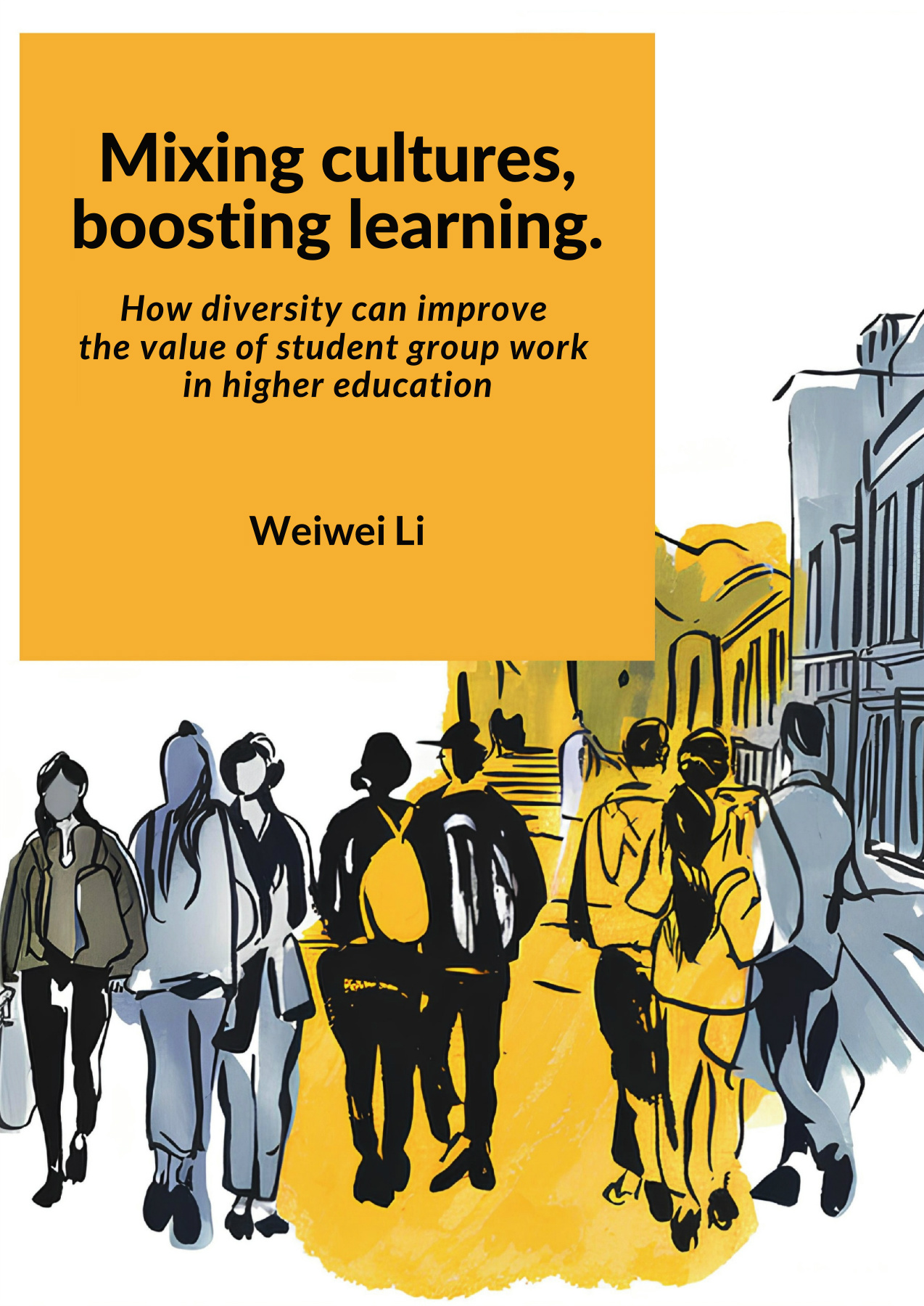
Share this project
Summary
In the context of internationalisation and interdisciplinarity in higher education, student diversity in collaborative learning settings is recognised as a valuable educational resource. It provides all students with opportunities for intercultural experiences and competence development. Integrating students' diverse cultures in group work improves the quality of cross-boundary interactions and knowledge synthesis, enabling them to address complex real-world problems. It also improves individual diversity attitudes, openness, cultural empathy, and social initiative, preparing students for the global workforce and team-based environments.
Despite the recognised potential of diversity as a resource in education, effectively integrating both disciplinary and national cultures in group settings is often impeded by challenges such as students’ limited engagement due to uncertainty and intergroup biases, and the urgent need for innovative practices from educators and institutions. Addressing these challenges is crucial to maximising the benefits of cultural diversity in student group work.
This dissertation aims to answer a central research question: ‘Under which conditions can diversity in a collaborative learning setting provide added value for students' thriving?’ It applies a consistent theoretical framework, the Categorisation-Elaboration Model, and considers perceptions of benefits and costs, goal orientation, quality of intercultural interaction, and intercultural competence development of both international and domestic students. It explores teachers’ teaching practices, self-regulation, and needed support, constructs the concept of a teacher-initiated diversity climate, evaluates the impacts of interdisciplinary programmes on students’ competence development, and discusses their interactions in leveraging the added value of diversity in groups to boost students’ learning.
Chapter 2 delves into students’ perceived benefits of intercultural group work (IGW) and their impact on the quality of intercultural interactions. Through a survey involving 233 students, this chapter explores and assesses the task-specific and general value in diversity and their relation to intercultural interactions within IGW. It further examines the variance in learning experiences between local and international students, finding that international students are more engaged in and benefit more from international classrooms. This finding not only resonates with the past decade’s development of internationalisation in higher education where students especially international ones are more aware of the meaning of international education, but also highlights a new challenge for teachers to engage local students more in international learning. Teachers are invited to adopt a sensitive approach to identify both local and international values, rituals, needs, and perceptions, and carefully tailor their teaching to engage different student groups. The findings also confirm that recognising the benefits of diversity in group projects encourages students to learn from their peers about the topic and stimulates them to reassess their own intercultural attitudes and personal growth, particularly for local students in international programmes.
Chapter 3 shifts focus to educators' perspectives and their experiences with mixing national diversity for better education in student groups. By conducting semi-structured interviews with 20 teachers who have implemented group work strategies in international programmes, this chapter uncovers the strategies in diversity climate creation, task design, instruction, and feedback and assessment that educators employ to promote intercultural interactions in IGW. For example, establishing a positive diversity climate has been recognised as the initial step in teachers' strategies to boost student engagement in intercultural settings, and good teaching practices are described in ensuring that students feel comfortable, safe, included, and valued. The findings encourage reflection among educators regarding their own self-regulation in intercultural contexts and how the identified strategies and good practices can empower them in their teaching contexts. This study further identifies students’ engagement, educators’ beliefs, and institutions’ recognition and support that affect teachers’ effectiveness as facilitators in intercultural group work.
Chapter 4 simultaneously analyses the impact of perceived benefits and perceived costs on students’ interdisciplinary interactions. The regression analyses indicate that individuals’ eagerness to gain insights from different disciplines overrides the impediments associated with interdisciplinary endeavours. The findings highlight the importance of students’ positive beliefs in diversity for the efficiency of IGW and further encourage teachers’ efforts in facilitating students' deliberate recognition of the benefits of joining intercultural group work. Building on the exploration of teachers’ strategies in IGW discussed in Chapter 3, Chapter 4 constructs the notion of a teacher-initiated diversity climate and measures how students’ perception of this teacher-initiated diversity climate influences their interactions. Utilising a survey of 108 students, this study uncovers that improving students' positive perceptions of diversity in IGW is the underlying mechanism by which perceived positive diversity climate enhances the quality of interdisciplinary interactions. This study not only expresses the students’ resilience in their motivations when encountering differences, but also highlights the important contextual factor of a diversity climate that related to a teacher’s instructions in intercultural contexts.
Chapter 4 begins with an analysis of cross-sectional data on students' perceptions and their interactions within an interdisciplinary context, setting the stage for Chapter 5: a longitudinal study over three months to evaluate the impact of an interdisciplinary team-based module designed by the monolingual faculty of a local university. Using a pre- and post-survey of 137 students, this chapter discovers that there are positive changes in three social-perceptual intercultural traits of open-mindedness, social initiative, and cultural empathy development among the students after the interdisciplinary programme. Also, the initially perceived uncertainty in working with others from different disciplines reduced significantly after three-month interdisciplinary programme. This study confirms that the interdisciplinary programme provides a unique intercultural education opportunity for local students in monolingual faculties to develop intercultural competence and reduce intercultural anxieties. Besides the impacts of institutional innovation in introducing interdisciplinary programmes, it was observed that students with higher levels of mastery orientation are better able to improve their intercultural competence through interdisciplinary group work. This finding aligns well with the statement that a demanding environment requires positive goal orientation from students, as they need to actively learn from and with peers to achieve their self-development and competence improvement goals.
The findings underscore the practical applicability and benefits of integrating cultural diversity in group work, providing evidence-based recommendations for students, educators, and policymakers. This dissertation not only advances the understanding of mixing cultures in education but also offers actionable insights for fostering more effective and inclusive diverse group work in academic settings.