Viktor Van der Valk
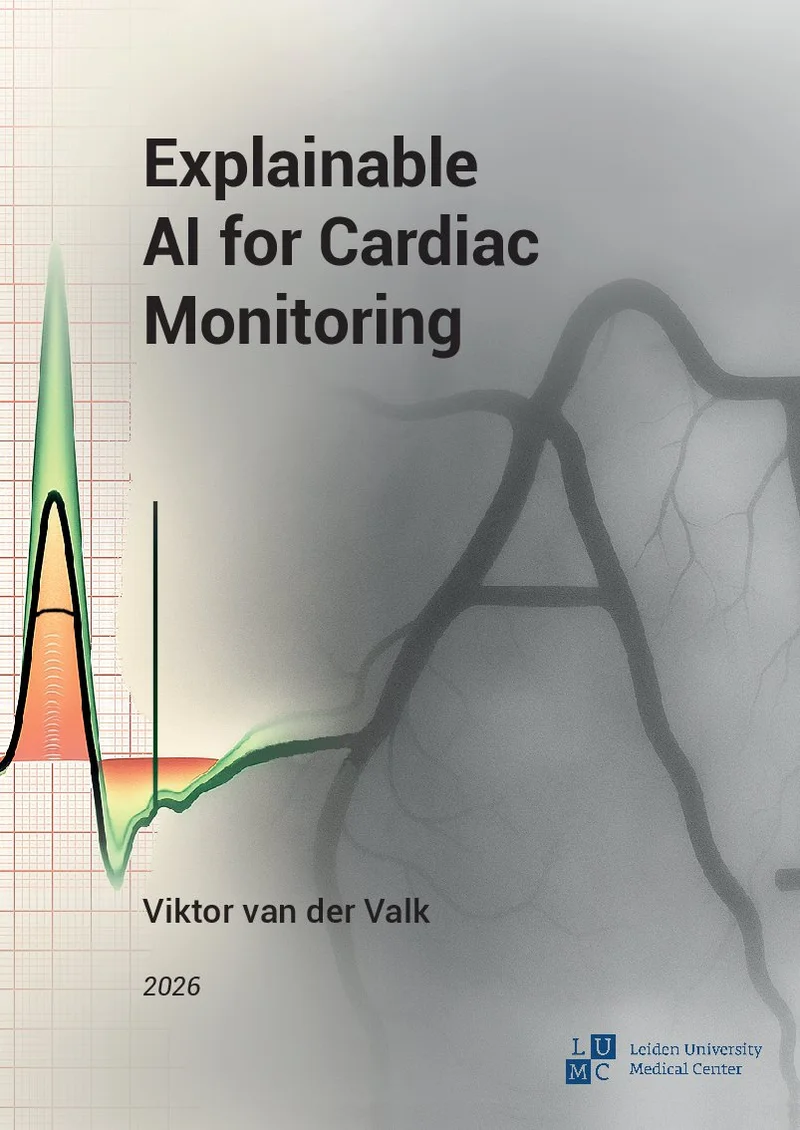


Explainable AI for Cardiac Monitoring
Summary This thesis explored the integration of AI, and particularly deep learning, into various stages of the myocardial infarction (MI) clinical workflow, ranging from imaging and physiological monitoring to the extraction of structured data from free-text reports. Across different modalities and tasks, we investigated how AI and, if relevant, explainable AI methods can reduce clinical workload. In Chapter 2, we addressed the growing interest in deep learning–based analysis of invasive coronary angiography (ICA) by conducting a comprehensive systematic review. The field is marked by heterogeneity in task definitions, evaluation metrics, and datasets, which hinders direct comparison and clinical translation. By organizing existing literature into four primary tasks of the clinical workflow: frame selection, vessel segmentation, lesion localization, and lesion assessment, we provided structure to a fragmented research landscape. We further identified methodological trends and common limitations, and proposed clinically relevant future direction and recommendations aimed at facilitating fair benchmarking. In Chapter 3, we investigated how LLMs can automate the extraction of clinically relevant variables from semi-structured ICA and echocardiography reports. By evaluating multiple LLM approaches, prompt engineering and fine-tuning, across different computing environments, we demonstrated that LLM performance in general is strong, but depends on task complexity, model size and class imbalance. Taking these into account, we concluded that even smaller locally run LLMs have a use-case in extracting simple labels, such as left ventricular function (LVF) or treatment strategy, from cardiac reports. This work enables the automated structuring of large volumes of clinical data, laying the groundwork for scalable cohort creation, model training, and retrospective analysis. The successful classification of echocardiogram reports with LLMs, directly accelerated the labeling process for the ECG classification studies in Chapter 4, 5 and 6. LLMs have a direct use case here which speeds up the research workflow, but they could similarly speed up the clinical workflow. Finally in Chapter 4, 5 and 6, we focused on ECG as a widely accessible, non-invasive signal for cardiac assessment. We developed and evaluated explainable AI models based on VAEs, aimed at predicting LVF, a critical post-MI prognostic marker, and mortality. In Chapter 4, we improved prediction (AUC=0.853) and explainability by jointly optimizing reconstruction and classification objectives, demonstrating that meaningful cardiac features can be extracted from the 12-lead ECG. In Chapter 5, we extended this approach by explicitly disentangling LVF-relevant features in the latent space through supervised adversarial learning. This allowed us not only to maintain predictive performance (AUC=0.868), but also to generate interpretable signal-specific visualizations of how variations in ECG signals relate to LVF, thereby enhancing model transparency and trustworthiness in a clinical setting. In Chapter 6 we applied the same method to the 1-lead smartwatch ECG and compared LVF prediction from the 1-lead (AUC=0.883) and the 12-lead (AUC=0.897) ECG. This comparison aimed to evaluate the use of the 1-lead ECG as a proxy for both 12-lead ECG-derived LVF and echocardiogram-derived LVF. Taken together, the studies in this thesis illustrate how deep learning models, when carefully tailored to clinical tasks, can contribute to a more efficient and scalable MI workflow. From automating complex imaging analyses to structuring textual data and deriving interpretable physiological markers, AI offers tangible solutions to alleviate the growing burden on healthcare systems. However, several challenges remain. Conclusion The MI care pathway is complex and labor intensive and will therefore become increasingly unsustainable in the face of increasing prevalence of cardiovascular disease [1]. This thesis presents a multifaceted approach to help alleviate this burden through the integration of explainable, efficient, and scalable AI methods across imaging, physiological signals, and clinical text. We have shown that deep learning can enhance diagnostic accuracy and interpretability in ICA and ECG analysis, and that large language models can unlock the value of unstructured clinical reports, both of which are key enablers for generating large, labeled datasets and supporting data-driven decision-making. By identifying methodological gaps, proposing practical solutions, and demonstrating proof-of-concept implementations, this work contributes to the growing body of research aiming to bridge the gap between AI development and clinical adoption. Ultimately, the impact of AI in cardiology will depend not only on technical advances but also on careful integration into clinical workflows, transparency of algorithms, and the availability of high-quality data. Continued interdisciplinary collaboration between clinicians, engineers, and data scientists will be crucial to ensure that the full potential of AI is realized in improving patient outcomes in cardiovascular care.
| Publicatiedatum | 11 juni 2026 |
| Universiteit | Universiteit Leiden |
| Auteur | Viktor Van der Valk |
| Order nummer | 19020 |