Ara Cho
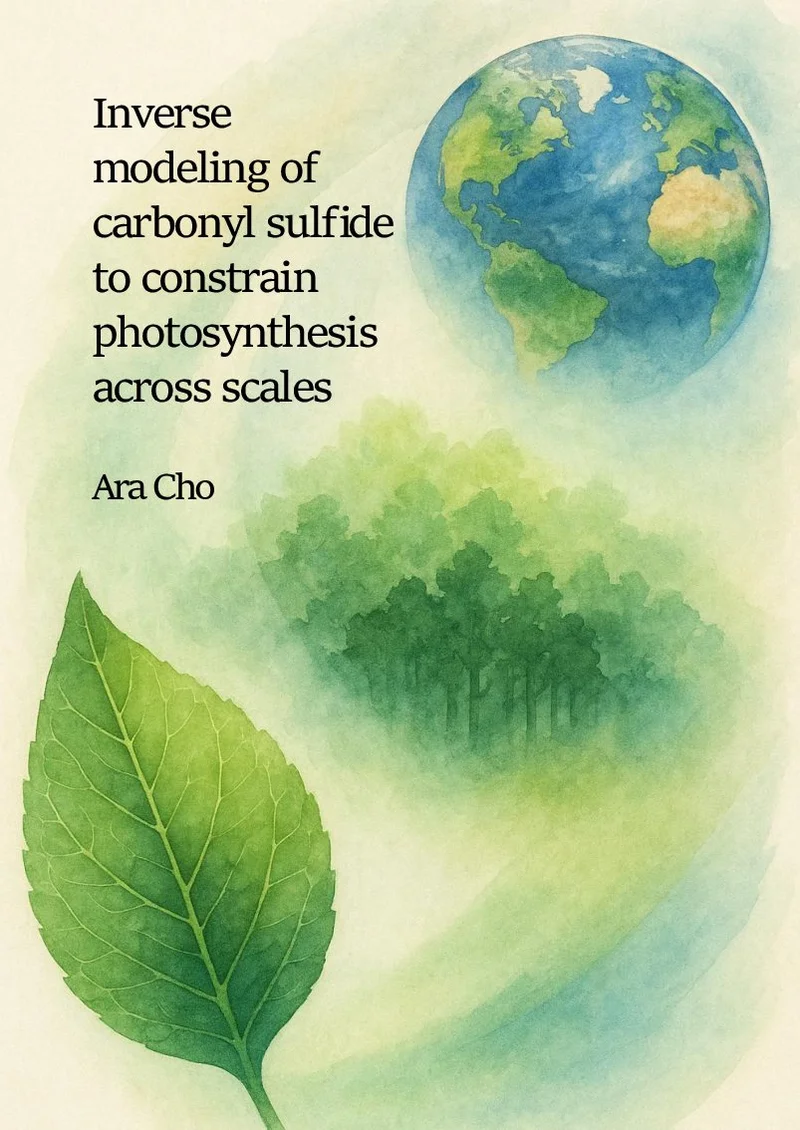


Inverse modeling of carbonyl sulfide to constrain photosynthesis across scales
This dissertation evaluated the potential of carbonyl sulfide (COS) as a tracer for gross primary productivity (GPP) by combining experiments, modeling, and inverse analyses from leaf to global scales. The central finding is that COS provides valuable complementary information on plant carbon uptake, but its quantitative use as a global proxy for GPP remains constrained by both physiological and methodological uncertainties. A key contribution of this work is to show that COS does not simply scale linearly with CO2 uptake. Leaf-level experiments revealed conditions under which COS uptake responded differently from photosynthesis, including high-temperature emission potentials and amplified sensitivities to stomatal closure. At larger scales, these physiological characteristics necessitated refinements in model parameterizations of stomatal and mesophyll conductance. Although such improvements enhanced agreement with site-level flux observations after parameter optimization, the global inversions continued to reveal structural limitations—most notably a strong dependence on prior COS vegetation fluxes, incomplete representation of COS-specific processes, and the absence of diurnal variability in the inversion framework. This dissertation further demonstrates that COS can provide information on photosynthesis that is not accessible from CO2 alone. At the leaf scale, COS uptake offered additional constraints on stomatal conductance, complementing the traditional reliance on H2O and CO2 observations. At the canopy scale, COS fluxes revealed additional insights into stomatal dynamics during autumn and at night, and suggested improvements in the treatment of humidity stress as well as an original stomatal conductance model in SiB4. At the global scale, COS provided limited additional constraints on CO2, primarily due to the sparse observational coverage of COS and the resulting weak constraints, compounded by structural limitations in current model. Nevertheless, the inversion results showing a persistent underestimation of the COS vegetation sink at high latitudes may point to biases in current GPP representations. Taken together, these results show that COS contributes independent and complementary information across scales, underscoring its potential as a tracer of photosynthesis. At the same time, they emphasize that further progress depends on (i) refining the mechanistic understanding of COS exchange across species and environments, (ii) improving the representation of nocturnal and stress-related processes in land surface models, (iii) strengthening coupled CO2–COS inversion frameworks, and (iv) expanding observational networks globally through coordinated campaigns and satellite missions. These advances will determine the extent to which COS vegetation fluxes can be integrated into robust global monitoring of GPP.
| Publicatiedatum | 10 juni 2026 |
| Universiteit | Wageningen University |
| Auteur | Ara Cho |
| Order nummer | 18792 |