Linda Remijn Nelissen
Symptomatic treatment of myasthenia gravis
3 september 2026
Universiteit Leiden
Open Ebook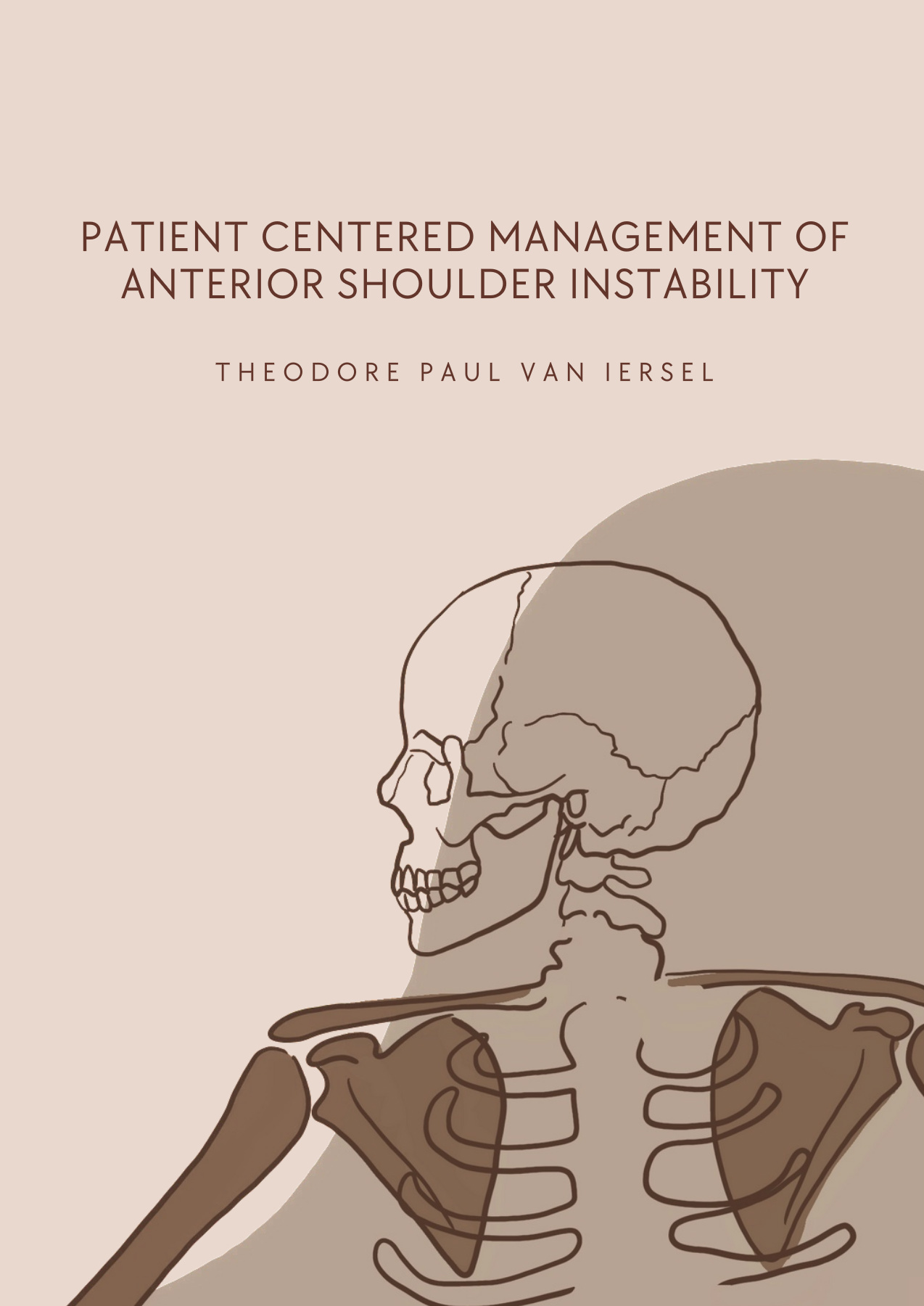
Share this project
Summary
This thesis was carried out to gather more insight regarding the subject of patient centered care of shoulder instability. Chapter 1 is a general introduction into shoulder instability, its pathophysiology and the current non-operative and operative treatment options. Also, chapter 1 stated the research questions of this thesis.
In chapter 2 patient perspectives regarding the non-operative and operative treatment of shoulder instability is discussed, based on an online focus group study which we carried out. An important part of this study was having interactive group discussions between patients which can help healthcare professionals gather insight into these patient perspectives. This study revealed that fear of (recurrent) dislocation, preoperative counseling, communication between surgeons and physiotherapists and the need for a consistent postoperative rehabilitation protocol were important patient perspectives.
Chapter 3 continues with the results of the study presented in chapter 2, mostly the fear for (recurrent) shoulder dislocation that patients experience both before and after receiving treatment. Until the initiation of the Tampa Scale for Kinesiophobia in Shoulder Instability (TSK-SI) study, there was no scale available yet as a diagnostic tool for diagnosing kinesiophobia in patients with shoulder instability. For this study we asked Dutch shoulder specialized physiotherapists and orthopedic surgeons to help creating this diagnostic tool using a four round consensus study design, modifying the currently existing TAMPA scale, originally created to diagnose kinesiophobia in patients with chronic low back pain. This resulted in the 18-item TSK-SI, which will be validated during the MATASI TRIAL (chapter 8).
Chapter 4 provides a critical overview and meta-analysis of the current literature regarding the surgical treatment options when primary arthroscopic Labral repair (ALR) fails. For this study secondary ALR was compared with secondary open bony reconstruction (OBR). Moreover, these results were then compared with primary OBR. The most important finding of this study was that a BRP showed a lower recurrence rate when it was a primary procedure compared to when there was a ALR prior to the BRP.
In chapter 5 we looked into the prognostic factors for failure to return to sport (RTS) after an arthroscopic Bankart repair (ABR). This was important to investigate since 3-40% of patients who fail to RTS or who are not able to successfully RTS after an ABR in current literature, with ‘successful’ often being defined as the RTS to the same or higher level of sport. The study showed that glenoid bone loss and overhead use of the shoulder during work was predictive for failure to RTS after ABR. When looking at failure to successfully RTS, preoperative Body Mass Index (BMI) and preoperative professional sports level were significant predictors. In contrast, an ‘Anterior Labral Periosteal Sleeve Avulsion’ (ALPSA) and bony Bankart lesion facilitated successful RTS.
Chapter 6 presented the results of a comparable study that was presented in chapter 5. However, this study looked at prognostic factors of failure to RTS after a specific type of OBR, the open Latarjet procedure (OLP). There were no significant factors for failure to RTS. However, it did reveal that athletes participating in overhead/collision shoulder sport with hitting movements and sudden stops were more prone to failure to RTS.
Chapter 7 provides a summary of reasons why patients do not return after ABR and OLP, which are the most frequent surgical procedures treating shoulder instability. We started to look into this because there were no studies summarizing these considerations, which is remarkable knowing that 3-40% of patients do not RTS in current literature. This study showed that the majority of patients who do not RTS (70%) after shoulder stabilizing surgery do so because of reasons which are not shoulder function dependent, like fear of (recurrent) dislocation, lack of motivation or change of personal interest/priorities.
In chapter 8 the protocol of a new national multicenter randomized controlled trial (RCT) is presented, the MATASI TRIAL. This RCT will investigate the effect of fear reducing interventions during rehabilitation of patients undergoing ABR, as it showed to be an important patient perspective in chapter 2 and an important reason of patients not to RTS in chapter 7. Multiple Dutch hospitals and clinics will participate in this randomized study, in which roughly 100 patients have to be included based on the sample size calculations. The primary outcome is fear for (recurrent) dislocation and this will be measured after 6, 12, 24 and 48 weeks. Also, at 48 weeks functional Magnetic Resonance Imaging (MRI) scans will be made, in which brain activity is measured. In chapter 9 we described the content of the rehabilitation protocol which the ‘experimental’ group will undergo during the MATASI TRIAL.
Chapter 9 describes which modalities have to be included in the fear reducing rehabilitation protocol following ABR. For this study, international experts from different countries participated in a Delphi consensus study. During four rounds they were asked which interventions should be included in the rehabilitation protocol based on evidence based interventions. The final protocol will be used in the MATASI trial, as described in chapter 8.
In chapter 10 the studies of this thesis were reviewed and the author reflects on the subject of patient centered care of shoulder instability. Also, the research questions which are stated in the introduction were answered. Last, recommendations were made for future research which draws a perspective for following studies.