Emre Gunerken
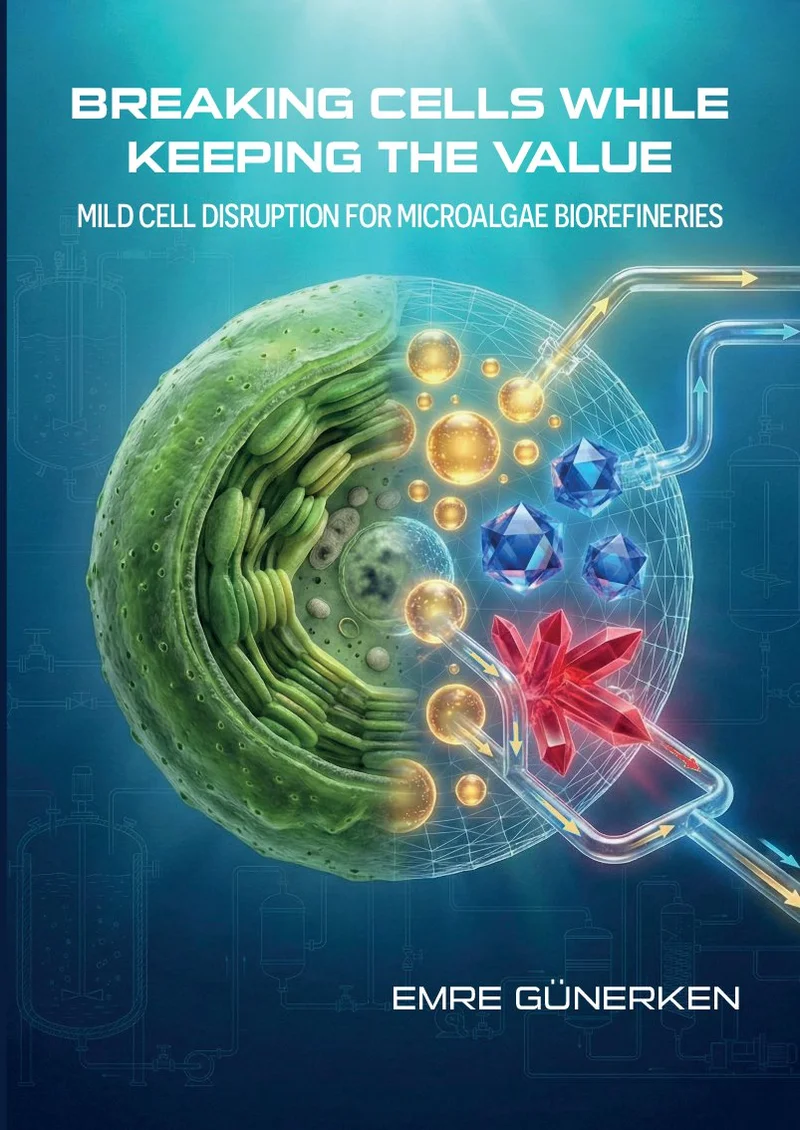


BREAKING CELLS WHILE KEEPING THE VALUE:
This PhD thesis addresses key challenges in microalgae biorefineries by developing an efficient, mild cell disruption technique to enhance the recovery of intracellular biomolecules while minimizing energy consumption and product degradation. Driven by global imperatives to transition from fossil-based resources to sustainable alternatives amid escalating greenhouse gas emissions and resource scarcity, the research positions microalgae as versatile feedstocks for biofuels, biochemicals, nutraceuticals, and high-value compounds. Microalgae’s superior carbon fixation capacity (10-50 times that of terrestrial plants) and ability to integrate wastewater treatment with CO2 sequestration underscore their potential in circular bio-economies. The work comprehensively evaluates mechanical and non-mechanical disruption methods, identifying limitations in energy efficiency, scalability, and product quality. Conventional approaches like bead milling and high-pressure homogenization achieve high yields but consume substantial energy (0.81-147 kWh/kg dry biomass) and generate shear forces that compromise sensitive biomolecules. To overcome these, the thesis explores cultivation strategies, such as nitrogen depletion, which alter cell physiology to improve disruption efficiency and selectivity, particularly for lipids (up to 92% phospholipid release). A novel analytical method using flow cytometry enables rapid, accurate quantification of disruption yields, correlating strongly (R²=0.9867) with biomass release while distinguishing intact, leaking, and disrupted cells. This advancement facilitates real-time process optimization, reducing analysis time from hours to minutes. Culminating the research is the development of a patented continuous explosive decompression device using CO2, which addresses mass transfer limitations in conventional explosive decompression method through innovative sparger design and hydrodynamic mixing. Compared to batch systems, it reduces processing time 3.2 - 9.6 fold, CO2 consumption 8.5 - 48.2 fold, and achieves 24 - 36% biomass release at shear rates only 0.33% of bead milling. Techno-economic analysis reveals superior performance: 0.3 kWh/kg dry biomass versus 2.8 kWh/kg for bead milling (89% energy reduction), with capital costs 45,000 EUR versus 77,000 EUR for equivalent capacity. Statistical modeling identifies pressure and flow rate as dominant parameters influencing release ratios, while co-solvents enable selectivity control. The technology demonstrates secretion (extraction without rupture) and scattering (debris formation) mechanisms, offering tunable product recovery. Overall, the thesis argues that the field’s usual trade-off (“harsh but effective” vs “mild but inefficient”) is not inevitable; with integrated cultivation–disruption thinking, better analytics, and intensified continuous design, mild and scalable disruption can be engineered toward industrial relevance. This can be a step towards energy-efficient solution that could transform microalgae biotechnology into a viable industrial platform for addressing climate, energy, and resource challenges.
| Publicatiedatum | 12 juni 2026 |
| Universiteit | Wageningen University |
| Auteur | Emre Gunerken |
| Order nummer | 19019 |