Sven Geurts
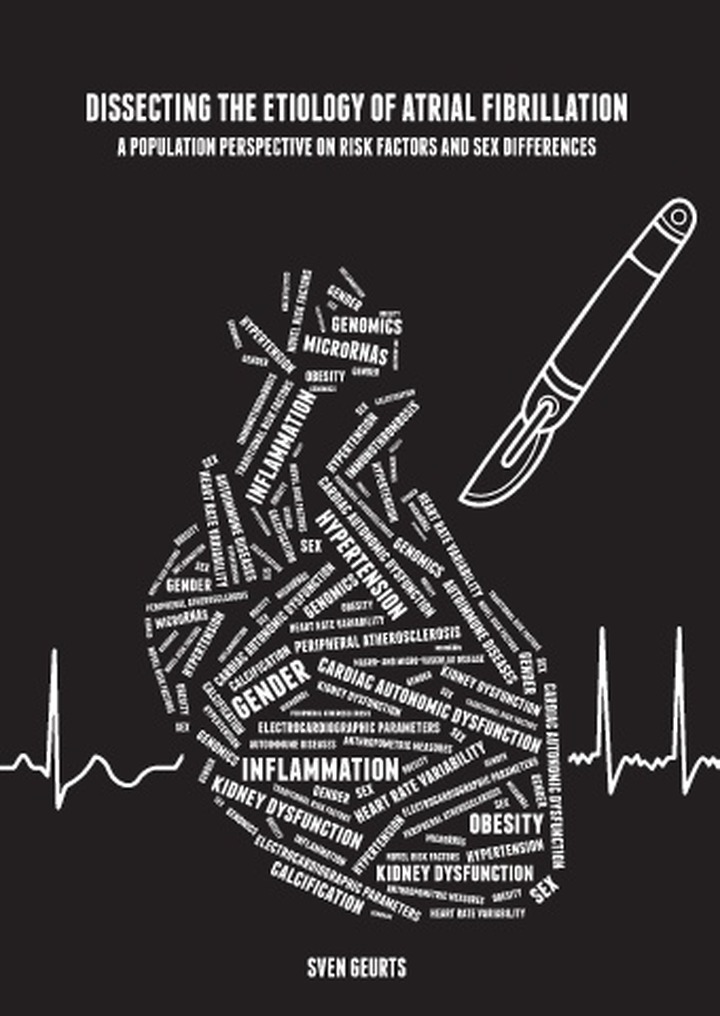


Dissecting the Etiology of Atrial Fibrillation
The human heart (myocardium) is a fascinating and powerful fist-sized muscular organ that pumps around blood through the cardiovascular system. The heart is located in the middle compartment of the chest (thorax) called the mediastinum. The heart is anatomically divided into four chambers: two upper chambers called the left and right atria and two lower chambers called the left and right ventricle. At rest the heart beats around 60-80 times per minute whereas during physical exertion it may beat up to 180-200 times per minute, depending on the metabolic needs of the body. The pump function and its frequency are further regulated by the sinoatrial node, located in the upper right atrium, which is the orchestrator of the cardiac rhythm. In a physiological setting, electrical activity is initiated by pacemaker cells in the sinoatrial node. These very specialized cells generate an electrical current that travels in series from the sinoatrial node to the atrioventricular node to the bundle of His and ends at the Purkinje fibers located in the ventricles. This travelling electrical current causes the atria and ventricles to contract sequentially which makes blood flow from the atria to the ventricles to the cardiovascular system. In atrial fibrillation, this normal cardiac rhythm is disturbed by chaotic electrical activity in the atria. This chaotic atrial electrical activity or excitation leads to unproductive atrial contraction and may subsequently cause an irregularly irregular ventricular excitation and contraction. Atrial fibrillation is the most common cardiac arrhythmia worldwide and its prevalence has reached epidemic proportions due to aging of the general population and the increasing prevalence of atrial fibrillation risk factors such as obesity, hypertension, diabetes mellitus, coronary heart disease, and heart failure. In the past decades, the scientific community propelled the knowledge regarding the epidemiology, prediction, pathophysiology, and treatment of atrial fibrillation. Despite this global scientific effort in the past decades to better understand this complex and polygenetic disorder, the atrial fibrillation etiology remains unclear. As one can imagine this complexity further complicates the prediction, prevention, and management of atrial fibrillation. Generating new evidence is therefore warranted to reduce the disease burden of atrial fibrillation. Therefore, we mainly investigated the etiology (cause of a disease) of atrial fibrillation in participants from the Rotterdam Study, the UK Biobank, and several large-scale genomic consortia. In Part I, we introduced atrial fibrillation, the aim, and the topics that underlie this thesis. In Part II, we described macro- and micro-vascular disease as a risk factor for atrial fibrillation. In Chapter 2.1, we investigated the (sex-specific) association between arteriosclerotic calcification and atrial fibrillation. We found that higher coronary artery calcification volume in the general population, especially in men, and higher aortic arch calcification volume in women were significantly associated with an increased risk of new-onset atrial fibrillation. This underlines that interventions to lower arteriosclerotic calcification, specifically coronary artery calcification, might prevent atrial fibrillation in the general population, in particular in men. In Chapter 2.2, we examined the (sex-specific) association between peripheral atherosclerosis and atrial fibrillation. We showed that higher carotid atherosclerosis, and lower extremity atherosclerosis were significantly associated with an increased risk of new-onset atrial fibrillation, especially in women. This suggests that treatment to reduce (sub)clinical peripheral atherosclerosis carries a preventive capacity for atrial fibrillation in the general population, especially in women. In Chapter 2.3, we evaluated the bidirectional association between kidney function and atrial fibrillation. We observed that kidney function, in particular estimated glomerular filtration rate based on cystatin C, and atrial fibrillation are significantly bidirectionally associated. In Chapter 2.4, we examined the bidirectional causality between kidney function and atrial fibrillation by using Mendelian randomization. Our results supported the significant bidirectional causality between kidney function and atrial fibrillation. Overall, the findings from the latter two subchapters imply that kidney dysfunction and atrial fibrillation may form therapeutic targets to prevent both conditions in the general population. In Part III, we assessed cardiac autonomic dysfunction as a risk factor for atrial fibrillation. In Chapter 3.1, we studied the (sex-specific) association between heart rate variability and atrial fibrillation. We observed that heart rate variability was significantly associated with increased new-onset atrial fibrillation risk, in particular in women. Subsequently, our Mendelian randomization also supported the causality of the association between heart rate variability with atrial fibrillation. This suggests that modulation of heart rate variability might prevent atrial fibrillation in the general population, in particular in women. In Chapter 3.2, we determined the (shape of the) association and sex differences between electrocardiographic parameters and atrial fibrillation. We observed that the shape of association between baseline electrocardiographic measures and their risk of new-onset atrial fibrillation were generally mostly U- and N-shaped. Further, we reported that longitudinal measures of higher PR, and higher QTc interval were significantly associated with an increased new-onset atrial fibrillation risk, more specifically in men. This means that different thresholds of electrocardiographic parameters might translate to a differential risk among men and women and that therapies that target electrocardiographic parameters might prevent atrial fibrillation in the general population, in particular in men. In Part IV, we reported on inflammation as a risk factor for atrial fibrillation. In Chapter 4.1, we described the association between immunothrombosis and atrial fibrillation. No significant associations between markers of immunothrombosis and new-onset atrial fibrillation in the general population were observed. Therefore, we hypothesize that immunothrombosis may be associated with atrial fibrillation through other cardiovascular risk factors or conditions that may lead to atrial fibrillation. In Chapter 4.2, we systematically reviewed, and meta-analyzed the literature on the association between immunothrombotic markers and atrial fibrillation. We found that atrial fibrillation is significantly associated with higher levels of immunothrombosis. The associations were most pronounced in the cross-sectional analyses whereas limited longitudinal studies were available. This supports the hypothesis that immunothrombosis is promoted by atrial fibrillation and that “atrial fibrillation begets atrial fibrillation”, as the prothrombotic state is considered as an underlying mechanism of atrial fibrillation. In Chapter 4.3, we studied autoimmune diseases and their influence on atrial fibrillation risk. Various autoimmune diseases such as rheumatic fever, rheumatic heart disease, type 1 diabetes mellitus, multiple sclerosis, myasthenia gravis, Crohn’s disease, ulcerative colitis, rheumatoid arthritis, psoriatic and enteropathic arthropathies, polyarteritis nodosa, systemic lupus erythematosus, dermatopolymyositis, systemic sclerosis, ankylosing spondylitis, and Paget’s disease were studied. Significant associations between rheumatic fever without heart involvement, type 1 diabetes mellitus, Crohn’s disease, ulcerative colitis, rheumatoid arthritis, polyarteritis nodosa, systemic lupus erhythematosus, and systemic sclerosis and new-onset atrial fibrillation risk were found. These associations were mostly prominent in women. These results highlight the (potential sex-specific) impact of different autoimmune diseases on atrial fibrillation risk. In Part V, we investigated anthropometric measures, trajectories of obesity-related measures and blood pressure, and microRNAs as traditional and novel risk factors for atrial fibrillation. In Chapter 5.1, we described the association between anthropometric measures and atrial fibrillation. We reported that measures of anthropometrics were significantly associated with an increased risk of new-onset atrial fibrillation. Increased height in men and increased weight, and central obesity (waist-to-hip ratio) in women showed the largest associations with atrial fibrillation risk. This underpins that height in men and weight, and central obesity (waist-to-hip ratio) in women are risk factors for new-onset atrial fibrillation risk. This stresses that a sex-specific approach for screening and monitoring of anthropometrics might aid in atrial fibrillation prevention. In Chapter 5.2, we evaluated the association between trajectories of obesity-related measures and blood pressure and atrial fibrillation. Longitudinal trajectories of obesity-related measures and blood pressure were significantly associated with new-onset atrial fibrillation risk. Sex differences in the associations between waist circumference, hip circumference, and diastolic blood pressure trajectories and new-onset atrial fibrillation risk were also observed. This highlights the importance to assess the long-term exposure to modifiable risk factors such as obesity, and hypertension for future atrial fibrillation preventive strategies. In Chapter 5.3, we assessed the effect of antihypertensive (high blood pressure) drugs by conducting a drug target Mendelian randomization study. Well-validated published genetic variants were used as genetic proxies of 12 antihypertensive drug classes including alpha-adrenoceptor blockers, adrenergic neuron blockers, angiotensin-converting enzyme inhibitors, angiotensin-II receptor blockers, beta-adrenoceptor blockers, centrally acting antihypertensive drugs, calcium channel blockers, loop diuretics, potassium-sparing diuretics and mineralocorticoid receptor antagonists, renin inhibitors, thiazides and related diuretic agents, and vasodilators via their corresponding gene and protein target, and we determined their impact on atrial fibrillation prevention through their downstream effect which is to lower systolic blood pressure. Significant preventive causal effects of lowering systolic blood pressure per 10 mmHg via alpha-adrenoceptor blockers, beta-adrenoceptor blockers, calcium channel blockers, vasodilators, and all 12 antihypertensive drug classes combined on atrial fibrillation risk, were observed in our drug target Mendelian randomization analyses. This is promising as it indicates that lowering systolic blood pressure using certain antihypertensive drugs carries a potential to prevent atrial fibrillation. These findings may guide future clinical trials and have implications for repurposing antihypertensive drugs in atrial fibrillation prevention. In chapter 5.4, we studied the association between microRNAs and atrial fibrillation. We observed that higher plasma levels of MiR-4798-3p were significantly associated with the odds of prevalent atrial fibrillation in men. Furthermore, miR-4798-3p may potentially regulate the expression of a number of atrial fibrillation-related genes including genes involved in calcium and potassium handling in myocytes, protection of cells against oxidative stress, and cardiac fibrosis. This might explain why miR-4798-3p is involved in atrial fibrillation pathophysiology. In Part VI, we discussed the implications of sex and gender in atrial fibrillation research. In Chapter 6.1, we determined the association between women-specific risk factors and atrial fibrillation. We showed that early or delayed menopause, early or delayed menarche, or irregular menstrual cycles were significantly associated with increased new-onset atrial fibrillation risk. Further, both nulliparity and multiparity, compared to having 1-2 children, were significantly associated with an increased new-onset atrial fibrillation risk. This highlights that the reproductive history of women is of added value while designing preventive strategies for atrial fibrillation. In Chapter 6.2, we described the current status, future directions, and potential of sex- and gender-specific atrial fibrillation prediction by leveraging big data. Atrial fibrillation is a complex and polygenetic arrhythmia and its prediction models are not yet conclusive despite the advances over the last two decades regarding the epidemiology, prediction, pathophysiology, and treatment of atrial fibrillation. The possibilities with clinical data, multidimensional datasets, electrocardiograms, electronic health records, and wearable devices are apparent. However, ample challenges remain before artificial intelligence-enabled algorithms can be adopted for sex- and gender-specific prediction, prevention, and management of atrial fibrillation. Lastly, in Part VII, we discussed and summarized the main findings of the studies embedded in this thesis. Further, we addressed methodological considerations, reviewed potential implications of this thesis, and pointed out potential future directions. In this thesis, we aimed to dissect the etiology of atrial fibrillation using a population perspective on various risk factors and sex differences. We found that vascular-, cardiac autonomic-, inflammatory-, traditional-, novel-, and sex-specific risk factors are implicated in the etiology of atrial fibrillation. Future research may further dissect this complex and polygenetic arrhythmia layer by layer by combining observational and experimental studies to eventually expose the underlying biology of atrial fibrillation.
| Publicatiedatum | 30 mei 2023 |
| Universiteit | Erasmus Universiteit Rotterdam |
| Auteur | Sven Geurts |
| Order nummer | FTP-202604100941 |
| ISBN nummer | 978-94-6469-310-2 |