Share this project
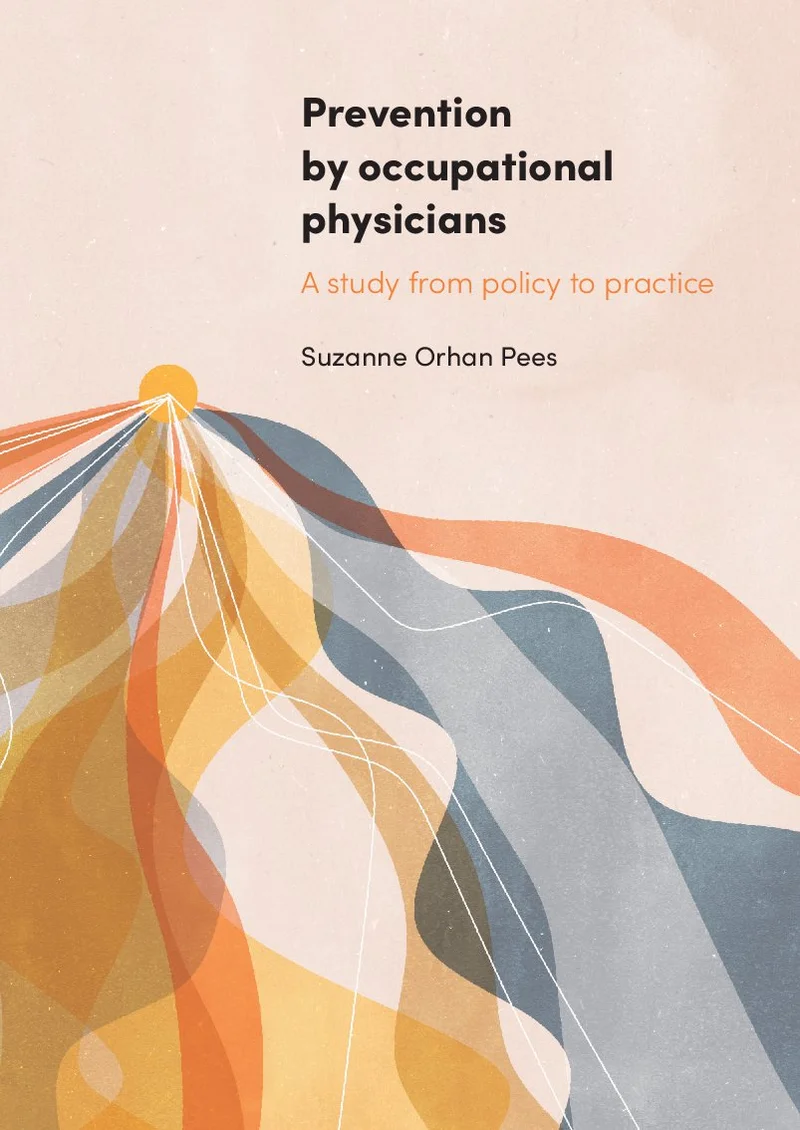
Suzanne Orhan Pees
Vrije Universiteit Amsterdam
Publication date: 22 september 2026
University: Vrije Universiteit Amsterdam
ISBN: 978-94-6534-589-5
Prevention by occupational physicians:
Summary
Work-related health complaints are a major problem. Not only are they associated with significant personal suffering, but they also lead to high costs for employers and society. This highlights the importance of attention to health in relation to work. The Working Conditions Act (Arbowet) sets out the rules, rights, and obligations for employers and employees to ensure that everyone in the Netherlands can work in a healthy and safe environment. Since the revision of the Arbowet in 2017, the preventive role of occupational physicians (OPs) has become more central. For example, OPs were given access to the workplace, employees gained the right to consult an OP preventively during open consultation hours, and the basic contract was introduced, which sets minimum requirements for contracts between occupational health service (OHS) providers and employers.
Nevertheless, it appears that many OPs in practice spend little time on preventive tasks, with the focus remaining on sickness absence management. The ultimate aim of the study in this thesis was therefore to stimulate the implementation of preventive tasks by OPs. To realize this, we formulated two objectives:
- Objective 1: To provide insight into the reasons and determinants of the limited implementation of preventive tasks by OPs in practice.
- Objective 2: To design an intervention aimed at increasing the execution of preventive tasks by OPs, and evaluate the implementation of the intervention as well as the effects on time allocated to preventive tasks.
Objective 1: To provide insight into the reasons and determinants of the limited implementation of preventive tasks by OPs in practice.
Chapter 2 describes the behavioural determinants of OPs regarding prevention, specifically their attitude, perceived social support, and self-efficacy expectations (ASE), and how these factors relate to the time they spend on preventive tasks. The results show that OPs generally have a positive attitude towards preventive tasks. For example, 96% of OPs see it as part of their job to engage in prevention. Nevertheless, their self-efficacy expectations regarding the execution of preventive tasks are relatively low, with only 57% expecting to be able to carry them out successfully. The perceived support from the environment varies by stakeholder: the majority (84%) of OPs feel supported by colleagues in performing preventive tasks, but less than half (43%) feel supported by the employers they work for. Both support from employers and higher self-efficacy expectations are associated with spending more time on preventive activities, while no associations were found for attitude.
Chapter 3 focuses on how OPs’ time allocated to preventive tasks is associated with their work experience, based on five indicators: work pace and workload, variety in work, use of competencies, autonomy, and work enjoyment. We found that participating OPs spend 14.5% of their time on preventive tasks compared to 68.9% on sickness absence management and 16.6% on other tasks (research, policy, and education). Because these tasks represent proportions of the total workload and sum to a fixed total of 100%, we used compositional data analysis (CoDa) to investigate how time allocation relates to work experience. An increase in time spent on one task automatically leads to a decrease in time spent on one or more of the other tasks. The results showed that more time spent on preventive tasks, relative to other tasks, was associated with a greater sense of variety in the work and a higher feeling that the work sufficiently utilizes skills and competencies. No significant associations were found for work pace and workload, autonomy, or work enjoyment. Thus, performing preventive tasks partially contributes positively to the work experience of OPs, without making the work more demanding in terms of workload.
Although self-employed workers (SEW) in the Netherlands in theory have access to occupational health care, they often have to arrange and pay for this themselves. The cross-sectional study described in Chapter 4 therefore examined the use of preventive care by SEW and how this is associated with their risk perception. Risk perception was assessed based on the perceived likelihood and seriousness of developing work-related complaints and disability. About 16% of the 348 participating SEW had ever visited an OP preventively. This percentage was slightly higher (20.6%) among SEW who had disability insurance. The main reason for not using preventive care was a perceived lack of necessity (60.1%). Additionally, some SEW were unaware of the possibility (18.4%) or did not see the added value of visiting an OP (15.3%). Risk perception was partly associated with preventive visits to the OP. A lower perceived risk regarding work-related complaints was associated with lower odds of using preventive care provided by the OP. For disability, only a lower perceived likelihood was associated with the use of preventive care by the OP.
A barrier to the implementation of preventive tasks is that the effects are often unclear. For this reason, a systematic review was conducted on the effectiveness of preventive interventions, carried out by occupational health professionals, on work-related stress complaints. Chapter 5 describes the results of this review. Nine studies met the inclusion criteria, although the types of interventions, target groups, and involved occupational health professionals varied greatly. The effects of preventive interventions were also found to be mixed: some interventions showed short-term positive effects or were particularly effective for participants who closely followed the intervention (high fidelity), while other interventions had no effect. Preventive interventions appear to be especially effective when they are offered more intensively or frequently, although the evidence is limited and the outcomes are often mixed. This highlights the importance of well-executed and well-implemented interventions in preventing work-related stress complaints.
Objective 2: To design an intervention aimed at increasing the execution of preventive tasks by OPs, and evaluate the implementation of the intervention as well as the effects on time allocated to preventive tasks.
To support OPs in their preventive role and to improve the implementation of preventive tasks, we designed an intervention for OPs. Chapter 6 describes the development of the intervention and the protocol for its evaluation. The intervention was developed using the steps of Implementation Mapping, utilizing both information from the literature and input from relevant stakeholders. First, the factors that hinder or facilitate the execution of preventive tasks were identified. Next, strategies and methods to address these barriers were gathered during stakeholder meetings and from the literature. Based on this information, an intervention was developed consisting of three meetings for peer groups. Peer group meetings are mandatory for the re-registration of OPs and contribute to professional development and quality improvement. In the three meetings, existing peer groups focused on the topic of prevention, during which OPs created a personal action plan to address barriers and increase their engagement in preventive tasks in practice. Input from colleagues and reflection on personal goals played an important role in this process. Before the start of the intervention, the coordinators of the participating ICT groups received training to prepare them.
The intervention for OPs was evaluated in the IM-PROmPt study, which stands for Implementation of Preventive Tasks by Occupational Physicians. The IM-PROmPt study is a cluster-randomized controlled trial conducted between May 2023 and September 2024. The 41 participating ICT groups were randomly assigned to the intervention condition (N=21, who received the program and accompanying developed materials) or the control condition (N=20, who conducted their peer meetings as usual). The evaluation of the implementation process and the effects on the performance of preventive tasks in practice are described in Chapter 7 and Chapter 8.
The process evaluation described in Chapter 7 had four objectives: to describe 1) the reach and uptake of the intervention; 2) the extent to which the intervention was implemented as intended; 3) facilitating and hindering factors that influenced implementation; and 4) experiences of participating OPs with the intervention. Data for the process evaluation were collected through a questionnaire completed by 98 OPs in the intervention group and 17 individual interviews with OPs and group coordinators. The intervention was well adopted by participating groups: 20 of the 21 groups in the intervention condition participated in the intervention, and three-quarters of the OPs attended all meetings. The majority of OPs formulated personal goals related to prevention and started working on these in practice. Examples of goals set by OPs were discussing the topic of prevention with employers, blocking time in the agenda for preventive tasks, and organizing workplace visits. When goals could not be achieved, this was often due to lack of time or resistance from employers. OPs indicated that participation in the intervention led to good discussions with colleagues and greater awareness of (the importance of) preventive tasks. Several groups also indicated that they would return to the topic of prevention on the agenda of their ICT meetings. According to participants, the intervention could be improved by allocating more time for it and by making more use of existing tools and guidelines.
The effects of the intervention for OPs on the working time they spend on preventive tasks are described in Chapter 8. The 227 participating OPs completed an online questionnaire at three time points: at baseline, after approximately six months, and after approximately twelve months. The primary outcome of the study was the time spent on preventive tasks. This was assessed in two ways: as a percentage of the total working time devoted to preventive tasks, and as the number of hours spent on various preventive tasks in an average month. The results showed that the intervention had no effect on the percentage of working time spent on preventive tasks: both the intervention and control groups spent more time on prevention over time, increasing from 14% at baseline to 17% at the twelve-month follow-up. Developments outside the study, such as increased attention to the importance of prevention within the professional association and in policy, may have contributed to this. However, the intervention did have an effect on the time OPs spent on providing preventive advice during sickness absence management. OPs in the intervention group spent, on average, five hours more per month on this task at the twelve-month measurement than those in the control group. One explanation for this finding is that, for this task, OPs are not dependent on extra time, money, or approval from employers. Taking up this task is therefore largely within their own control, unlike many other preventive tasks.
Discussion and conclusion
In Chapter 9, the General Discussion, the main findings of this dissertation are discussed in the context of previous research results. In addition, methodological considerations are addressed, and various recommendations are made for future research, policy, and practice.
In summary, it can be concluded that OPs encounter barriers at various levels in the area of prevention, which often prevent them from taking on preventive tasks. Many of these barriers are related to the way the system in the Netherlands is organized and financed. Although the process evaluation showed that the developed intervention was well-implemented within existing peer groups and positively evaluated by participating OPs, an effect was found only for providing preventive advice during sickness absence management. Both the practical barriers, which cause the work of OPs to focus mainly on sickness absence management, and the results of this research show that OPs still mainly work at the individual level and do not sufficiently make the transition to prevention at the organizational level.
Future research should focus on what more is needed to strengthen the execution of preventive tasks and how interventions for OPs can address this. This knowledge, together with the insights from this dissertation, can be used for further development of the intervention. In addition, future research should pay more attention to the behaviour and behavioural determinants of other stakeholders, such as employers and employees, and explore how they can be encouraged to invest in prevention.
Policy efforts should focus on better formalizing concrete and less voluntary agreements regarding prevention, both in service contracts between OHS and organizations, as well as in legislation. Financial (dis)incentives for employers to invest in prevention should also be considered by policymakers. These policy initiatives should be combined with actions aimed at increasing awareness among employers, employees and SEW of who the OP is and what they can offer. This can be achieved, for example, through campaigns or information provided by other (healthcare) professionals. OPs can support this by making themselves more visible within organizations and visiting the workplace more frequently.
Based on this dissertation, we conclude that preventive tasks remain underutilized in the work of OPs, and that the developed intervention has not yet led to sufficient change. To achieve better implementation of preventive tasks, a broader perspective on prevention is needed, with more attention to the context. Within this broad view of prevention, attention should be paid to individual characteristics of workers, the work environment and organizational factors, interaction and collaboration between different stakeholders, and the wider social context.
See also these dissertations


Leon van Rijsbergen
What Do You Think You’re Doing?
17 september 2026
Rijksuniversiteit Groningen
Open Ebook
Irene Oude Lansink
Contractures in children with spinal muscular atrophy
8 oktober 2026
Universiteit Utrecht
Open Ebook
Simon Tiberi
Optimizing TB treatment with Beta-lactams in intensive care settings
23 september 2026
Rijksuniversiteit Groningen
Open Ebook
Jia Li
Deciphering the Hepatic Microenvironment
16 september 2026
Rijksuniversiteit Groningen
Open Ebook
Rinnert Schurer
THE SIGNIFICANCE OF HIGH-MOLECULAR WEIGHT ORGANIC CARBON FOR THE BIOLOGICAL STABILITY OF DRINKING WATER
17 september 2026
Wageningen University
Open Ebook

Talitha Spanjersberg
Context-aware phenotyping of cardiac disease across translational models
4 september 2026
Universiteit Utrecht
Open Ebook
We print for the following universities