Martijn de Roij
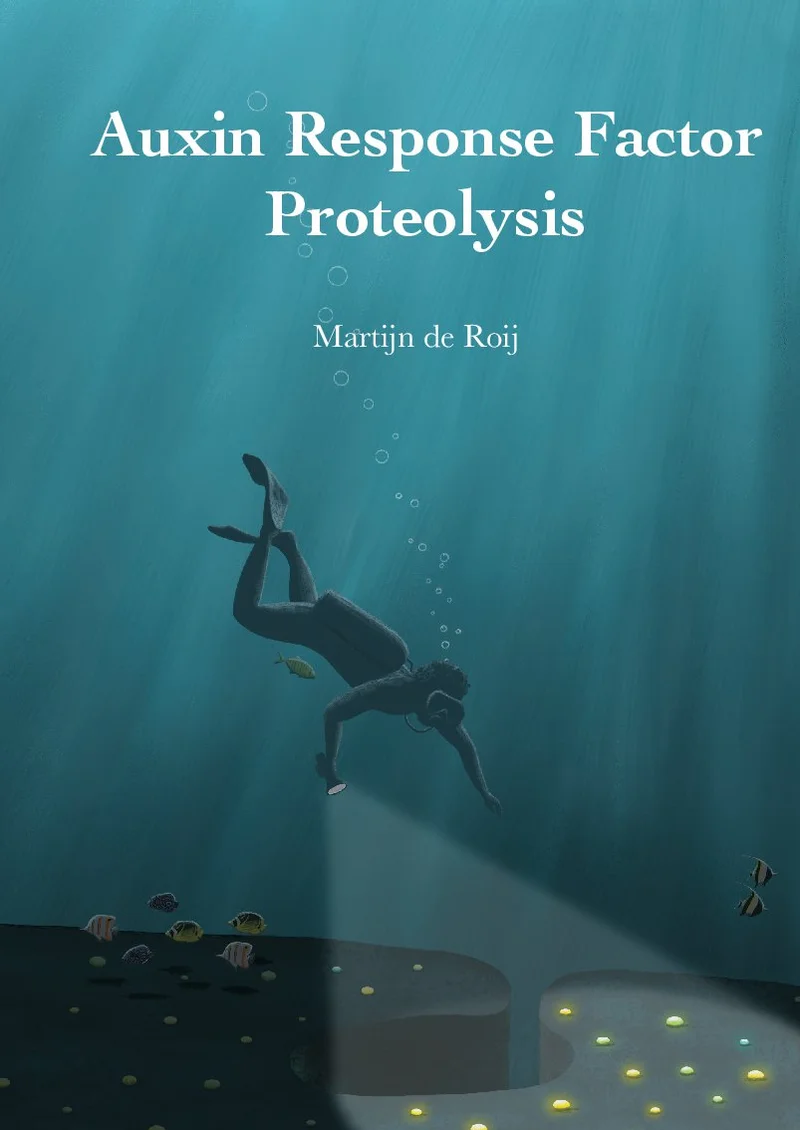


Auxin Response Factor Proteolysis
The transition from life in water to land represents one of the most profound evolutionary events in Earth’s history. Around 600 million years ago, ancestors of present-day land plants colonized terrestrial habitats that were initially hostile and largely uninhabitable. Successful colonization of these environments required these early plants to evolve novel developmental mechanisms to cope with unprecedented environmental stressors. Meeting these challenges necessitated an increasingly complex multicellular body plan, which in turn required the development of sophisticated regulatory networks capable of coordinating growth, cellular patterning and responses to environmental cues. Central to the regulation of plant development is the signaling molecule auxin, a phytohormone that governs a wide array of processes, including embryogenesis, organ formation, regeneration, and environmental adaptation. Auxin acts as a positional signal, guiding tissue patterning, cellular identity, and the timing of developmental events. Despite being a chemically simple molecule, auxin coordinates a vast diversity of developmental responses throughout the plant lifecycle. Understanding how auxin orchestrates these complex processes remains a central question in plant biology. Auxin signaling in land plants is primarily mediated through the Nuclear Auxin Pathway (NAP), a transcriptional molecular system that translates changes in intracellular auxin concentrations into specific changes in gene expression. Core components of the NAP are the AUXIN RESPONSE FACTOR (ARF) transcription factors, which bind to DNA elements and regulate the transcription of auxin-responsive genes. Their activity is modulated by Aux/IAA inhibitor proteins, which repress ARF activity in the absence of auxin. When auxin levels increase, auxin promotes the interaction between Aux/IAA proteins and the TIR1/AFB receptor complex, leading to Aux/IAA degradation through the 26S proteasome. Removal of these inhibitory proteins relieves the repression on ARF transcription factors, enabling transcriptional activation of auxin-responsive gene expression. While this canonical model provides a robust framework for understanding auxin signaling, it largely views ARF transcription factors as static components of the NAP, whose abundance is primarily determined by gene expression. However, emerging evidence, much of which is presented in this thesis, suggests that ARF proteins themselves are subject to regulated degradation through the 26S proteasome. How this degradation is regulated, its biological functions, and its evolutionary origins remain largely unexplored. In this thesis, I investigate the mechanisms, functions, and evolutionary history of ARF degradation. To address these questions, I exploit the liverwort model Marchantia polymorpha, which possesses a minimal yet complete auxin signaling network. Using a combination of genetic, biochemical, and evolutionary approaches, I demonstrate that proteasome-mediated degradation of ARF transcription factors is an essential regulatory mechanism shaping auxin responses. In Chapter 1 I introduce the signaling molecule auxin, its role in plant development, and the current understanding of the auxin signaling machinery. I conclude the chapter with an overview of the thesis and the specific research questions addressed in subsequent chapters. Chapter 2 provides a conceptual and historical framework for the thesis. It reviews the discovery of auxin and the chronological unraveling of the Nuclear Auxin Pathway model, with a focus on the role of the ubiquitin-proteasome system in auxin signaling. Furthermore, it discusses emerging evidence for ARF degradation and defines the key questions in the field. In Chapter 3 we develop experimental tools to study auxin signaling dynamics in vivo. By generating fluorescent genomic knockin lines in Marchantia, we visualize auxin signaling components from their native loci. This work reveals dynamic accumulation patterns of ARF proteins and demonstrates that proteasome-mediated degradation can rapidly alter ARF protein stoichiometry during development. These findings raise new questions about the mechanisms regulating ARF degradation, which I address in the following chapters. In Chapter 4 I investigate the molecular basis of ARF degradation. Through sequence analysis, we identify a conserved motif in the ARF DNA-binding domain that serves as a degradation signal. Functional assays demonstrate that this motif is necessary for ARF degradation and show that similar mechanisms are present across diverse plant species. Furthermore, I show that perturbing this signal leads to ARF stabilization, with severe developmental consequences. In Chapter 5 I explore the developmental consequences of perturbing ARF stability in greater detail. Through the generation of inducible stabilized ARF variants, mutant complementation assays, and a thorough analysis of concomitant mutant phenotypes, this chapter demonstrates that regulated ARF degradation is essential for normal development and is required throughout almost all Marchantia life stages. Additionally, the results presented in this chapter reveal functional differences between A- and B-class ARFs in their reliance on proteolytic regulation. In Chapter 6 and Chapter 7 I aim to identify components which regulate ARF degradation, using different, complementary strategies. In Chapter 6, I report on a forward genetic screen in the moss Physcomitrium patens to identify regulators of ARF degradation. I isolate mutants in which ARF stability is increased, and mapping the putative causative mutations lead to the identification of a set of candidate genetic components. Follow up experiments revealed that it is unlikely that any of these candidates are direct regulators of ARF degradation. Chapter 7 employs TurboID-based proximity labeling to identify proteins associated with unstable ARFs. This approach led to a selection of candidate interaction partners that may participate in ARF degradation complexes. These partners proved refractory to mutagenesis, preventing functional assessment at present. We provide alternative strategies to test their involvement in ARF degradation. In Chapter 8 I integrate the findings of the thesis, speculate on their biological roles, and discuss their broader implications for auxin biology, plant development, and evolutionary biology. The chapter highlights unresolved questions and outlines future research directions aimed at identifying the molecular machinery responsible for ARF proteolysis. The work I presented in this thesis establishes proteasome-mediated degradation of ARF transcription factors as a central regulatory mechanism in auxin signaling and plant development, with deep evolutionary roots.
| Publicatiedatum | 2 september 2026 |
| Universiteit | Wageningen University |
| Auteur | Martijn de Roij |
| Order nummer | 19248 |
| ISBN nummer | 978-94-6534-524-6 |