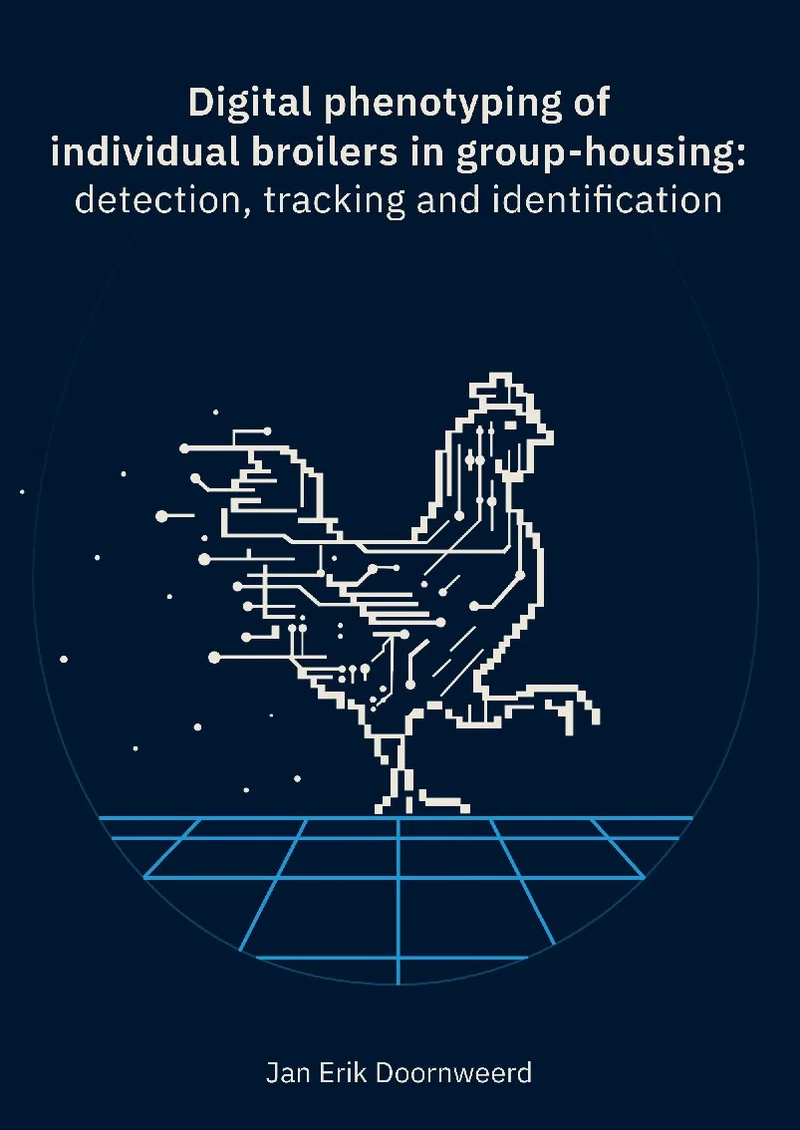
Jan Erik Doornweerd
Digital phenotyping of individual broilers in group-housing
4 september 2026
Wageningen University
Open Ebook
Share this project
Summary
Worldwide 2.5 billion people lack access to sanitation. This impacts public health, environment, welfare, and moreover results in a loss of resources. Conventional sanitation systems consume energy, chemicals, land and produce sludge that requires disposal, whereas a range of opportunities exists that enables valorization of resources from our “waste”, such as energy, phosphorus, compost, plastic and paper. Resource recovery may become a driver for economic growth and respond to profound changes of the world’s population impacting food security and availability of finite natural resources.
The backlog in sanitation development can partly be attributed to the absence of a functional sanitation planning framework that allows for integration of cross-sectoral elements, such as health, technical, environmental, financial, institutional, demand for sanitation by-products, and welfare aspects. To evaluate a set of alternative sanitation systems, policy makers require a framework for resolving trade-offs, costs and benefits across spatial and temporal scales, and sustainability dimensions (social, environmental and economic).
In Chapter 2 we demonstrated that the integration and material cycle closing of water, waste and energy in a Chinese residential area development (Qinglong district in Changzhou) will become beneficial to the establishment of the envisaged green city. Four different scenarios focusing on water, nutrient and energy recovery were compared with the baseline wastewater management practice. Besides environmental benefits, the economic benefits of the resource recovery oriented sanitation concepts were shown. The financial break-even point with the baseline scenario was already after 5 years, provided that recovered resources can be sold for a marketable price. The presented concepts were considered to be applicable for a wide range of new urban developments in China and similar rapidly developing densely populated regions worldwide.
Despite the potential benefits of resource recovery oriented sanitation concepts, developing countries often do not consider alternative sanitation systems or integrate identified cross-sectoral elements to select a sanitation system. Rather, policies promote the introduction of a single type of system only. In Indonesia, for instance, decentralized (communal) wastewater treatment systems (DEWATS) are promoted as the core of the sanitation improvement. Under the Indonesian “Accelerated Sanitation Development for Human Settlements Program” thousands of new DEWATS are planned for construction in the coming five years. In Chapter 3 we therefore evaluated the technical and financial-economic aspects and users’ involvement of three different DEWATS: (1) Settler + Anaerobic Baffled Reactor (ABR) + Anaerobic Filter (AF), (2) Digester + Settler+ ABR + AF, and (3) Settler, equalization, activated sludge, clarifier and filtration. The evaluation showed that all three systems complied with the current regulations. Further, a clear reduction in specific investment costs per household was found with an increasing number of households per system. This shows the potential of scaling up community based systems (typically 100 households per system) to medium centralized off-site systems (typically 500-5,000 households per system). Only regular operational costs (e.g. wage of the operator) were recovered from fees collected by the community, whereas costs for desludging, major repairs and capital and replacement costs were not. Surveys with users showed different levels of involvement of local men and women in the planning stages of the project. The study recommended that application of DEWATS should be evaluated in the context of a (city wide) sanitation strategy.
In spite of existing sanitation system selection criteria and the demonstrated link between residential features and occurrence of health and environmental issues in the absence of sanitation, an integrated sanitation systems analysis for different residential conditions is lacking. To develop a sanitation planning framework, first a technical and financial feasibility analysis of wastewater and solid waste systems for application in Indonesia was prepared. Chapter 4 describes the selection of on-site, community-based and ten off-site wastewater systems as well as conventional, centralized and decentralized 3R (Reduce Reuse Recycle) solid waste systems. COD, BOD, nitrogen, phosphorus and pathogen removal efficiencies, energy requirements, sludge production, land use and resource recovery potential (phosphorus, energy, duckweed, compost, water) of wastewater treatment systems were determined. Solid waste systems were analyzed according to land requirement, compost and energy production and recovery of plastic and paper. In the financial analysis, investments, operational costs and benefits and Total Lifecycle Costs of all investigated options were compared. Technical performance and TLC were used to guide system selection for implementation in different residential settings. The effect of price variations of recoverable resources and land prices on total lifecycle costs was determined in an analysis. A 10-fold increase in land prices for land intensive wastewater systems resulted in a 5 times higher TLC, whereas a 4-fold increase of the recovered resource market price resulted in maximum 1.3 times lower TLC. For solid waste, these impacts were reversed – land price and resource selling price variations resulted in a maximum difference in TLC of 1.8 and 4 respectively. Technical and financial performance analysis can therefore support decision makers in system selection and anticipate the impact of price variations on long-term operation.
To translate government policy in sanitation implementation strategy, the outcomes of the performed feasibility analysis was incorporated in a sanitation planning framework. Available sanitation planning frameworks were not found applicable, since these did not include (1) all population groups, (2) both wastewater and solid waste treatment and resource recovery systems, (3) readily available selection criteria, (4) integration with land use planning activities, and (5) identification and budget allocation of implementing institutions. Therefore, in Chapter 5 a comprehensive framework was developed that directly links a government policy to a nationwide long-term planning and budgeting for wastewater and solid waste interventions. The framework requires input from different stakeholders, such as government planners and experts to formulate starting points and targets. Based on a limited number of indicators to enable the sanitation system selection (population density, urban functions), three outputs are generated. The first output is a selection and visualization of the spatial distribution of wastewater and solid waste systems. The second output generates the total number of people served, budget requirements and distribution of systems. Thirdly, the required budget is allocated to the responsible institution to assure effective implementation. The determined budgets are specified by their beneficiaries, distinguishing urban, rural, poor and non-poor households. The framework was applied for Indonesia and outputs were adopted in the National Development Plan. A more than fivefold increase of the national contribution as compared to the current budget allocation is needed for Indonesia. The budget for campaigning, advocacy and institutional strengthening to enable implementation was determined to be 10% of the total budget.
The initial objective of the developed sanitation planning framework is to accelerate access to sanitation. Therefore, it primarily focuses on the beneficiaries (or “front-end” users) of sanitation facilities. However, to foster long-term operational and financial sustainability, also the needs of potential “back-end” user of sanitation products should be considered. Back-end users comprise among others agriculture, horticulture, aquaculture and plastic and paper processing industries. Despite the availability of methods to analyze material flows and demand forecast, a comprehensive framework that includes recoverable resources from both wastewater and solid waste and that allows for a nationwide temporal and spatial demand forecast is lacking. Therefore, in Chapter 6 the future potential demand of recoverable resources based on past consumption trends and future forecast for a selected number of recoverable resources is described. Phosphorus and compost demand analysis was based on (1) fertilizer requirements of 68 staple foods, horticulture and plantation crops and (2) anticipated increase in production area of these crops. Duckweed demand as a protein-rich fish feed was analyzed based on the forecasted demand from tilapia and carp aquaculture. The potentially recoverable (waste) plastic and paper to substitute conventional manufactured products were based on extrapolation of past trends in plastic and paper production in Indonesia. The potential contribution of recoverable products to the forecasted demand for 2035 was assessed for phosphorus (15%), compost (35%), duckweed (7%), plastic (66%) and paper (18%). A geographical discrepancy between potential recovery and demand location for phosphorus and compost was determined. Therefore, the locations of potential markets should be considered in the planning and selection of wastewater and solid waste facilities.
Following the developed sanitation system selection criteria, planning framework, and resource demand analysis, Chapter 7 describes a methodology to support a policy maker in formulating a cost- and environmentally effective sanitation strategy. This required an analysis of (i) sources of pollution, (ii) mitigating measures and resource recovery potentials and their effect on health and water quality, and (iii) benefits and costs of interventions. The impact of different sanitation interventions on (1) water quality improvement, (2) resource recovery potential, and (3) monetized benefits to costs ratio were quantified. The Benefit Cost Ratio (BCR) compared monetized benefits (health, access time, improved water sources & environment, land values and sale of recovered resources) to required costs of interventions (CAPEX and OPEX). The integration of technical, hydrological, agronomical and socio-economic elements to derive these three tangible outputs in a joint approach is a novelty. The applicability and added value of this approach was demonstrated using the heavily polluted Indonesian Upper Citarum River in the metropolitan Bandung – Jakarta region. Domestic interventions, applying simple (anaerobic filter) technologies were economically most attractive with a benefit cost ratio (BCR) of 3.2, but could not reach target water quality. To approach the desired water quality, both advanced domestic (nutrient removal systems) and industrial wastewater treatment interventions were required, leading to a BCR of 2. Benefits from selling recovered resources from solid waste and wastewater represent here an additional driver for improving water quality and outweigh the additional costs for resource recovery facilities. It was thus shown that water quality interventions justify their costs and are socially and economically beneficial.
In the discussion Chapter 8, the Sanitation National Planning framework (SaNaP) is presented. The potential of the SaNaP to evaluate system costs, pollution loads, production and consumption parameters and potential resource demand and supply for a set of alternative sanitation systems is illustrated using Indonesia as an example. The introduction of resource recovery concepts in the Indonesian sanitation sector development can contribute considerably to a circular economy. For Java that accounts for nearly 60% of the Indonesian population, one third of the compost and phosphorus demand can be satisfied through recovered resources. Resource recovery is shown to be a potential driver to accelerate sanitation development. Several possibilities are identified to enhance the functioning of SaNaP, such as extension of the number of (1) included technologies, (2) system selection criteria, (3) environmental indicators, (4) monetized benefits, (5) specific market demands, (6) recoverable resources, and (7) visualized geographical related output. The here presented framework was developed for the Indonesian government, but the application of this framework may benefit the quality of life of millions of people in other rapidly developing countries.