Linda Remijn Nelissen
Symptomatic treatment of myasthenia gravis
3 september 2026
Universiteit Leiden
Open Ebook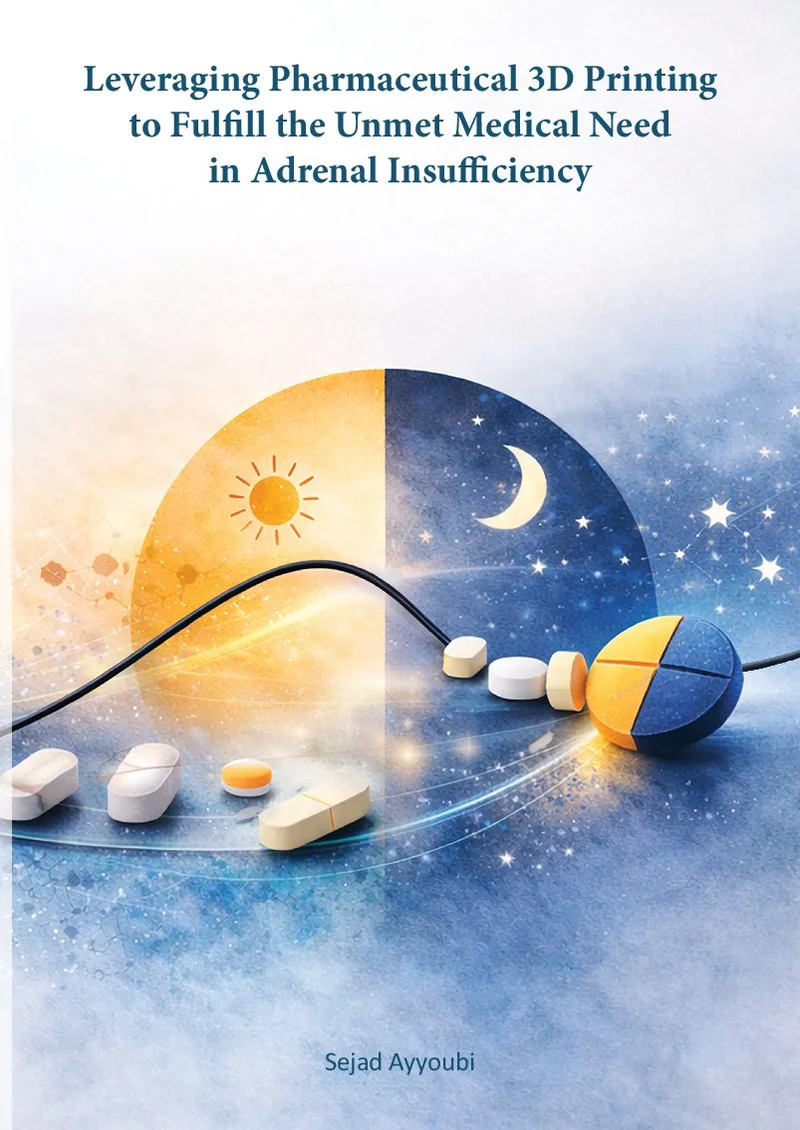
Share this project
Summary
There is a lack of suitable hydrocortisone formulations for patients with primary adrenal insufficiency. It is a rare disease, also known as Addison’s Disease, with a prevalence of 1-2 patients per 10,000 people. The cornerstone of the treatment consists of glucocorticoid and mineralocorticoid replacement therapy, usually in the form of oral hydrocortisone and fludrocortisone. Long term glucocorticoid replacement therapy consists of three times daily hydrocortisone treatment with 10 mg immediately on waking, 5 mg at midday, and 5 mg in the early evening.
The current three times daily treatment with hydrocortisone does not mimic the physiological circadian plasma cortisol in patients. In normal physiology, cortisol is highest in the morning and gradually decreases throughout the waking day. However, the current standard of care consists of multiple daily dosing, leading to fluctuating plasma cortisol concentrations. This leads to an increased risk of developing co-morbidities and mortality. Modified release hydrocortisone products have been marketed but are only available in fixed dosages. The degree of cortisol deficiency is subject to interindividual variation related to differences in genetic and environmental influences. There is therefore a need for a hydrocortisone formulation that better mimics the gradual physiological cortisol plasma-concentrations, with the ability of flexible dose adjustment.
We hypothesize in this thesis that using pharmaceutical 3D printing, a sustained release hydrocortisone formulation can be developed which mimics the physiological situation better. We tested this hypothesis by studying different 3D printing techniques, quality of printed tablets and the cost of manufacturing.
Pharmaceutical 3D printing is a relatively new technology for medicine manufacturing. The most researched 3D printing methods are extrusion-based methods such as semi-solid extrusion (SSE). SSE printed products have already entered clinical trials and commercial, pharmaceutical grade SSE printers are already marketed, making this technology one of the most mature ones. The production process involved the pre-mixing of raw pharmaceutical materials, where in some cases heat is applied, to form a semi-solid material.
The semi-solid material is subsequently loaded into a syringe, forming the pharmaceutical ink. A predefined design is generated with 3D printing software which contains the movement instructions of the printer. The design and the ink are fed to the printer which then prints the material in a layer-by-layer manner, forming the final product. Heat is applied during printing to ensure material flow through the printer nozzle. The deposited material hardens due to exposure to room temperature after printing, which ensures the mechanical integrity of the final product. Research in recent years has demonstrated that this technique allows the pharmacist to adjust the drug dosage, release profile, shape, and taste of pharmaceutical products. These properties make pharmaceutical 3D printing especially suitable as an extemporaneous pharmacy compounding method. Extemporaneous compounding is defined as the practice of preparing medicinal products for an individual patient when there is no commercial alternative available. Pharmacists in the Netherlands are allowed by law to manufacture medicinal products for their owns patients when suitable commercial alternatives are lacking.
In Chapter 2, fused-deposition modeling (FDM) 3D printing was explored as a 3D printing technique to develop sustained release formulations, using nifedipine as a model drug. Two factors had the highest influence on drug release, the excipients and the design. Pores were designed into the pellets to increase the surface area, which led to a faster drug release. Furthermore, this research demonstrated that by balancing water-soluble and water-insoluble excipients, the drug release can be fine-tuned. More water-soluble excipients led to faster release rates, while the opposite was observed with more water insoluble excipients. However, nifedipine was used as a study drug with no clinical value.
To show true clinical value, a shift was made to 3D print personalized sustained release hydrocortisone for patients with adrenal insufficiency. There is a lack of formulations that mimic the gradual physiological cortisol release in patients with adrenal insufficiency, where the drug dose can be personalized. Chapter 3 describes an FDM 3D printed hydrocortisone formulation that releases 10 mg hydrocortisone over 24 h. Content uniformity and drug release were compliant to the European Pharmacopeia guidelines. Tablet size and drug dose were highly correlated, which could be used for easy dose personalization. However, the high processing temperatures of > 100 °C led to impurities in the final product.
Although the potential of pharmaceutical 3D printing has been demonstrated by researchers worldwide, no formal costing analysis studies have been published. In Chapter 4, an initial effort is presented to elucidate the manufacturing costs of pharmaceutical 3D printing. A micro-costing study was performed in a hospital pharmacy setting. Costs related to facility, personnel, materials, and equipment were considered. An open-access costing framework was developed to calculate the cost of one 3D printed tablet. The framework was applied to the sustained release hydrocortisone formulation presented in chapter 3, resulting in costs of €1.97- 3.11 (best-case-worst-case) per tablet. It was previously unknown whether it would cost tens of euros or a few eurocents to manufacture a 3D printed tablet. Identifying the manufacturing costs of a 3D printed formulation in a hospital pharmacy setting can aid in the implementation of this technology in hospital pharmacy and further health technology assessment.
Clinical translation of the personalized hydrocortisone formulation was still lacking due to the impurities caused by high printing temperatures shown in Chapter 3. A shift to semi-solid extrusion (SSE) 3D printing was made. Prior to developing the SSE hydrocortisone sustained release formulation, we first screened 27 excipients that are suitable for this printing technique. In Chapter 5, we found that a combination of lactose with poly ethylene glycol 4000, or poloxamer 407 had good printing properties at processing temperatures of < 80 °C. Furthermore, we found that these excipients are also suitable for pediatrics, based on the STEP database. This knowledge was used to develop the sustained release hydrocortisone formulations for patients with adrenal insufficiency. In Chapter 6, personalized immediate release and a sustained release hydrocortisone formulations are presented with processing temperatures of < 100 °C. It was possible to accurately print tablets ranging from 0.5 to 10.0 mg hydrocortisone. The quality of the 3D printed products was higher compared to conventional pharmacy compounded methods, demonstrated by low acceptance values. 3D printed tablets were compared to split and solubilized commercial tablets and pharmacy compounded capsules ordered from three independent pharmacies in the Netherlands. Furthermore, the costing framework in Chapter 4 was applied to the SSE tablets, resulting in costs of <€ 3.00 per tablet for both release profiles. No impurities were observed. However, a stability-indicating analysis method was not used. Compendial testing of these formulations while using a stability indicating analysis method is now the only barrier to clinical implementation of personalized, 3D printed hydrocortisone for patients with adrenal insufficiency. There are, however, some challenges for broader implementation of pharmaceutical 3D printing as an extemporaneous compounding method. Validation of manufacturing processes and analytical methods may not be feasible in most pharmacies due to the lack of dedicated manufacturing and quality control facilities, qualified personnel, and financial purposes. Pragmatic guidelines are needed to facilitate pharmacists to manufacture 3D printed medicines. The Royal Dutch Pharmacy Association (In Dutch: Koninklijke Nederlandse Maatschappij ter bevordering der Pharmacie; KNMP) has guidelines for extemporaneous compounding of formulations, ranging from suppositories to tablets. The guidelines address the complete manufacturing of final products, from starting materials to shelf-life of the final product, detailed production parameters, and batch-release criteria. This relieves the pharmacist from stability testing and validation of processing temperature ranges. Similar pragmatic guidelines should be drafted to ensure widespread adoption of pharmaceutical 3D printing for the benefit of the patient. Currently, pharmacists produce pharmaceutical inks as well as the final products themselves. This limits however broader implementation and access to personalized pharmaceuticals to patients as not all pharmacies are equipped with the facility and qualified personnel for ink production and 3D printing. Chapter 4 proposes an organization that manufactures dedicated pharmaceutical inks. In this scenario, pharmacists can purchase pre/filled syringes and solely focus on printing a personalized drug for the individual patient. Focusing only on the printing part lowers the threshold for implementation. Furthermore, higher temperatures are used in 3D printing compared to conventional pharmacy compounding techniques. High processing temperatures can lead to thermal degradation and impurity formation when applied to an active pharmaceutical ingredient (API). As most conventional manufacturing techniques do not apply heat, there is little information available on the thermal stability of API’s. An open access platform where thermal stability data is shared would also greatly aid in the broader implementation of pharmaceutical 3D printing. Finally, in order to ensure broad implementation of 3D printed pharmaceuticals, financial agreements should be made with healthcare insurers. Cost-effectiveness studies would aid in these discussions. More research is needed to demonstrate the cost-effectiveness of 3D printed tablets with a focus on sick days, disease control, mortality, morbidities, quality of life, ability to work, hospital or general practitioner visits, and other relevant parameters. The work presented in this thesis is focused on adrenal insufficiency, however, 3D printing can also be used for other populations with an unmet need such as in pediatrics. 45 % to 60 % of all pediatric drug administrations in the European Union are unlicensed or off label due to the lack of suitable formulations. Furthermore, the pediatric population is defined by a high heterogeneity regarding pharmacotherapy. Physiological properties that may determine the drug dose, e.g. body surface area, body weight, and organ maturation are highly variable in children in comparison to adults. 3D printing could be used to manufacture non-commercially available dosages of specific medicines. Relevant patient characteristics, used to determine the optimal pharmacological treatment, change over time. Ideally, this is monitored, and the pharmacological treatment is adapted continuously over time to ensure the best treatment for the patient. For adrenal insufficiency, the first steps have been taken in the monitoring of plasma cortisol by a smartwatch. We foresee a future where the pharmacist can periodically monitor real-time individual health-related patient data, generated by similar smart technologies, and when necessary, can 3D print a personalized therapy for the individual patient.