Maurice Evers
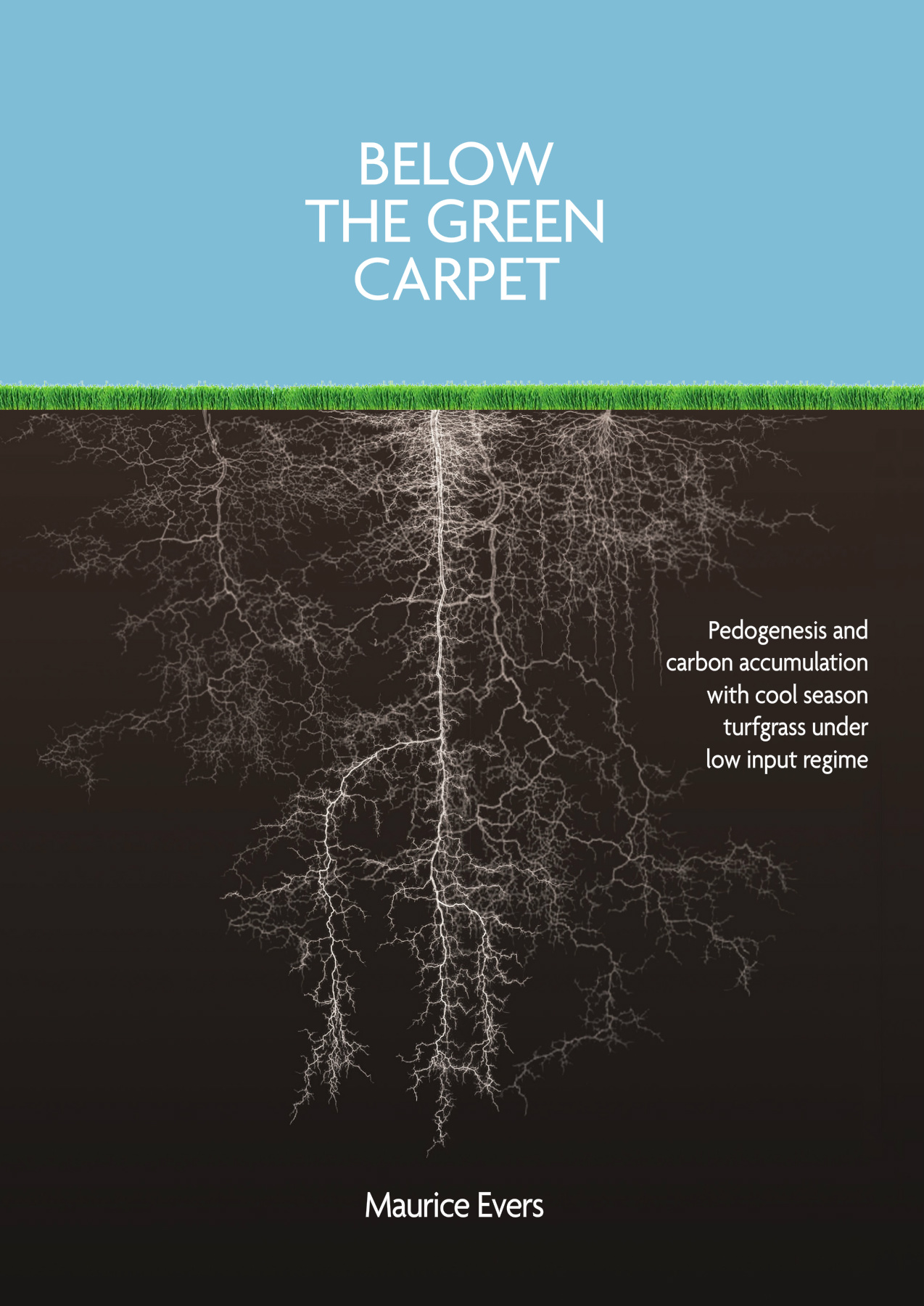


Below the green carpet
Introduction Grasses are the most important agricultural plants in the world. In addition to providing a wide variety of food, they help stabilize various semi-natural and cultivated environments, and provide the species used as turf in lawns, parks, sports fields and golf courses, and ornamental grasses for horticultural use. Grasses for the use as turf are called turfgrasses. Turfgrasses play their role in the mitigation of climate change effects. They contribute to carbon (C) sequestration in turfgrass soils and reduce effects of heat stress and promote the infiltration of precipitation to deeper soil layers in urban areas. In turfgrass use and management, C accumulation at a moderate level provides positive effects such as resilience, cushioning, wear tolerance, insulation from environmental extremes, and buffer capacity for water and nutrients. However, when C accumulation in turfgrass soils becomes excessive, disadvantages such as decreased water infiltration into and distribution through the soil, easily result in (1) lower tolerance of turfgrass to climate extremes, caused by a shallower root system and reduced biomass development, and (2) more problems with diseases and insects. Ultimately, this may result in lower turfgrass quality with reduced playability characteristics. Many turfgrass maintenance actions are intended to control excessive C accumulation in the upper centimeters of a turfgrass soil. This maintenance requires high inputs of labor, specific machines and equipment, water, sand, and the use of pesticides. With an increasing impact of climate change and more strict regulations to ban the use of chemical pest control and minimize the use of water, the turfgrass sector is facing major challenges these days. In the perspective of a more ecological and durable approach of turfgrass maintenance, high inputs are no longer accepted, and the choice of turfgrass (sub)species and their varieties with relatively low C accumulation in the topsoil becomes increasingly important in maintenance practices. Detailed information on the amount of C accumulation with different turfgrass (sub)species and varieties under low input maintenance is lacking today. This thesis aims to increase the understanding of C accumulation in different distinctive soil layers in a turfgrass soil, related to the quantity and quality of plant biomass formation by a broad spectrum of turfgrass (sub)species and varieties. Such new information can assist the turfgrass sector in making choices for turfgrass (sub)species and varieties to develop a more sustainable turfgrass system, with regard to C accumulation with a minimum of excessive C in the soil. Thatch – mat – soil distinction Organic matter accumulation from plant biomass development in a turfgrass system results in the appearance of several distinctive layers: canopy, thatch, mat and soil, respectively. Discerning thatch and mat in turfgrass soils is important in research into organic matter development, and, therefore, in choosing the correct turfgrass maintenance actions to keep turfgrass healthy and to optimize playability. In turfgrass practice, a layer with a major amount of visible organic matter (VOM) in the upper part of turfgrass soils is referred to as “thatch”. “Mat” is a tightly intermingled layer of decomposing organic matter and soil, directly below the thatch layer or replacing the thatch layer. In practice, thatch is detrimental for turfgrass health and playability, where mat is desirable when mat thickness and the amount of organic matter in mat is not too much. However, determining boundaries of thatch and mat in practice is often experienced as difficult because of inherent ambiguity in terminology and diagnostic techniques. In this thesis I describe a practical method for the distinction of thatch, mat and soil layers, being a combination of visually and manually observable characteristics, according to the internationally accepted classical soil horizon classification system and observable mineral and plant biomass structures. In chapter 2, for two widely different turfgrass species, I analyzed total organic matter (TOM) and dry bulk density (ρd) in thin slices of 6 mm (between 0 and 10 cm soil depth), resulting in clear patterns for both soil properties with increasing depth. Statistical analysis of TOM patterns resulted in similar boundary depths between calculated and observed layers, validating our practical method for the distinction of thatch, mat and soil layers as a reliable method. Furthermore, I characterized thatch, mat and soil layers by different TOM fractions, referred to as visible organic matter (VOM), containing non-decomposed plant derived biomass, decomposed organic matter (DOM) and native soil organic matter (SOM). In regular soil organic matter analyses, it is customary to exclude VOM structures, i.e. particles bigger than 2 mm. Here, I reintroduced VOM as an important TOM fraction for layer distinction in turfgrass soils. Thatch contained VOM, in this thesis defined as the fraction > 600 µm, as the main TOM fraction, with an additional substantial amount of DOM. In contrast to thatch, mat contained DOM as the main TOM fraction with a substantial VOM fraction. SOM was the main TOM fraction in a deeper soil layer. Total organic matter (TOM) content in soil layers depended on turfgrass species, while the distribution of TOM fractions in thatch, mat and soil was independent from turfgrass species. I therefore concluded that VOM is an important TOM fraction to consider, together with TOM, regarding differences in excessive C accumulation in turfgrass soils among turfgrass (sub)species. C accumulation in distinctive soil layers with monocultures of cool season turfgrasses In chapter 3 and 4, I compared the amount of C accumulation of plant derived biomass in a turfgrass soil in monocultures of cool season turfgrass species within the first three years of establishment, in field studies at three different locations in the Netherlands. The thickness of thatch, mat and soil layers was quantified, and plant derived biomass in these layers analyzed for dry matter, C and N concentrations, and CN ratio. When thatch and mat layer thickness were measured together, I found no differences in soil layers between monocultures of (sub)species of turfgrasses, confirming the results of other studies. However, when layers were separated, Festuca rubra spp. and Poa pratensis had significantly thicker thatch layers, together with a significantly thinner mat layer than other (sub)species, such as Lolium perenne, which rather showed the opposite pattern. These results suggested a significantly negative correlation between thatch thickness and mat thickness for all turfgrass (sub)species. Another set of measurements on the nursery of a Dutch golf course confirmed, under practical circumstances, that thatch thickness significantly differed between (sub)species and even between varieties within most (sub)species. Thicker thatch layers correlated with thinner mat layers. These results are highly relevant for the choice of turfgrass (sub)species and varieties creating the thinnest thatch layer combined with some mat thickness. In thatch, C accumulation via plant derived biomass was positively correlated to thatch thickness and its C concentration from visible plant biomass. In mat and deeper soil layers, however, no correlation between C accumulation and layer thickness or C concentration was apparent. As a result of significant differences in C accumulation in thatch, C accumulation in the top 20 cm soil profile did show major variation between (sub)species in a sequence of Festuca rubra subspecies > Festuca ovina > Agrostis stolonifera, Festuca arundinacea, Poa pratensis > Lolium perenne. Within subspecies of Festuca rubra and within Agrostis, I found significant differences in C accumulation and even between varieties of Agrostis canina, again mainly related to significant differences in C accumulation in thatch. This underlines the importance of layer distinction when studying C dynamics in turfgrass soils. I conclude that the thatch layer is the most important layer in C accumulation, affecting turfgrass sod quality the strongest, and may not be excluded from a turfgrass soil in turfgrass science, like it is often done today. For turfgrass management, layer distinction is also important for choosing the right maintenance actions to control excessive C accumulation, because optimal maintenance actions are different for thatch and mat. I hypothesized that underlying causes for differences in C accumulation in soil layers between turfgrass (sub)species and varieties were related to (1) differences in plant growth rate, resulting in varying visible organic matter (VOM) productivity and allocation pattern of plant biomass, and (2) differences in nitrogen use efficiency (NUE_N), being the product of the mean residence time (MRT) of plant biomass constituents and the nitrogen productivity (A_n), resulting in quality differences of plant biomass, which are expressed in the CN ratio. In chapter 4, I concluded that amongst Festuca rubra subspecies, the increase in VOM in the thatch layer positively correlated to growth rate and led to a decrease in plant biomass in mat and deeper soil layers. Among Agrostis species, I found a negative correlation between growth rate and allocation of VOM to the distinctive soil layers, possibly caused by a difference in plant density. The CN ratio of VOM in all soil layers positively correlated to growth rate, both for Festuca rubra subspecies and Agrostis species, with an increase of CN ratio from thatch to the deepest soil layer. However, given a strong collinearity between visible plant biomass and its CN ratio, VOM was the only factor that substantially explained the variation of C accumulation among subspecies and species. C accumulation in distinctive soil layers with mixtures of cool season turfgrasses Turfgrass sods usually consist of several (sub)species of grasses and different varieties for optimal sod quality. After a 3-yr period of turfgrass establishment in a field study in the Netherlands, I concluded that, opposite to a relatively constant thatch-mat layer thickness among monocultures of different species and subspecies, mixtures of turfgrass (sub)species seemed to vary more in thatch and mat thickness, as well in the total thickness of both layers combined, than did monocultures. In a 4-yr pot experiment, in which I measured thatch and mat thickness in monocultures of different Festuca rubra subspecies and in three different mixtures of these subspecies under low input management. Given the possible synergistic effects between subspecies and their varieties on plant biomass production, I expected to find differences between actual measured thatch thickness and VOM concentration in thatch with mixtures, with values that could be calculated from their respective monocultures and their relative abundance. In thatch thickness I found hardly any differences. However, over time, the measured and expected VOM concentration in the thatch layer of subspecies mixtures, and along with this C accumulation, seemed to start to differ, but only during the first 2 years of establishment and with a different outcome. Some mixtures resulted in a lower accumulation of VOM where others resulted in a higher accumulation. More research is needed with various compositions of subspecies mixtures to understand the differences between mixtures and to apply these insights in turfgrass management. C accumulation under low input maintenance with Festuca rubra subspecies Fine fescues (Festuca rubra subspecies) are more commonly recommended in sustainable golf course maintenance because of their tolerance to low maintenance, high climate adaptiveness and low vulnerability to turfgrass diseases. Low maintenance, including very low N-input and non-disturbance, is suggested to support turfgrass playability via control of excessive plant biomass growth to overcome soil layering. In a 4-yr pot experiment, I analyzed the development of visible plant biomass in distinctive soil layers, thatch and mat, in response to low N fertilization levels and non-disturbance maintenance, in three monocultures of fine-leaved Festuca rubra subspecies. Over time, thatch became thicker and stabilized together with a decreasing and stabilizing mat thickness, showing pedogenesis resulting in a balance between C accumulation in thatch and mat. N-fertilizer level and subspecies did not or only marginally influence maximum thatch and mat thickness. However, the density of visible plant biomass (VOM) between distinctive soil layers showed clear differences. First, an increase in thatch and mat layers towards a maximum VOM concentration was apparent already after 1 to 2 years, which was different among Festuca rubra subspecies and independent from N-fertilizer input. Second, depending on subspecies and N-fertilizer, in deeper soil layers, either a continued increase in VOM concentration occurred with no maximum reached at the end of the experiment, or an increase in VOM concentration was found towards a maximum already after 1 to 2 years. I showed that under low maintenance, with moderate N-input and no disturbance, it is feasible to minimize both thatch thickness and visible plant biomass density in thatch, mat and deeper soil layers, together with a decreased risk on excessive thatch development. This can best be realized in the sequence of Festuca rubra rubra > Festuca rubra trichophylla > Festuca rubra commutata Main conclusion and considerations With the results of this thesis, I showed that it is possible to adjust today’s turfgrass maintenance into a more sustainable practice with low input and low disturbance. Excessive C accumulation in turfgrass soil may be prevented, by choosing the right turfgrass (sub)species and its varieties, either as monocultures or mixtures, applying a more optimal N fertilization, and by choosing the correct maintenance actions via the use of the new method for soil layer distinction. This involves using varieties with a low risk on excessive C accumulation in thatch formation. However, information about the risk on excessive thatch formation with commercial varieties per (sub)species is lacking in existing seed guides. These seed guides contain a long list of commercial varieties per (sub)species, with new varieties added every year. I suggest new research to develop a standardized practical method to determine the risk on excessive C accumulation in thatch and mat with existing and new commercial turfgrass varieties, and to list these in seed guides. I also propose new research with seed mixtures, selecting a combination of varieties with the lowest risk on excessive C accumulation in thatch and mat. A promising option might be to incorporate micro-clover, a refined clover with very small leaves, as a non-turfgrass species in a mixture. Micro-clover may assist in lowering N fertilization in turfgrass maintenance, while providing an acceptable quality of turfgrass. Furthermore, I suggest new research on visible plant biomass and CN ratio development in thatch and mat with different varieties of different turfgrass (sub)species during the growing season and at different low N input regimes. This will help to find optimal N fertilization levels for turfgrasses to control temporal high plant biomass concentrations in thatch and mat.
| Publicatiedatum | 11 maart 2025 |
| Universiteit | Radboud Universiteit |
| Auteur | Maurice Evers |
| ISBN nummer | 978-94-6510-436-2 |