Marieke Poppe
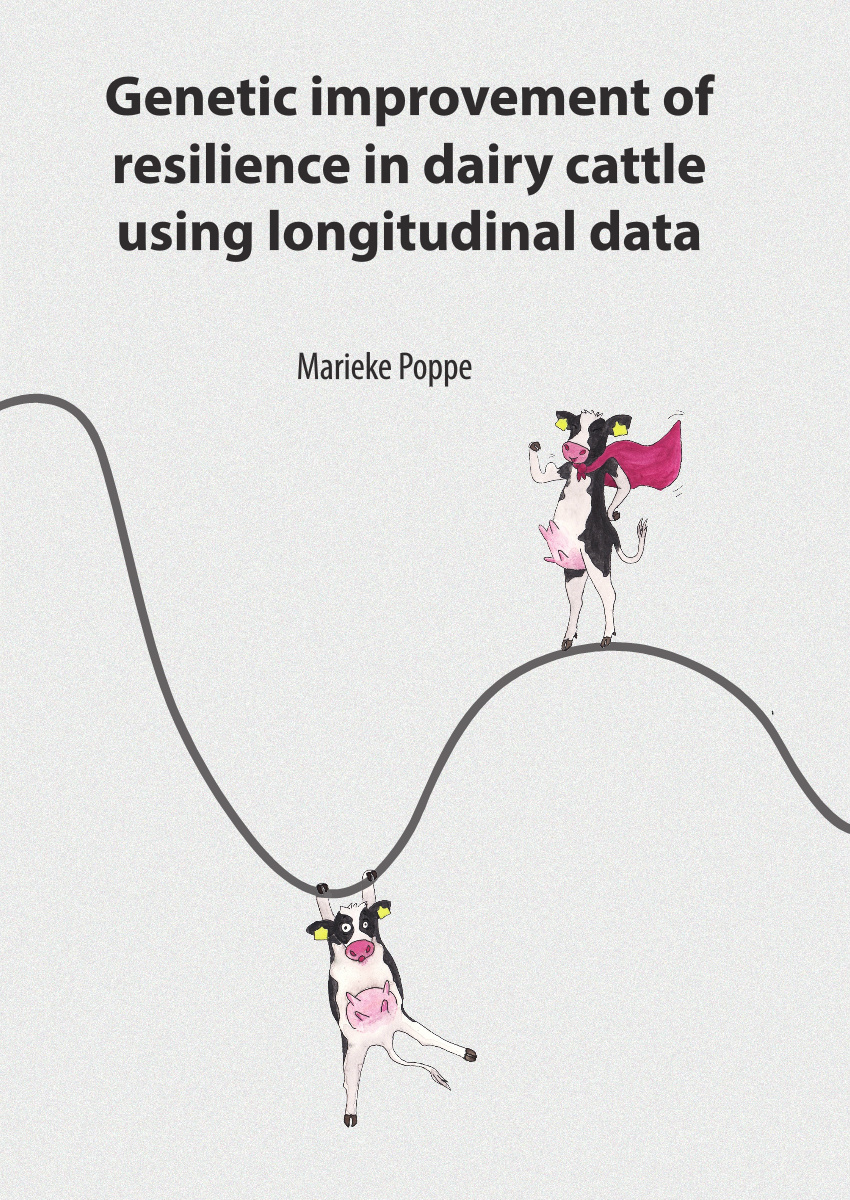


Genetic improvement of resilience in dairy cattle using longitudinal data
Resilience is the ability of a cow to be minimally affected by disturbances and if affected, to recover quickly. Improving resilience is important for animal welfare and for the benefit of the farmer wanting to work with trouble-free cows. I investigated new traits based on daily recorded milk yield and activity sensor data to indicate how resilient a cow is; resilience indicators. I investigated if these indicators can be used in genetic selection and what the economic relevance was and the usefulness at herd level. The resilience indicators were the variance, autocorrelation, and skewness of the deviations of daily milk yield and activity from the expected values. Resilient cows are expected to fluctuate closely around the expected milk yield, and therefore have low variance. They are also expected to have little dependency between subsequent deviations, and therefore have weak autocorrelation. They are also expected to have a symmetrical distribution of negative and positive deviations, and therefore have little skewness. Chapters 2, 3, and 4 focused on genetic analysis of the resilience indicators based on daily deviations from expected milk yield. These chapters showed that variance and autocorrelation were promising resilience indicators, while skewness was not suitable due to low heritability and unfavorable genetic correlations with health traits. Variance and autocorrelation were both heritable and had favorable genetic correlations with other resilience-related traits such as udder health and longevity. Moreover, variance had moderate to strong genetic correlations with magnitude of the production response to unidentified disturbances at herd level and to a heat wave. Autocorrelation had moderate to strong genetic correlations with recovery time from these disturbances. Variance and autocorrelation of daily deviations from expected milk yield thus covered different aspects of resilience. Chapter 5 contains a genetic analysis of potential resilience indicators as well, but based on deviations from expected step count instead of expected milk yield. The variance and autocorrelation of daily step deviations were studied, but also some additional traits, including activity level. Most of the studied resilience indicators were heritable, and especially the activity level had considerable heritability. The resilience indicators based on step count had genetic correlations with different health, fertility and longevity traits than the resilience indicators based on milk yield, which suggests that the indicators based on activity and milk yield indicated resilience to different types of disturbances. Chapter 6 showed that large differences existed between herds in the variance and autocorrelation of their cows, that cannot be explained by differences in genetics. This suggests an effect of management on resilience. Furthermore, herds with cows with high variance, also tended to be herds with high incidence of rumen acidosis, high somatic cell score, low survival to second lactation, and high production level. This suggests these herds were herds with many disturbances. For autocorrelation, the correlations with herd performance traits were more ambiguous. Chapter 7 showed the economic importance of variance and autocorrelation of daily milk yield deviations. Cows with low variance in lactation 1 had higher lifetime profit than cows with high variance, which was mainly due to longer herd life and also higher milk components. Cows with low autocorrelation did not have significantly different lifetime profit than cows with high autocorrelation, but they did have lower treatment costs, which stresses its importance for easy management. Chapter 8 contains a general discussion consisting of two parts. In the first part I discuss the lessons learnt from this thesis and literature when developing a new resilience indicator based on fluctuations in longitudinal production or sensor data. The most important lessons are, that different longitudinal traits represent resilience to different disturbances, that resilience indicators measured in an environment with a lack of disturbances are not able to predict resilience well, and that correcting longitudinal data for long-term trends (e.g. lactation curves) before calculating resilience indicators is important. In the second part, I discuss the application of the resilience indicators in a dairy cattle breeding program. The resilience indicators based on milk yield express genetic variation that cannot be explained by the current traits in the national index. This new genetic variation is expected to have both economic and non-economic value. Economic value can be expected through labor time and milk losses. Non-economic value can be expected through improved animal welfare. Once the economic value and non-economic value are determined in more detail, the resilience indicators based on milk yield should be included as a resilience index in the breeding goal. The resilience indicators based on activity could be added to that resilience index once they have been studied in more detail, to offer a more complete representation of resilience.
| Publicatiedatum | 4 maart 2022 |
| Universiteit | Wageningen University |
| Auteur | Marieke Poppe |
| Order nummer | FTP-202604071054 |
| ISBN nummer | 978-94-6447-077-2 |