Share this project
Luca Bordes
Wageningen University
Publication date: 16 mei 2025
University: Wageningen University
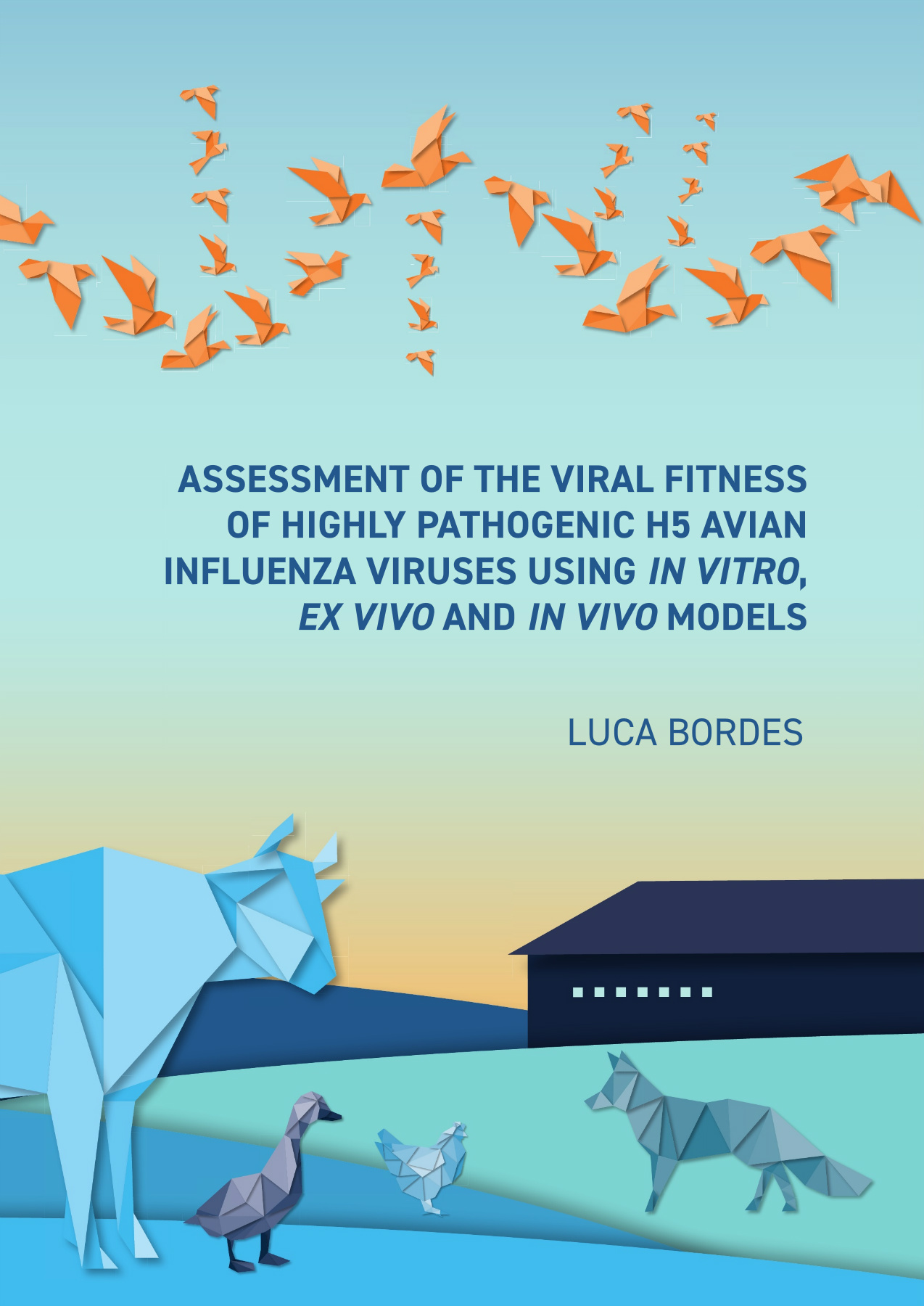
Assessment of the viral fitness of Highly Pathogenic H5 avian influenza viruses using in vitro, ex vivo and in vivo models
Summary
Influenza A viruses have a diverse host range including humans, swine, and avian species, and have a significant impact on public health and animal health. Avian influenza viruses are of particular concern due to their capacity to circulate within wild bird populations, cause severe disease in poultry, and exhibit a remarkable capacity for host adaptation. All influenza A viruses undergo continuous evolution, a process accelerated by their segmented RNA genome, which facilitates genetic reassortment. This mechanism drives the emergence of novel viruses with altered viral fitness. Adaptations in the viral genome can affect the ease by which the virus can spread between animals (transmission fitness), replicate in different species (replication fitness) and the severity of the disease caused by the virus to the host (virulence). To assess the dynamic changes in the viral fitness of avian influenza viruses, transmissibility, replication, and virulence are routinely evaluated through animal studies. However, this approach significantly restricts the number of viruses that can be evaluated, is too slow to implement within the time frame of actual emerging outbreaks, incurs high costs and requires the use of animals.
The overarching objective of the research in this thesis is to identify viral fitness of HPAI viruses, while concurrently advancing alternative approaches to animal models for identifying viral fitness in both avian and mammalian hosts. To assess the viral fitness in poultry, an in vitro model using primary chicken embryo fibroblasts and duck embryo fibroblasts combined with a mathematical model for virus replication dynamics was used for eight HPAI viruses from the H5 clade 2.3.4.4, spanning the 2014-2024 epizootics. The mathematical model categorized cells into susceptible, latent, infectious, and dead compartments, allowing precise derivation of parameters like the infecting time (tinf), generation time (tgen) and basic reproduction number (R₀). The combination of in vitro experimentation and mathematical modeling provided a thorough and quantitative characterization of the replication dynamics of the virus. Additionally, the study considered the translation of in vitro parameters to in vivo conditions, finding that replication fitness, but not virulence, aligns with outcomes observed in animal models. The potential of this in vitro model to predict transmission fitness was also explored, though further validation is needed.
Five of the HPAI H5 clade 2.3.4.4 viruses used in the in vitro model described above were evaluated using an in ovo model with embryonated chicken and duck eggs, as well as through experimental infections in chickens and Pekin ducks, with a particular focus on measuring virulence. Replication rates, average time to death, and virus spread in the embryo were measured and compared to the intravenous pathogenicity index in chickens and Pekin ducks to assess the in vivo translatability. The time-to-death and virus antigen expression in selected tissues from embryonated chicken and Pekin duck eggs appeared to be influenced significantly by the replication dynamics in the allantoic fluid. The measurements followed a similar pattern in both species, which did not align with the expected differences in virulence. Notable differences were observed in replication dynamics among HPAI H5 viruses and between poultry species. For example, the H5N1-2021 virus exhibited faster replication in the in ovo chicken and Pekin duck models but showed slower systemic virus dissemination compared to three other HPAI H5 viruses.
Well-differentiated airway epithelial cells (WD-AECs) arose as a critical tool for evaluating the viral fitness of respiratory viruses across various species, which is particularly useful for assessing the host range of respiratory viruses. However, the development of WD-AECs from chickens and Pekin ducks proved technically challenging. To enhance the expansion rate of airway epithelial cells derived from the bronchi of adult chickens and Pekin ducks, the cells were cultured as organoids, with the organoid medium supplemented by chicken-specific growth factors. Differentiation at air-liquid interface was optimized in a similar manner to the organoid cultures by supplementing differentiation medium with chicken-specific growth factors. This approach enabled the development of chicken WD-AECs that supported the replication of both HPAI and LPAI viruses without the addition of trypsin-like proteases.
An animal study was performed to evaluate the virulence and replication fitness of two HPAI H5N1 viruses in chickens and Pekin ducks. Additionally, this study expanded the reference panel used to assess the in vivo relevance of in vitro and ex vivo models for chickens and Pekin ducks. Furthermore, the virulence and replication dynamics of these H5N1 viruses were examined in Eurasian wigeons and Barnacle geese to explore potential shifts in host range compared to earlier HPAI H5 viruses. Virulence of the H5N1 genotype AB virus was lower in Pekin ducks, Eurasian wigeons and Barnacle geese compared to the H5N1 genotype C virus, whereas virus shedding was high for both viruses. Subclinical infections occurred in Pekin ducks inoculated with the H5N1 genotype AB virus which increases the risk for spillback to wild birds, spillover to other farms, mammals and humans. This study showed that both Eurasian wigeons and Barnacle geese remain potential hosts for contemporary H5N1 viruses. The reduced virulence combined with high virus shedding of the H5N1 genotype AB virus in Eurasian wigeons and Barnacle geese may have increased the risk for introduction into poultry of this virus.
The second part of this thesis focuses on identifying viral fitness of HPAI in several mammalian species. The detection of HPAI H5N1 in three red foxes during the 2020–2022 epizootic revealed neurological symptoms, and positive viral antigen staining in the brain. Two virus variants were isolated from one of these foxes, with one containing the avian PB2-S27E variant and one containing the mammalian PB2-S27K variant. The replication and stability was studied for both viruses, revealing that the PB2-S27K variant exhibited increased replication in human and dog cell lines compared to chicken cell lines. Additionally, the PB2-S27K variant demonstrated enhanced replication at the temperature of the mammalian upper respiratory tract compared to that of the avian respiratory tract, indicating more efficient replication in mammalian cells than in poultry cells.
Following HPAI H5N1 outbreaks in ruminants in the USA (2024), bovine WD-AECs were used to evaluate the susceptibility of cows to three European H5N1 viruses. The bovine cells supported virus replication without significant cytopathogenic effects. These findings suggest that ruminants may also be
See also these dissertations
Max Keizer
Surgical and Radiotherapeutic Nuances in Skull Base Tumors
23 juni 2026
Universiteit Maastricht
Open Ebook
Elfi Verheul
Optimizing Quality of Cancer Care Using Outcome Information
23 juni 2026
Erasmus Universiteit Rotterdam
Open Ebook
Francoise Dekker
FibrilPaints to Detect, Study and Modulate Amyloid Fibrils
14 juli 2026
Universiteit Utrecht
Open Ebook



Sam Neppelenbroek
Dysregulation of autoreactive B cell responses in autoimmune diseases
9 juli 2026
Universiteit Leiden
Open Ebook
We print for the following universities