Louise Lassalle


Diversity within
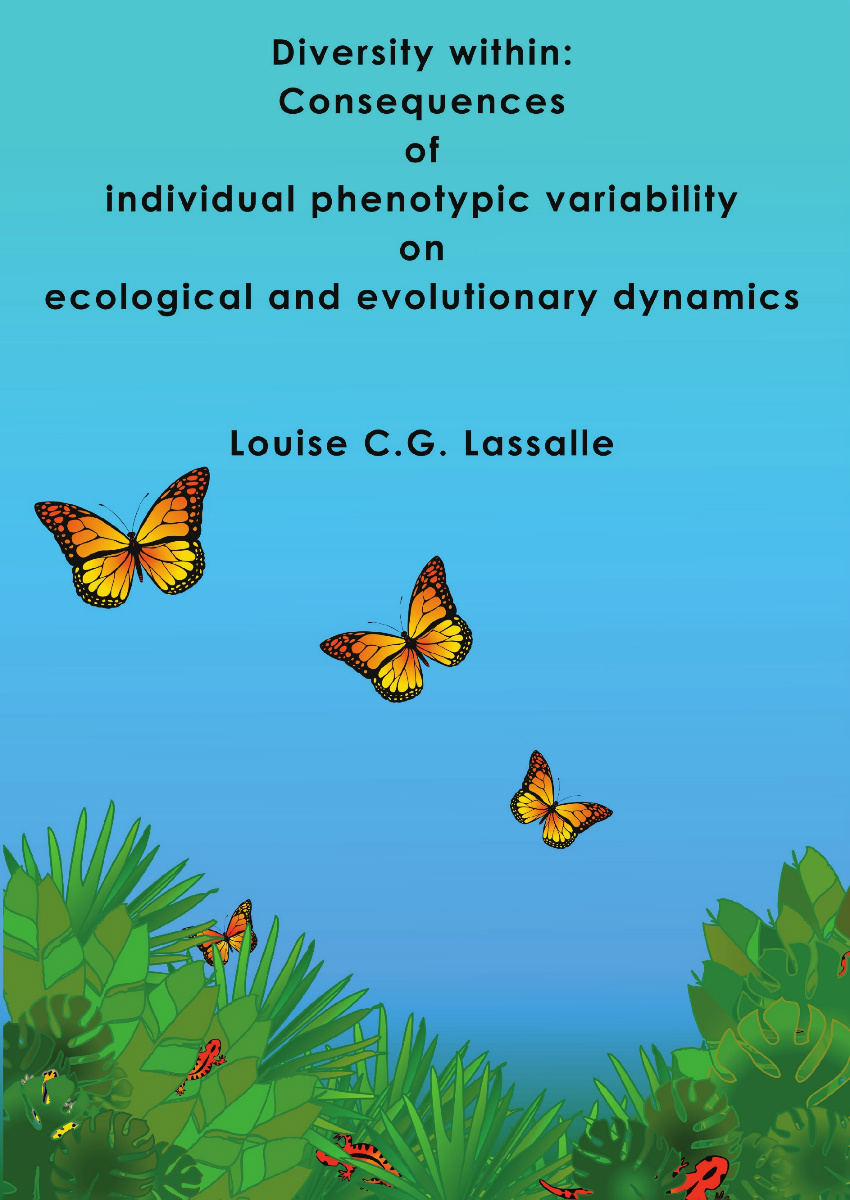
Diversity within: consequences of individual phenotypic variability on ecological and evolutionary dynamics Individuals interacting with their environment form the building blocks of ecological systems. How individuals grow and reproduce will determine population and ecosystem dynamics. Within a population, individual differences are ubiquitous in natural systems. Such variation can arise from genetic differences or responses to the environment, called phenotypic plasticity. Although individual life history variation is increasingly taken into account in the study of population dynamics, the role of phenotypic plasticity in individual life history decisions merits more attention. This thesis investigates eco-evolutionary consequences of individual variation in individual life histories resulting from phenotypic plasticity. Two universal interactions are studied: the acquisition of resources and responses to parasitism. To do so, two models have been developed taking into account stage-specific interactions and detailed life histories, using the physiologically structured population modelling framework. To examine the effect of flexible feeding strategies we use a structured population model where growth and reproduction are functions of body size. Juveniles and adults experience different feeding environments, and juveniles can switch to an alternative resource during their development (Chapter 2 and 3). We model the medication behaviour of the Monarch butterfly (Danaus plexippus) using toxic milkweeds (Asclepias spp.) to fight infection by the parasite (Ophryocystis elektroscirrha) in order to explore the effects of stage-specific responses to infection (Chapter 4 and 5). Changing diets during a life history is a common phenomenon in natural systems. Previous studies using physiologically structured models have shown that such behaviour can generate specific cyclic dynamics in populations driven either by population regulation via reproduction (competition in the adult stage) or via maturation (competition in the juvenile stage). Results in chapter 2 reveal how such regulation can dampen the effects of plastic feeding behaviour. As a results, stage-specific competition can limit the presence of intraspecific variation in feeding strategies. In addition, chapter 3 explores the evolution of plasticity and specialisation in feeding behaviour in both cases of population regulation. Specialised feeding strategies evolve in case of adult competition while competition in the juvenile stage leads to large amplitude cycles and the evolution of intermediate values of specialisation and plasticity in feeding strategies. Although plasticity nearly always evolves in both cases, it does so because the individual experiences selection for specialisation, not to exploit environmental variability. Results from chapters 2 and 3 draw attention to the prominent effects of population regulation in structured populations in the presence of responses such as plastic strategies. This thesis also investigates the effects of stage-specific plastic strategies as a response to infection. Hosts have developed a number of strategies to fight infection. Recently, it has been shown that non-immune responses such as medication strategies are more widespread than previously thought. Yet, medication strategies are still understudied, particularly in insects. In addition, these responses can be plastic, a property often associated with pathogen virulence or transmission rate. Chapters 4 and 5 describe a host-parasite system with an age-structured model associated to a susceptible-infected (SI) model, with an heterogeneous environment composed of toxic and non-toxic plants. The medication strategy is modelled as a plastic response to infection, such that the probability that butterflies deposit an egg on toxic plants is dependent on their infection status. Chapter 4 describes the impact of a plastic medication strategy on the persistence of infection. Infection-driven behaviour not only increases the efficiency of using toxic plants, the model results also show that different preference behaviours in infected and healthy individuals is linked to an increase in population birth rate. On an evolutionary level, chapter 5 shows that identical preferences from infected and healthy individual do not lead to removal of an infection, while the evolution of a plastic response does. Moreover, the evolution of plastic medication occurs regardless of the level of virulence in the parasite and toxicity in the plants. Chapters 4 and 5 highlight the importance of considering different aspects of the ecology of host life histories to fully understand host-pathogen evolutionary dynamics. In conclusion, this thesis, by exploring different intraspecific processes at eco-evolutionary scales demonstrates the importance of incorporating individual life history variation when exploring eco-evolutionary processes.
| Publicatiedatum | 6 maart 2020 |
| Universiteit | Universiteit van Amsterdam |
| Auteur | Louise Lassalle |
| ISBN nummer | 978-94-91407-82-6 |