Esther Mugi
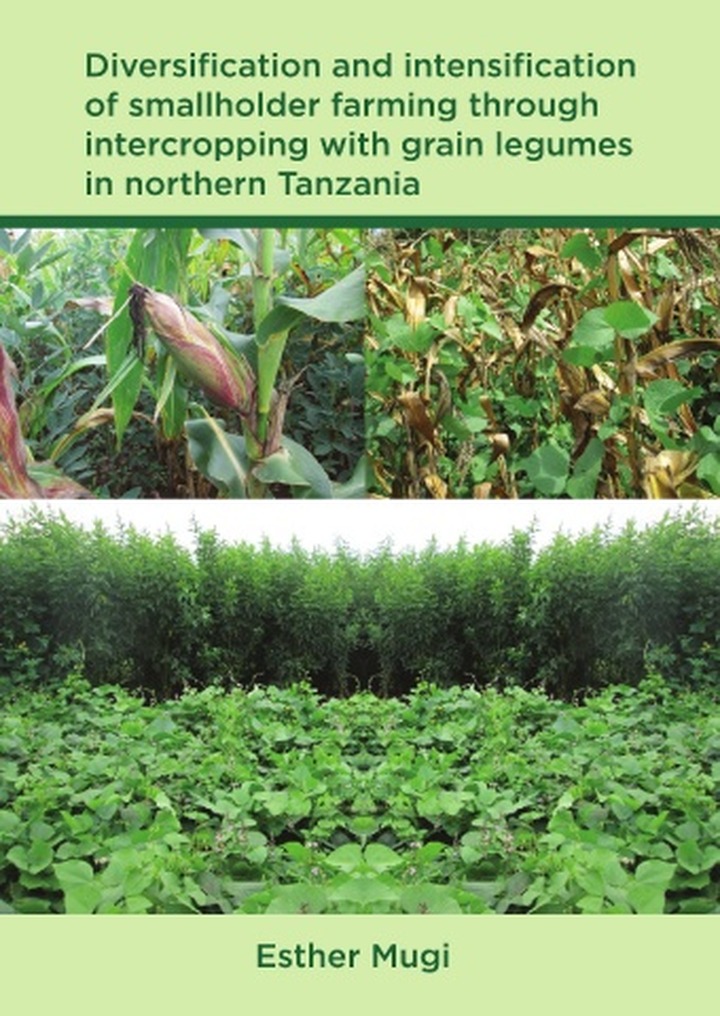


Diversification and intensification of smallholder farming through intercropping with grain legumes in northern Tanzania
Incorporation of grain legumes into cereal-based cropping systems is common in sub-Saharan Africa, where cereals are mainly intercropped with legumes such as pigeonpea, beans, dolichos lablab and cowpeas. Benefits of cereal-legume intercropping include greater ground cover and suppression of diseases and pests, and in subsequent seasons include the increase in supply of N from nitrogen (N2) fixation, improved soil health, weed (Striga) suppression and increased maize yields. In northern Tanzania, smallholder farmers commonly intercrop maize with legumes. This form of agriculture is practiced across a wide range of agro-ecological conditions. These crops form the basis of smallholder family food security and have further been identified as the engines of economic growth. This thesis focused on fine-tuning maize-pigeonpea/lablab intercropping systems, by working towards striking a balance between maximizing the benefits of inclusion of pigeonpea and lablab in the system and minimizing potential disadvantages emanating from their competition with maize. In Chapter 2, a farm-scale assessment of maize-pigeonpea productivity in northern Tanzania was done, to assess socio-economic factors, field management characteristics, and their association with productivity of maize-pigeonpea intercrops. Based on farmers’ practice, biomass production ranged between 1.0 and 16.6 for maize, and between 0.2 and 11.9 t ha for pigeonpea (at maize harvest). The corresponding grain yields ranged between 0.1 and 9.5 for maize, and between 0.1 and 2.1 t ha for pigeonpea. From this chapter, we learnt that performance of intercrops can be enhanced through application of organic and inorganic nutrient sources, and agronomic interventions including weeding, implementing soil conservation measures on steep slopes and optimising plant density. In Chapter 3, on-farm experimental trials comprising treatments with sole crops of maize, pigeonpea and lablab, as well as intercrops of maize with these legumes were conducted, with differing fertilizer application for two consecutive seasons (2017/2018 and 2018/2019), with a third season (2019/2020) where sole maize was grown. An evaluation of the growth and development of maize-pigeonpea and maize-lablab intercropping systems and their interaction with fertilizer showed that maize in intercrops was hardly affected by the presence of legumes, but the growth and yield of the intercropped legumes was negatively influenced by the presence of maize. The productivity of maize was positively influenced by N fertilization, but this was not the case for legumes, which responded positively to P fertilizer. For maize productivity, the difference between seasons was quite pronounced, with dry matter and grain production in the 2017/2018 season with up to 551 mm of rainfall being twice as high as in the 2018/2019 season, with up to 236 mm of rainfall. Legume productivity on the other hand was reasonably constant across the two seasons. The productivity of a sole maize crop grown in the 2019/2020 season following two seasons of legumes or legumes intercropped with maize was larger than in plots on which sole maize had been grown in the preceding seasons. Additionally, plots that had fertilizer applied in the preceding seasons had more productive maize crop, than control plots where fertilizer was not added. Thus, maize-legume intercropping with fertilizer application is effective in enhancing the productivity of smallholder cropping systems, and is superior to maize pure stands, not only for the additional grain yield from legumes but also due to the residual effects in a succeeding cropping season. Using the same experimental trials as in Chapter 3, Chapter 4 studied the effects of cropping systems and fertilizer use on nitrogen fixation and nitrogen uptake of the component crops in maize-legume intercrops. Sole long-duration pigeonpea fixed more N2 than all other cropping systems, corresponding to the higher shoot dry matter and N yield of this system. The combined N uptake of maize and legume in intercrops was consistently larger than that of pure stands of either maize or legumes. In the intercrops, the amount of N accumulated by maize was in most cases larger than that of the legume. Furthermore, sole legumes had consistently larger total N uptake than the intercropped legumes, whereas such consistency was lacking for maize. Application of fertilizer resulted in enhanced N uptake both in the current season and in a succeeding maize crop. Furthermore, we observed positive associations between grain yield, dry matter production and total N uptake of a succeeding maize crop, and the N-fixed by legume species in the preceding season. These insights underpin the fact that inclusion of grain legumes either as sole crop or intercropped with maize has a direct positive effect on maize productivity, which is carried over into the subsequent season. In Chapter 5, a parameter-sparse model was developed using Fortran Simulation Translator (FST) language, and was used to ascertain to what extent the productivity of maize – grain legume systems in northern Tanzania is limited by water availability. We observed that under rain-fed conditions, maize is dependent on the amount of water available, whereby water stress led to reduction in dry matter production amounting to 2330 kg ha. Legumes are dependent on their deep rooting system for production, whereby biomass reduction of up to 34% was recorded when their rooting depth was assumed to be similar to that of maize. Chapter 6 provides a general discussion of the findings generated in the thesis in the light of existing literature. The limitations of the current thesis are also highlighted, including recommendations for further research. This thesis improves our understanding of maize-legume intercropping systems both within and across seasons and provides valuable information that could help fine-tune these systems for increased productivity. We observed that major benefits of inclusion of pigeonpea and lablab in the system can be achieved, with minimum potential disadvantages emanating from their competition with maize productivity. In the case of maize-pigeonpea, maize productivity is not affected when the two crops are sown simultaneously, likely due to the initial slow growth of pigeonpea. In the maize-lablab intercrops, the latter which has a sprawling habit can be relay-planted one month after maize sowing, to reduce competition with maize.
| Publicatiedatum | 21 september 2022 |
| Universiteit | Wageningen University |
| Auteur | Esther Mugi |
| ISBN nummer | 978-94-6447-276-9 |