Dorit Teuscher
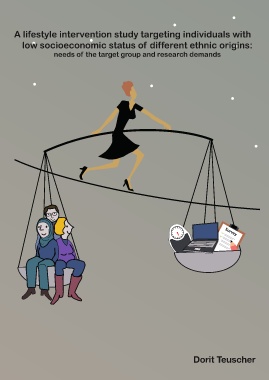


A lifestyle intervention study targeting individuals with low socioeconomic status of different ethnic origins
The increasing prevalence of individuals that are overweight or obese is leading to a growing public health problem worldwide. Overweight and obese individuals are at increased risk to develop non-communicable chronic diseases such as cardiovascular disease and diabetes mellitus type II. Especially individuals with low socioeconomic status and ethnic minorities are at high risk for the development of cardio-metabolic diseases in western countries. Lifestyle intervention studies have shown that the combination of a healthy diet and increased physical activity has beneficial effects on body weight and the prevention of cardio-metabolic diseases and such interventions seem cost-effective methods to reduce the risk of developing diabetes mellitus type II and cardiovascular diseases. However, individuals with low socioeconomic status and ethnic minorities are inadequately reached for those lifestyle intervention studies and when enrolled they are more likely to drop out. As a consequence, evidence whether lifestyle interventions would yield similar effects among individuals with low socioeconomic status and individuals with different ethnic origins is lacking. If these lifestyle interventions are less effective among groups with low socioeconomic status inequalities in health may even widen. Common barriers to engage in healthy behaviour are lack of time, lack of facilities and resources, financial costs and a lack of motivation. Individuals with a low socioeconomic status might face additional barriers, like little exposure to healthy eating and physical activity early in life, low levels of support and low paid and inflexible jobs. These barriers indicate that healthy eating and physical activity cannot be seen in isolation from other daily life activities. Therefore, it is important that lifestyle interventions also embrace the social context of health behaviours. An approach that not solely focuses on the individual seems to have advantages especially for individuals with a low socioeconomic status. The overall aim of this PhD thesis was to explore the effectiveness of an adapted lifestyle intervention targeting individuals with low socioeconomic status of different ethnic origins. For this purpose, the design and evaluation of an adapted lifestyle intervention, called the MetSLIM study, are described in this thesis. The original study on which the MetSLIM study is based, was the ‘Study of Lifestyle intervention and Impaired glucose tolerance Maastricht’ (SLIM), which was a randomised controlled trial set up in order to investigate the effect of dietary counselling in combination with a physical activity programme on impaired glucose tolerance. The SLIM study showed the beneficial effects of nutrition advice and physical activity promotion on the prevention of diabetes mellitus type II. The SLIM lifestyle intervention was effective in preventing diabetes mellitus type II in Dutch individuals aged 40-70 years after an intervention period of on average 4.1-years (range 3–6 years). As in other studies, individuals with low SES were more likely to drop out. To be able to adapt the SLIM lifestyle intervention study to the needs and preferences of the target group, first of all a focus group study was conducted. The aim of this focus group study, described in chapter two, was to inform the adaptation process of the existing SLIM lifestyle intervention and study design towards individuals with low socioeconomic status of different ethnic origins. Focus group interviews were held among groups recruited in deprived neighbourhoods. The interviews were held with groups of individuals with Dutch, Turkish and Moroccan ethnic origin and provided fruitful data to inform the adaptation process. The study results provided insight into the perspectives of groups with different ethnic origin on healthy eating and physical activity and highlighted the challenges individuals with low socioeconomic status with Dutch, Turkish and Moroccan origin experience with regard to lifestyle change. Furthermore, the focus group study showed that health behaviours, like eating healthily and physical activity are not conscious processes, but are collective social practices, which are embedded in daily life. The results show that the wish to eat healthily and to be physical active competes with other daily priorities. The insights gained in this study, guided the adaptation of the existing lifestyle intervention and pointed out the necessity to include the social context of eating healthily and being physically active in the lifestyle intervention. Chapter three describes the adapted lifestyle intervention and study protocol of the MetSLIM study based on the findings of the study described in chapter 2. In addition to the results of the focus group interviews, the experiences gained during this study and consultations with researchers and health care professionals working with the target group informed the adaptations process. The MetSLIM study protocol was based on the SLIM study protocol and was especially set up to target individuals with low socioeconomic status of Dutch, Turkish and Moroccan origin. The SLIM study was adapted with the aim to lower barriers to study participation, to place more emphasis on the interaction with others and the social environment of participants. Chapter three describes the obstacles and considerations encountered during the adaptation process. In order to meet the preferences of the target population the intervention had to be conducted in a community setting. Thus, the study setting changed from a university setting (as in the SLIM study) to a community setting. The recruitment strategies and measurements for the MetSLIM study also had to be adapted to better fulfil the needs of target group. Furthermore, the study design was changed from RCT to a quasi-experimental design with waist circumference as main outcome. To the lifestyle intervention additional group meetings about price concerns and social occasions with regard to a healthy diet were added. The lifestyle advice was given by ethnicity-matched dieticians; the physical activity lessons by gender-matched sports instructors. All these activities were provided in participants’ own neighbourhood and were given for women and men separately. The balance between contextual fit and methodological demands had to be considered during the adaptation process. This chapter describes the considerations that have taken place to balance research demands with the needs of the target group. The following chapter four describes the effectiveness of the MetSLIM intervention with respect to waist circumference and other cardiometabolic risk factors, lifestyle and quality of life among 30- to 70-year-old adults with an elevated waist-to-height ratio. Participants were recruited in deprived neighbourhoods of Eindhoven and Arnhem via their GP or in community centres. In total 220 participants started in the MetSLIM study, of those 117 were recruited for the intervention group and 103 for the control group. 40% had no formal education or only primary education and 64% had a foreign background. The MetSLIM study had a quasi-experimental design. Measurements were performed at baseline and after 12 months intervention. For the intervention group a lifestyle programme was set up including four group meetings on a healthy lifestyle, weekly physical activity lessons guided by a sports instructor and a maximum of 4 hours of individual dietary advice given by an ethnicity-matched dietician. At the end of the study no outcome data could be obtained in 31% of the participants and these individuals were classified as drop-outs. The results of the remaining 149 participants that completed the study indicate that the lifestyle intervention was effective in reducing waist circumference, weight and fat percentage compared to the control group. Furthermore, total and LDL cholesterol improved in the intervention group compared to the control group. Other cardiometabolic risk factors were not affected by the intervention. Beneficial effects on quality of life were seen with regard to self-rated health compared with one year ago and self-rated health compared with that of others. Significant improvements in dietary behaviour were only observed for fibre intake and subjectively reported physical activity level had not increased after 12 months. In chapter five the results of the accelerometer-based measurements of physical activity are described. The physical activity lessons of the MetSLIM intervention were set up with the aim to increase physical activity levels of participants. The sports instructors tailored the content of the physical activity lessons to the skills and preferences of participants. Furthermore, participants were allowed to bring a friend or family member along to stimulate attendance. Additionally, the main tenant of the lessons was sociability and group cohesion. At baseline and after 12 months, 121 participants of the MetSLIM study wore the accelerometer. The wear time analysis of the data provided sufficient data for 106 participants (63 of the intervention group and 43 of the control group), at baseline as well as for end measurements (minimum of 4 days and 8 hours per day). After 12 months no changes in sedentary behaviour and physical activity were detected in the intervention group compared with the control group. The last study in this thesis, described in chapter six, investigates the process of the study implementation. The evaluation of the MetSLIM study implementation shows essential aspects that had potential impact on the successful implementation of the MetSLIM study in deprived neighbourhoods. Being flexible, also with respect to the in- and exclusion criteria, during the recruitment process enabled the enrolment of sufficient participants. Another important finding of this evaluation is that the attributes, like the ethnicity, of the recruiter are essential for successful recruitment of individuals with different ethnic origins into health research. Furthermore, our evaluation showed that recruiting GPs for this type of research can be challenging and that healthcare professionals have their own opinions about intervention components. They give their personal contribution to the intervention as they influence the content and delivery of an intervention in many different ways and are in this sense co-producers of intervention components and the outcome an intervention achieves. This requires flexibility on the part of both research teams and health professionals, in order to adapt quickly to changing local circumstances, and underlines the importance of continuous practical reflection on the study methods and intervention components. Finally, in chapter 7 the methodological challenges associated with conducting research among a generally inadequately reached target group are described. Implications for practice and for future research are given, followed by a general conclusion. Considerations for effective recruitment and retention of individuals with low socioeconomic status of different ethnic origins in health research are discussed and adjusted research methods are recommended. A flexible recruitment protocol, the community setting as research site, building trust by increased visibility and involvement of researchers or site coordinators, and translated study materials are for example promising strategies in order to reach and retain individuals with low socioeconomic status of different ethnic origins effectively. The appropriate approach of lifestyle interventions that target individuals with low socioeconomic status of different ethnic origin are also discussed. An approach that recognises that individuals are embedded within social systems that shape (health) behaviours and takes their life circumstances into account may enable people to better implement lifestyle advice in their daily life. Furthermore, the evaluation of the effectiveness of such lifestyle interventions are discussed. As the context is an integral part of an intervention, effect evaluations should not only focus on outcomes but also on which conditions make certain outcomes more likely, for which people, and in which context. This thesis shows that intensive preparatory work helps to identify successful adaptations that make lifestyle interventions more suitable for individuals with low socioeconomic status of Dutch, Turkish and Moroccan origin. Furthermore, this thesis illustrates that a lifestyle intervention adapted to the needs of the target group can be effective.
| Publicatiedatum | 10 juli 2017 |
| Universiteit | Universiteit Maastricht |
| Auteur | Dorit Teuscher |
| Order nummer | FTP-202603271429 |
| ISBN nummer | 978-94-6295-694-0 |