Share this project
Marie Fleur Bremaud
Wageningen University
Publication date: 24 juni 2026
University: Wageningen University
ISBN: 978-94-6534-428-7
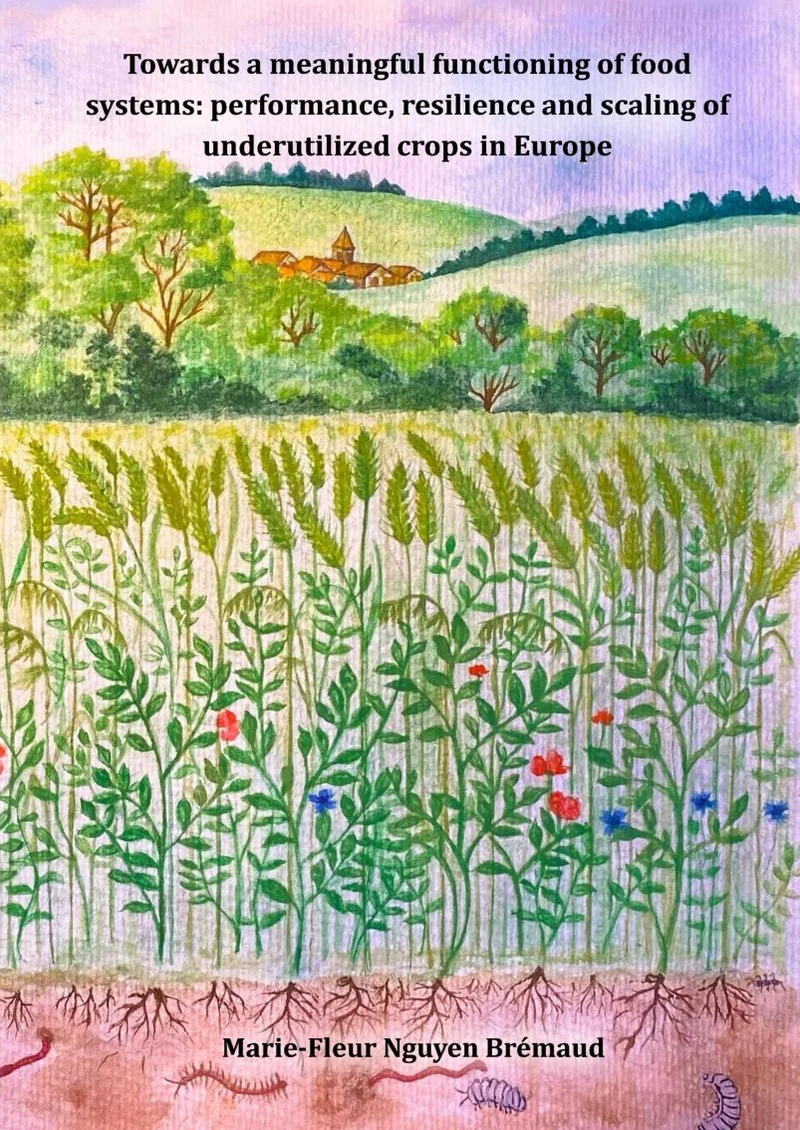
Towards a meaningful functioning of food systems
Summary
This thesis aimed to explore the functioning of European food systems using underutilized crops (UCs). UCs, as genetically diverse and locally adaptable crops, have been identified as potential contributors to more sustainable food systems. For example, through diversifying farms and due to their good adaptability to various environments, they may support farms and value chains’ resilience, especially in the face of climate change. The literature on UCs and, especially, economic aspects related to UCs is dispersed across different disciplines, which impedes possibilities to get a full picture of their potential challenges and contributions in European contexts. Additionally, little information is available on the farm management and performance of the farms using UCs. Similarly, at value chain level, the processing and marketing of UCs are little reported in the literature. Last, although scaling UCs may benefit the resilience of food systems, it appears that unlocking these potential benefits depends crucially on how UCs are scaled. The overall objective of this thesis was broken down into four sub-objectives, each covered by various chapters.
In Chapter 2, the scientific literature on the economic aspects of UCs in Europe was scoped by categorizing findings into three levels: farm, value chains and communities, and by looking at opportunities and challenges. At farm level, the economic performance indicators of yield, price, costs, profit and risks were investigated in further detail. Additionally, social and institutional aspects impacting the economic performance of UCs were reported as opportunities and challenges. Fifty-five papers were found. Results showed that UCs mostly related to specific farm types, i.e. with agroecological or low-input practices, and mostly involved local selling. Some UC farm characteristics repeated across the literature were lower input costs, moderate but stable yields, low production risks, sometimes relatively high selling prices and higher market independence. However, the literature reported challenges, e.g. farmers faced difficulties in accessing UC seeds and UCs were mostly commercialized outside of mainstream food systems due to incompatibility with crop registration rules and standardization requirements. To stimulate wider adoption, releasing UCs from their informal status and supporting bottom-up initiatives of producing UCs appeared essential to widen their use and eventually contribute to development paths towards more sustainable and resilient food systems.
In Chapter 3, the farm management of UC farms was analyzed. The farm structure, farmers’ goals and decision-making, farm performance, and farmers’ perceived resilience and challenges were investigated for 17 farms using UCs in France. Values found for structure and performance indicators were compared with data from the Farm Accountancy Data Network (FADN) for the same farm production, regions and year. Interviewed UC farmers often had specific goals, e.g. they wanted to contribute to the local economy and food autonomy. Decision-making focused on boosting farm autonomy through seed saving, using little inputs, and on-farm processing. The studied UC farms were profitable with moderate levels of debt, and farmers considered their income sufficient to support their households. Outputs were usually valorized through direct sales and short chains. Overall, interviewed UC farmers deemed their farms resilient but still faced challenges, such as limited know-how and limited access to seeds when starting with new UCs. It appeared that more effort was needed to integrate UCs effectively into EU policy frameworks such as the Farm-to-Fork strategy.
In Chapter 4, the resilience of three value chain case studies using UC cereals was investigated in Scotland, France and the Netherlands. Via semi-structured in-depth interviews with the main chain actors, it explored how actors of these chains build resilience of their business and the value chain as a whole, through the four resilience attributes of agency, buffering, connectivity and diversity. Results showed a strong agency, observed through actors' knowledge and skills to save natural resources and implement circularity. Buffers were limited, e.g., regarding workforce or cash flow. Connectivity materialized through tight partnerships to jointly manage transportation, price setting or quality and quantity variations in harvest. Diversity was observed through enhancing farm-level agrobiodiversity, cultivating several crops next to cereals, saving different UC varieties per cereal species and developing different finished products sold in multiple places. As a conclusion, both farm and post-farm stages of UC chains were configured based on principles of resilience. These chains provided practical examples to configure other resilient value chains and may inspire the modification of mainstream chains.
In Chapter 5, the scaling of UCs in the Netherlands was explored by considering three types of scaling: scaling deep (farming systems can be redesigned by changing institutions, rules, and policies), up (changing narratives, beliefs and ideas), and out (replicating successful initiatives and tools across different contexts or regions). Through two workshops with different types of local actors using UCs, it performed a SWOT analysis of the current situation, then explored a future desired situation for UCs in the Netherlands. Results showed mismatches between farm and food policies and UC production and processing, and a lack of societal awareness. Yet, active networks and field initiatives demonstrated that knowledge for producing UCs still exists. The desired future situation for UCs was characterized by (i) regulations specifically adapted to fit UC farms and processors, creating a favorable entrepreneurial environment for local food systems, (ii) societal knowledge on UCs, with media spotlighting UCs and crop diversity and educational programs emphasizing on UCs at different levels, (iii) an outreach organization helping farmers learn about seed saving and access seeds through shared facilities, paying with seeds they have produced.
The main conclusions are:
1. The overall conclusion of this thesis is that the functioning of European food systems using UCs is characterized by actors who implement specific practices and decision-making, and share motivations related to society's well-being and environmental preservation. They greatly value resilience, even if it means trying ways outside norms.
2. UC farms are profitable. Their profitability comes with several specificities. For instance, after their establishment phase, they often operate with low levels of costs, debts and subsidies. Also, profitability is achieved through non-mainstream decision-making; related to increasing farm autonomy, diversity (e.g. in terms of crops, partnerships, finished products, and selling channels), and enhancing nature and local social connections. UC farmers achieve sufficient income levels to support their households (Chapters 2 and 3).
3. UC value chains are composed of profitable businesses operating through collaboration, information sharing and long-term partnerships. Instead of competing to optimize individual margins, they support each other so that each partner can stay in business. Their functioning can inspire other value chain actors and new entrepreneurs (Chapter 4).
4. UC farmers’ motivations differ from those of mainstream farmers. For instance, they aim to feed their family and local community with quality local food, to live close to nature, and to contribute to the local economy of their place. Farm profitability is a means rather than an objective (Chapter 3).
5. UC value chain actors aim at participating in the food autonomy and local economy of their territories. They do this, among others, through the creation of more local businesses, more collaboration in value chains, and the development of new selling channel opportunities. These contributions represent a significant share of UC actors’ motivations (Chapters 3 and 4).
6. UC value chains demonstrate a satisfying level of resilience despite challenges such as unfit policies. They operate through implementing numerous innovative strategies to boost their agency, connectivity and diversity levels. Developing these attributes is key to dealing with shocks (Chapter 4).
7. This thesis shows that UCs contribute to resilience aspects. However, economic and social aspects of UCs in Europe have been mostly overlooked by economists until recently. Data and research on economic arguments regarding UCs are sparse and scattered across different disciplines, especially in the European context. When economic analyses are done, they often focus on farms rather than potential impacts on value chains and the local economy, and often look at economic returns rather than at resilience. This thesis contributes to filling this research gap. The contribution of UCs to economic stability and resilience of the farming and food system at different levels is not yet fully uncovered (Chapters 2, 3, and 4).
8. For UCs to be scaled, a space needs to be created in mindsets and in policies for them, their farms and processors. For example, a deeper understanding of biodiversity, but also of the socio-economic contributions of local foods to communities, could support this change in mindsets. Moreover, policies need to take into account more systematically diversified farms and local food SMEs, rather than focusing solely on mainstream value chains (Chapter 5).
9. Reintroducing UCs and lifting crop diversity should be done through a plan that integrates education and awareness-raising strategies, policy changes and concrete initiatives for UC growing simultaneously. The large institutional lock-ins and a lack of societal awareness regarding both farming and food processing of UCs currently hold UCs back (Chapters 2 and 5).
See also these dissertations

Raghavendra Meena
Multiscale Modeling of Molybdenum and Tungsten Carbide Catalysts for Sustainable Biomass Conversion
22 juni 2026
Wageningen University
Open Ebook
Rebecca Steenaard
Quality of life and care in adrenocortical carcinoma
10 september 2026
Universiteit Maastricht
Open Ebook


Qi Yu
The impact of a negative energy balance on porcine phenotypic and granulosa cell molecular responses
18 mei 2026
Wageningen University
Open Ebook

Thomas Goldschmidt
Psychiatric Emergency Departments
24 juni 2026
Vrije Universiteit Amsterdam
Open EbookWe print for the following universities