Linda Remijn Nelissen
Symptomatic treatment of myasthenia gravis
3 september 2026
Universiteit Leiden
Open Ebook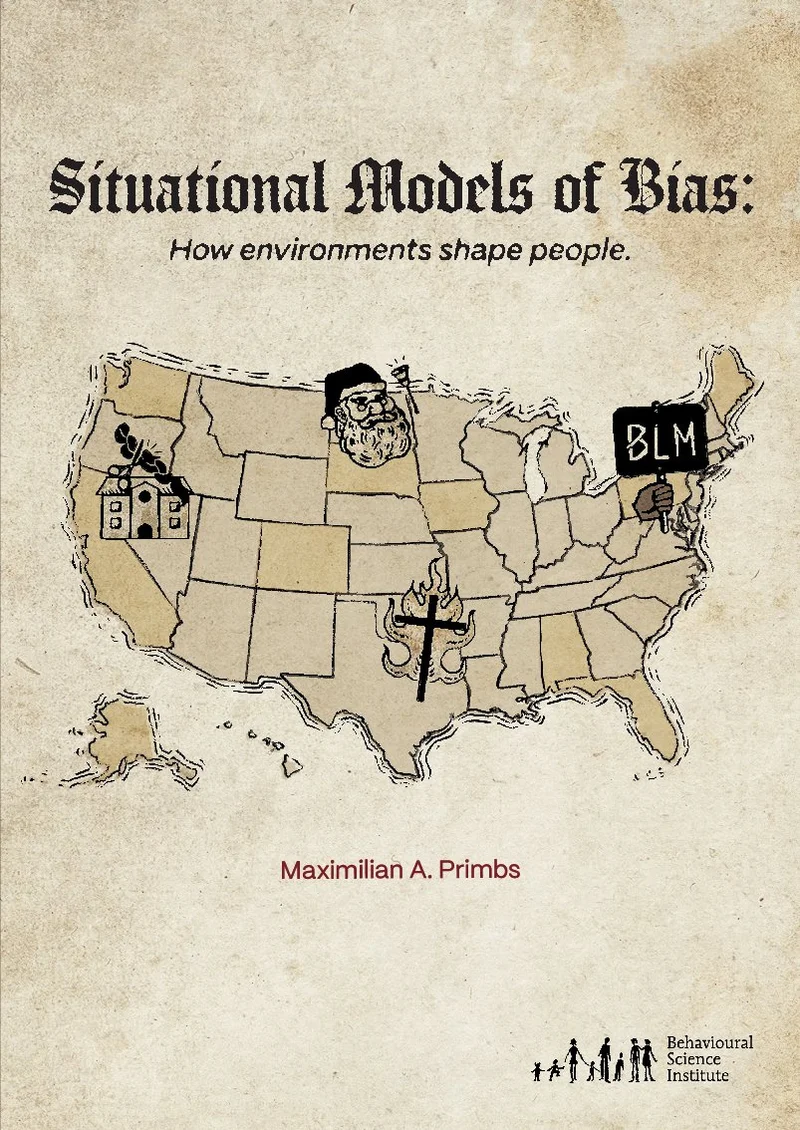
Share this project
Summary
Though vastly differing in content and predictions, traditional models of attitudes view attitudes as property of people. People’s cultural and personal learning histories entrench associations between social groups and concepts into their minds, inevitably shaping how they think, feel, and act. At least theoretically. A growing body of empirical work has shown that people’s intergroup attitudes are only weakly correlated with intergroup behaviour. For example, people’s attitudes towards Black people only weakly predict how people act towards Black people. The Bias of Crowds model redefines implicit bias as a property of situations or environments. The model argues that aggregated implicit bias scores reflect shared cultural knowledge accessible in a situation or environment. Followingly, regionally aggregated implicit bias scores reflect the shared cultural knowledge accessible in a given region, or the local social and cultural environment. In this dissertation, I examined multiple empirical predictions of the Bias of Crowds model with the aim of refining the model and improving our understanding of how environments shape implicit bias.
In Chapter 2, I reviewed the empirical evidence for the Bias of Crowds model, integrated existing studies into coherent psychological theory, and derived falsifiable predictions from the model. This chapter summarized all empirical chapters presented in this dissertation and concludes with ideas for future research. I outlined seminal predictions of the model and evaluated empirical evidence for each prediction. First, if regionally aggregated implicit bias scores reflect the local social and cultural environment, they should also reflect the system that created this environment. Historical inequalities might have created local social and cultural environments that justified the inequality, in turn creating norms, stereotypes, laws and institutions that perpetuated the local social and cultural environment long after the inequality has passed. Second, features of the environment that make negative or stereotypical mental content more accessible, should lead to increases in regionally aggregated implicit bias scores. Third, if regionally aggregated bias reflects the local social and cultural environment, then changes in the social and cultural environment should cause changes in aggregated bias. In the subsequent chapters I discussed these and other details in more detail.
In Chapter 3, I investigated the association between historical sundown towns and racial bias. Sundown towns are places in the United States that historically limited the movement or settlement of racial and ethnic minorities. If the local social and cultural environment present in historical sundown towns perpetuated itself across time, I would expect that the historical presence of a sundown town in a region is associated with higher levels of modern-day racial bias. Here, I combined historical databases on sundown towns in the United States with Project Implicit, geolocated IAT data of 1.3 million people. I found that the historical presence of sundown towns in a region was associated with higher levels of modern-day racial bias. This finding demonstrates that the remnants of long-past inequalities can still be observed today.
In Chapter 4, I investigated the association between the historical presence of Native American boarding schools and bias towards Native Americans. Native American boarding schools had the explicit purpose of assimilating Native American children into White American culture. Based on the findings observed in Chapter 3 and other research, I predicted that the historical presence of a boarding school in a region would be associated with higher levels of modern-day bias. However, using the data of almost 300.000 people, I found that regions that historically featured Native American boarding schools displayed lower levels of modern-day bias. I situated these findings in the historical context and noted that cultural assimilation in Native American boarding schools (as opposed to extermination of Native Americans as a people) reflected the egalitarian viewpoint at the time. The presence of a boarding school may therefore have reflected a more egalitarian local culture, which may have persisted over time through various psychological processes, including positive intergroup contact. This study thus suggested that the association between historical inequalities and modern-day biases depends on the historical interpretation of the inequality, and not on how the inequality is viewed today.
Next, in Chapter 5, I investigated whether regional-level intergroup contact is associated with lower levels of intergroup bias. To that end, I combined GPS data from 9.6 million Americans with data on racial bias from 1.3 million Americans. In line with the mechanism described in Chapter 4, I found that regions with higher levels of intergroup contact have lower levels of racial bias. This study bolsters intergroup contact as a potential mechanism through which a culture of egalitarianism may have persisted over time.
In Chapter 6, I investigated the association between historical Ku Klux Klan (KKK) presence, modern-day racial attitudes, and modern-day White Supremacist activity. I expected that historical KKK presence is associated with higher levels of modern-day racial bias and more modern-day White Supremacist activity. Though historical Klan presence was associated with more modern-day White Supremacist activity, it was also associated with lower levels of modern-day racial bias. While reflecting on these findings in Chapter 2, I argued that this represents a backlash effect: After the conviction of the Klan leader for the rape and murder of a White woman, people wanted to distance themselves from the Klan and shifted towards egalitarianism.
History is often remembered in our physical environment, with streets, schools and universities named after historical figures and memorials commemorating the past. In Chapter 7, I investigated the effects of the presence and removal of Confederate monuments, which commemorate the pro-slavery side of the US civil war, on racial bias. In Study 1, I first investigated whether the presence of a Confederate monument was associated with higher levels of racial bias. Followingly, I used longitudinal models to estimate the causal effect of the removal of a Confederate monument on aggregated racial biases within regions. However, neither the correlational nor the longitudinal analyses revealed a reliable effect of Confederate monuments on racial bias, or an association between both variables. In Study 2, I randomly assigned participants to be exposed to Confederate monuments or a passive control condition but found no significant effect of exposure to Confederate monuments on racial bias. In Study 3, I utilized a within-subject design, in which participants first completed measures of racial bias, then were exposed to Confederate monuments, and finally repeated the measures of racial bias. Here, too, I observed no significant effect of exposure to Confederate monuments on racial bias. Finally, in Study 4, I conducted a field experiment in which participants completed measures in front of a monument (versus a visually similar control monument) but again found no significant effect of exposure monuments on racial bias. Based on these findings, I concluded the physical reminders of historical inequalities studied here do not causally affect racial bias.
If regionally aggregated bias reflects the local social and cultural environment, then changes in the social and cultural environment should cause changes in aggregated bias. In Chapter 8 and 9, I tested this idea for two different changes in the social and cultural environment. In Chapter 8, I estimated the causal effect of the 2020 Black Lives Matter protests on racial bias. The 2020 BLM protests were a large-scale societal movement against police violence and systemic racism. I used Project Implicit data of almost 400.000 people to track day-to-day changes in aggregated implicit bias scores and found that there was a significant drop in implicit and explicit racial bias after the onset of the 2020 BLM protests. I used causal models and balancing weights to estimate the causal effect of the 2020 BLM protests and found that the protests causally affected implicit, but not explicit racial bias. This study provided initial evidence that changes in the social and cultural environment cause changes in implicit bias.
In Chapter 9, I investigated whether Christmas was associated with changes in racial bias. Existing research shows that exposure to religious symbols – as would be widespread during Christmas – is associated with both higher and lower levels of intergroup bias. Here, I found in the Project Implicit data of more than four million White Americans that Christmas was associated with increases in biases against Black people, Arab people, and people with darker skin tones. Additionally, I found that there were decreases in bias towards Judaism, Islam, and gay people. In a subsequent within-subjects study, I tracked the same people on Christmas and a week later and found increases in bias against gay people, and no changes in bias against Arab people. The effects of societal events may therefore differ depending on the social and cultural climate during that year, and aggregating data across years may be inappropriate for some research questions.
The Bias of Crowds model is a causal theory and predicts that environmental features cause implicit bias. Though virtually unheard of in psychology, drawing causal inferences from non-experimental studies, such as the studies presented in this dissertation, has a long history in economics and political science, which developed a variety of tools to help with the estimation of causal effects from non-experimental designs. In Chapter 10, I provided a tutorial for two such tools: Directed Acyclic Graphs and balancing weights. This chapter included easily adaptable R Code and gently introduces readers to the terminology of causal inference. Directed Acyclic Graphs are a tool that allow researchers to display their causal model and provide a mathematical foundation that allows for the identification of a causal effect. Balancing weights are a tool that allow researchers to estimate causal effects for common causal structures.
If implicit bias reflects the social and cultural environment, interventions that aim to decrease bias need to change the social and cultural environment. In Chapter 11, I discussed the Bias of Crowds model from a policy perspective and highlighted policy recommendations on counteracting the effects of historical disparities, shaping social narratives, and changing physical environments as efficient ways of decreasing intergroup bias.
Together, this dissertation provides a thorough examination of key predictions of the Bias of Crowds model. This examination spans the seven empirical chapters included in this thesis, two review articles, a methodological paper, and many more on-going (or by the time of defence, completed) research projects. First, I conclude that historical inequalities are associated with modern-day bias, but that the direction this association takes depends on the historical interpretation of the inequality. Second, I conclude that the physical environment may not play a causal role in activating and maintaining implicit bias. Third, I conclude that implicit bias changes as the social and cultural environment changes. I hope that this dissertation inspires researchers to stop asking what implicit bias is, and instead triggers discussions about when and where implicit bias is.