Linda Remijn Nelissen
Symptomatic treatment of myasthenia gravis
3 september 2026
Universiteit Leiden
Open Ebook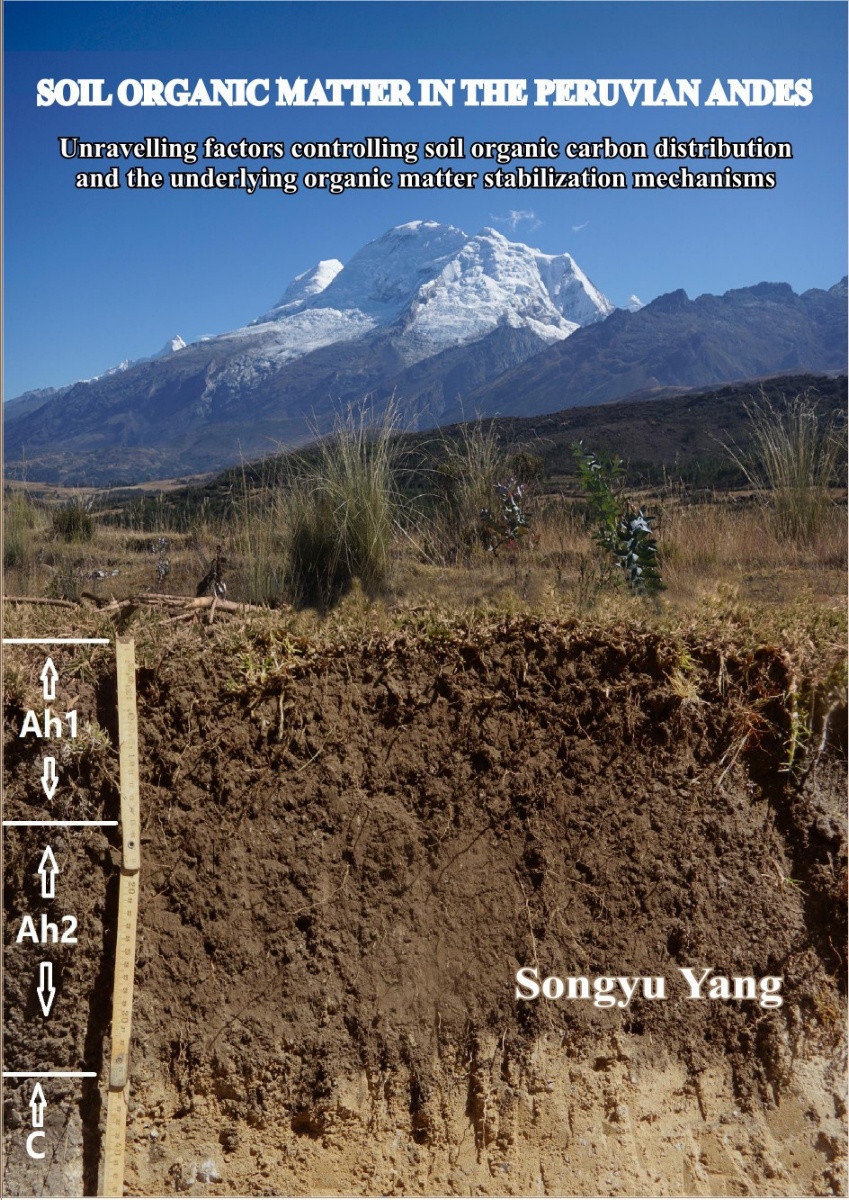
Share this project
Summary
Soil contains the largest terrestrial carbon (C) pool and plays an important role in global C dynamics. Alpine grasslands of the Neotropical Peruvian Andes have large soil organic carbon (SOC) stocks, which are crucial to food production and water provision for the surrounding areas. With regard to the high vulnerability of the grasslands under climate change, it is important to have insight into the persistence and vulnerability of the SOC stocks and the underlying stabilization mechanisms. However, alpine grassland soils in the Peruvian Andes are less-studied with regard to SOC stocks, and especially with regard to the mechanisms controlling SOC storage and Soil Organic Matter (SOM) composition at the molecular level. The objectives of this thesis were: (1) to quantify the SOC stocks and to find key factors controlling the SOC spatial patterns, (2) to have insights into the underlying mechanisms of soil organic matter stabilization, (3) to investigate SOM stabilization controlled by soil aggregation as affected by lithology and precipitation, and (4) to investigate potential relationships between SOM molecular composition and SOM stabilization in the studied alpine grasslands of the Peruvian Andes.
Chapter 1 provides the background of the research topic and general information of the sampling sites in the alpine grasslands of the Peruvian Andes. Briefly, in this chapter we summarized recent research progress in SOM stabilization mechanisms and proposed how to apply the knowledge of SOM stabilization for the soils of the Peruvian Andes under the background of global change.
In Chapter 2 the spatial distribution of SOC stocks was investigated over a variety of different bedrocks, land use types, grazing intensities and topographical positions. Soil samples were collected from 69 plots to estimate the SOC stocks of the entire soil profiles for the study area near Cajamarca (the wet site). In addition, multiple linear models were applied to identify significant soil formation and environmental factors controlling the distribution of SOC. The SOC stocks of the studied area were 215±21 Mg ha-1, which is higher compared to the global average level but lower compared to comparable ecosystems in the Ecuadorian Andes. The spatial variation of the total SOC stocks was predicted by soil depth and soil moisture. When soil depth and soil moisture were controlled as conditional variables, lithology was the key factor controlling the distribution of SOC stocks. Different from the total SOC stocks, SOC stocks of the upper 10 cm were predicted by soil moisture, lithology, grazing intensity and altitude. Most studies estimate SOC stocks by sampling to a limited constant depth. However, our results suggest that SOC stocks should be estimated using the entire soil profiles, because sampling to a limited constant depth results in underestimations of SOC stocks and overestimations of the effects of soil formation and environmental factors on the SOC stock distribution.
In Chapter 3 the effects of lithology on SOC stocks and SOM stabilization were investigated. Samples were collected from limestone soils (LSs) and acid igneous rock soils (ASs) in the wet site. SOM stabilization mechanisms were investigated using a selective extraction method to isolate active Fe, Al and Ca fractions. The results showed that the LSs had significantly higher SOC stocks than the ASs. In both LSs and ASs, SOM was stabilized by complexation with and/or adsorption on Fe- and Al-oxides. Exclusively in the LSs, the formation of Ca2+ bridges between OM and mineral surfaces also contributed to SOM stabilization. The Ca-induced SOM stabilization gives a potential explanation for the higher SOC stocks in the LSs. In contrast, no evidence was found that OM stabilization was controlled by crystalline Fe oxides, clay contents, allophones, Al toxicity or aggregate stability. The results suggest a shift in SOM stabilization dominated by Fe- and Al- oxides to that with the presence of Ca2+ bridges with increasing pH values driven by lithology.
In Chapter 4 the effects of precipitation and lithology on soil aggregate-size distribution and SOC stability were investigated. A wet-sieving method was applied to determine aggregate-size distribution, whereas a 76-day incubation of intact and crushed soil aggregates was applied to estimate SOC stability and aggregate-controlled SOM stabilization. Aggregate-size distribution was mainly controlled by lithology rather than precipitation, as indicated by larger aggregates for the LSs compared to the ASs. SOC stability declined with precipitation in the LSs, but had no significant change in the ASs. SOM occluded in aggregates played a limited role in SOM stabilization, as indicated by: (1) limited changes in SOC mineralization rates between intact and crushed aggregates, and (2) inconsistent patterns of aggregate-size distribution and patterns of SOC mineralization. Thus, SOM adsorption on mineral surfaces was the major stabilization mechanism. The results suggest that SOC stability was controlled by the interaction between lithology and precipitation, which is further controlled by soil mineralogy in relation to SOM input.
In Chapter 5 the molecular composition of SOM in relation to its stability against decomposition was investigated. For this, pyrolysis-gas chromatography/mass spectrometry (GC/MS) analyses assisted by tetramethylammonium hydroxide (TMAH) were applied using samples from the 76-day soil incubation with aggregates intact and crushed as described in Chapter 4. Potential changes in SOM molecular composition before and after incubation were used to estimate SOM stability and the microbial transformation of SOM molecules. Differences in SOM molecular composition after the incubation between intact and crushed aggregates were used to estimate the SOM protected by occlusion in aggregates. The results showed large relative abundances of compounds derived from fatty acids (FAs), with a major contribution of free FAs. The presence of double bonds (unsaturated vs. saturated FAs) and carbon chain length were key factors controlling the FA stability. Unsaturated FAs were more depleted after the incubation compared to saturated FAs and positively associated with soil organic carbon mineralization rates. The depletion of unsaturated FAs is likely to be explained by their easier degradation compared to saturated FAs and further attributed to their less stabilization controlled by association with mineral surfaces and/or chemical properties. Instead, it is unlikely explained by the stabilization controlled by occlusion in aggregates. Long-chain FAs were more depleted than short-chain FAs after the incubation and a possible explanation for this is that short-chain FAs received more protection by occluded in aggregate. Although we observed the microbial transformation of FAs during the incubation, it had limited effects on the prediction of FA stability using double bonds and carbon chain length. Finally, soil types and horizons also influenced the effects of double bonds and carbon chain length on FA stability. This suggests that more studies are required before generalizing our findings to other soils. The results give the evidence to show that the inherent properties of soil FAs control their interactions with the soil matrix and indirectly govern their stabilization and persistence in the Peruvian Andean soils under study.
Chapter 6 gives a synthesis of the major findings in this Thesis. The major findings were that: (1) Lithology is the key factor controlling SOC stocks and stability; (2) SOM stabilization is controlled by Fe- and Al-oxides in the wet-ASs, and is promoted by Ca2+ bridges in addition to the Fe- and Al-oxides in the wet-LSs; (3) SOC stability decreases with precipitation in the LSs but has limited differences in the ASs, which can be explained by soil mineralogy in relation to SOM input; and (4) the presence of double bonds and carbon chain length control the stability of fatty acids through the interactions with the soil matrix.
Implications of the findings were also discussed in Chapter 6. With regard to the SOM molecular composition, the results agree with the studies that found lipid-rich and lignin-depleted soils in the Andean grasslands of Ecuador. However, this is not common in soils from other areas. Further studies can focus on the underlying mechanisms of the large lipid fraction. With regard to SOM stabilization in general, the results gave evidence that SOM chemical composition affects SOM stability and their interactions with the soil matrix. Since the results are insufficient to explain whether the differences in stability between unsaturated and saturated FAs are attributed to chemical recalcitrance or interactions with mineral surfaces, more studies are required to investigate the affinity of unsaturated and saturated fatty acids to absorbed on mineral surfaces against microbial decomposition. With regard to the implications for ecosystem management, the results indicated the importance of the interaction between lithology and precipitation in relation to the OM input. Future research could focus on potential applications of the knowledge highlighted in this thesis to improve soil quality and to sustain ecosystem services of the Andean grasslands.