Wille
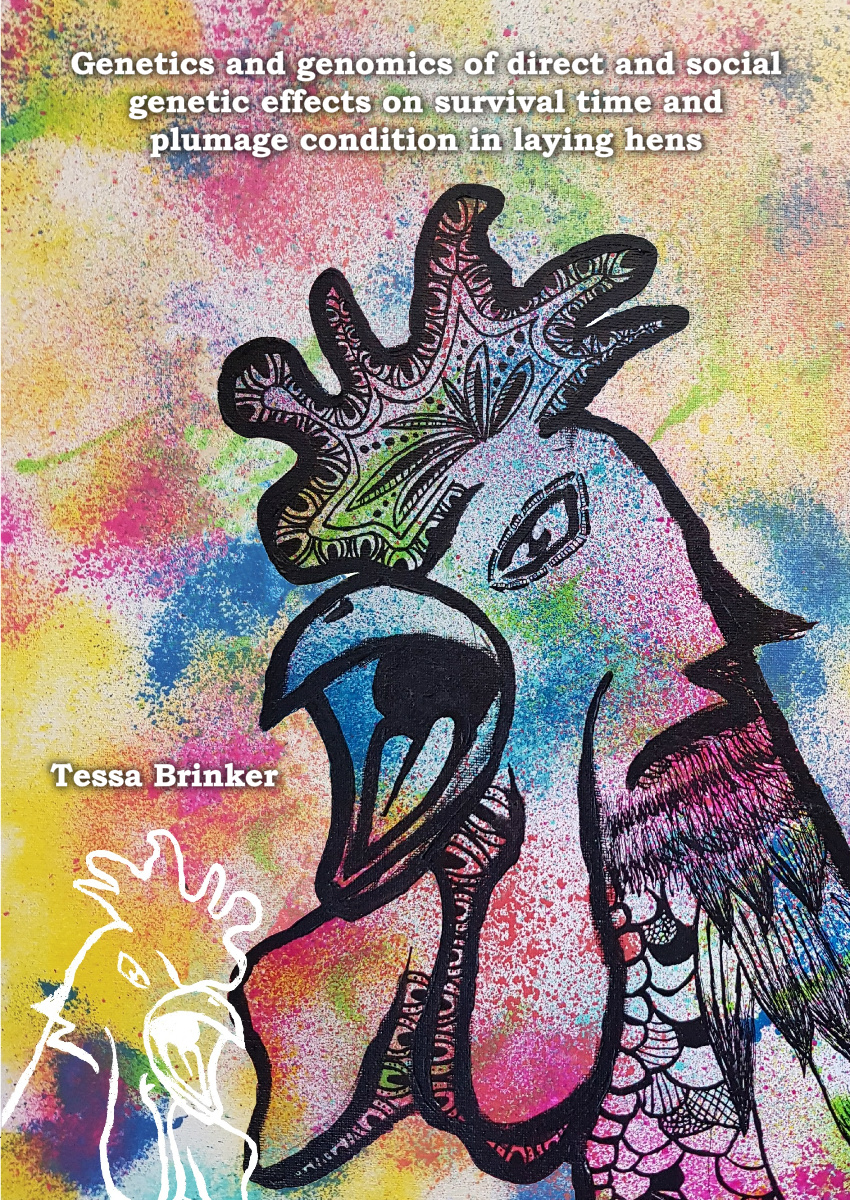


Genetics and genomics of direct and social genetic effects on survival time and plumage condition in laying hens
Social interactions are an integral component of life. They occur in both domestic and natural populations. Interacting individuals may affect each other’s characteristics. Examples are aggression in mink, cooperation in ants, and spouse effects in human. With social interaction traits, there are two distinct effects: the effect of an individual on its own phenotype (direct effect) and the effects of group mates on an individual’s phenotype (indirect effect). Direct and indirect effects can partly be genetically determined, where the phenotype of an individual depends on both the individual’s own genes (direct genetic effects; DGE) and the genes from its group mates (indirect genetic effects; IGE). This thesis focussed on cannibalistic interactions among laying hens which is one of the largest welfare problems in the egg production sector. Previous research showed that in order to reduce mortality due to cannibalism in laying hens, genetic solutions clearly need to consider both DGE and IGE. In this thesis, two traits that show the consequences of cannibalistic interactions are analysed using methods that incorporate both DGE and IGE: plumage condition (Chapter 2) and survival time (Chapter 3-5). Knowledge of the genetic parameters underlying a trait is required in order to estimate breeding values. The availability of these parameters will, moreover, provide more insight in the potential contribution of IGE to selection response. This thesis shows that up to 94% of the heritable variation in plumage condition (Chapter 2) and up to 61% of the heritable variation in survival time relates to IGE (Chapter 3). This indicates that methods of genetic selection that include IGE offer perspectives to improve plumage condition and survival time in laying hens. It is important that breeding values are estimated accurately because this will contribute to higher rates of genetic gain. Studies using DGE-IGE models have mostly focused on the trait survival time to reduce mortality due to cannibalism in laying hens. However, in these models, censored records were considered as exact lengths of life and models assumed that IGE were continuously expressed by all cage members, irrespective of whether they were alive or dead. Neglecting censoring and timing of IGE expression may reduce the accuracy of estimated breeding values. In Chapter 3, four models were considered to predict survival time in laying hens. One model was an analysis of survival time and the three other models treated survival in consecutive months as a repeated binomial trait. The latter three models can incorporate censoring and timing of IGE expression. The aim of this chapter was to investigate whether the accuracy of estimated breeding values was improved using the repeated measures models instead of using a model analysing survival time. Including the timing of IGE expression in the DGE–IGE model reduced accuracy of estimated breeding values compared to analysing survival time. Using repeated measures instead of analysing survival time increased accuracy of estimated breeding values up to 21%. Results in this thesis, therefore, suggest that prediction of breeding values for survival time in laying hens considering methods that can deal with censoring. This is an important result since more accurate estimates of breeding values contribute to higher rates of genetic gain. Separate estimation of DGE and IGE is not always possible. DGE and IGE can only be estimated based on pedigree information when hens are housed in groups composed of multiple families. Layer breeding organizations, however, often use recurrent testing, where hens are housed in sire-family groups and dam pedigree is unknown. Here, DGE and IGE are fully confounded. A sire model can be used to estimate the total breeding value (TBV) of the sire, which is the linear combination of the sire DGE and the sire IGE. There are, thus, two issues; the dam pedigree is unknown and separate estimation of DGE and IGE is not possible using pedigree information. Genomic information may solve both issues. First, genomic information provides the opportunity to reconstruct the dam pedigree which makes it possible to distinguish full-sibs from half-sibs. In turn, this may allow separate estimation of DGE and IGE, even when a group has the same sire (but not the same dam). Second, genomic information provides information on the actual genetic relationship between individuals. Actual genetic relationships between individuals vary around their expected value based on pedigree information because of linkage and Mendelian sampling. Thus, genomic information may provide new opportunities for estimation of genetic parameters when traits are affected by social interactions. In Chapter 4 it was, therefore, investigated whether DGE and IGE of survival time can be estimated separately for crossbred laying hens housed in sire-family groups using genomic information. However, the majority of these analyses did not converge and therefore a sire model which directly estimated the TBV was used. Estimates from a sire model using genomic information were compared to those from a sire model using pedigree information. In Chapter 4, there was no improvement in the accuracy of breeding value predictions using genomic information rather than using pedigree information. This was probably because of the limited number of sires and the use of a sire model. Moreover, Chapter 4 showed that, the total estimated heritable variance expressed as a proportion of phenotypic variance ranged from 3-25%. These results suggest that mortality due to cannibalism can be reduced by selection using a sire model, even though underlying DGE and IGE are unknown, because sire models capture the TBV. Genomic information is also used in Genome-Wide Association Studies (GWAS). GWAS are widely applied to a variety of traits and populations, but have been mainly focussed on DGE. Results from GWAS on DGE show that most quantitative traits in livestock are highly polygenic, and that variants tend to be associated with more than one trait (pleiotropy). The genetic architecture of IGE may, however, differ from the genetic architecture of DGE. With IGE, the phenotype of other individuals are affected rather than the phenotype of the individual itself (i.e. DGE). Selection targets such IGE only in the presence of feed-back mechanisms, using e.g. group selection or kin selection. IGE may, therefore, be less exposed to natural selection or artificial selection when not accounting for social interactions. In other words, selection has not exhausted variation due to IGE. It is, therefore, expected that some loci may have large IGE. However, only a handful of studies extended GWAS to include IGE. In Chapter 5, the aim was, therefore, to identify SNPs associated with direct and indirect effects for survival time in laying hens that show cannibalism. Moreover, GWAS results from analysis of survival time versus using repeated measures models were compared. Chapter 5 showed that the same quantitative trait loci were identified with all models. Moreover, GWAS results revealed SNPs with large DGE and a link of DGE and IGE for survival time in layers with the GABAergic system (GABBR2 gene), which supports existing evidence for the involvement of GABA in the development of abnormal behaviours. In Chapter 5, mortality due to feather pecking in laying hens was analysed in a single-SNP GWAS. Survival data of three layer crosses were used of which all originated from the same sire line but different dam lines. Results from this GWAS showed no consensus between the crosses. A possible reason is that SNP effects can differ among crosses due to different levels of linkage disequilibrium between the SNP and the QTL in the dam lines. Additional evidence that the origin of alleles may be important arises from the fact that detected SNPs (linking to GABBR2) were fixed or nearly fixed for the same allele in the maternal lines. This suggests that only the contribution of the paternal allele is important. Moreover, if allele-origin matters, the power for detection of SNPs associated with survival time is expected to increase when alleles are mapped specific to their allele origin. Chapter 6, therefore, aimed to map DGE and IGE for survival time, while considering the line origin of the alleles. However, accurately assigning the line origin to alleles (phasing), appeared to be challenging. Namely, new Mendel errors were identified after phasing (additional to the identified Mendel errors based on SNP genotypes). In Chapter 6 it is concluded that Mendel errors can have a large impact on the results of the analyses, even when the fraction of identified Mendel errors is small. Moreover, this thesis shows that repeating the quality control based on Mendel errors after phasing is an important step when conducting GWAS analyses with phased data, i.e. two Mendel error checks are required, one based on count data and one using phased data. Finally, Chapter 6, shows that the topic of this thesis is very relevant in the light of sustainable egg production, because i) it addresses important societal concerns, and ii) it contributes to sustainable development goal “End hunger” (SDG2) of the Food and Agricultural Organization of the United Nations.
| Publicatiedatum | 13 november 2020 |
| Universiteit | Wageningen University |
| Auteur | Wille |
| Order nummer | FTP-202604131103 |
| ISBN nummer | 978-94-6395-498-3 |