Tamara Van Gorkom
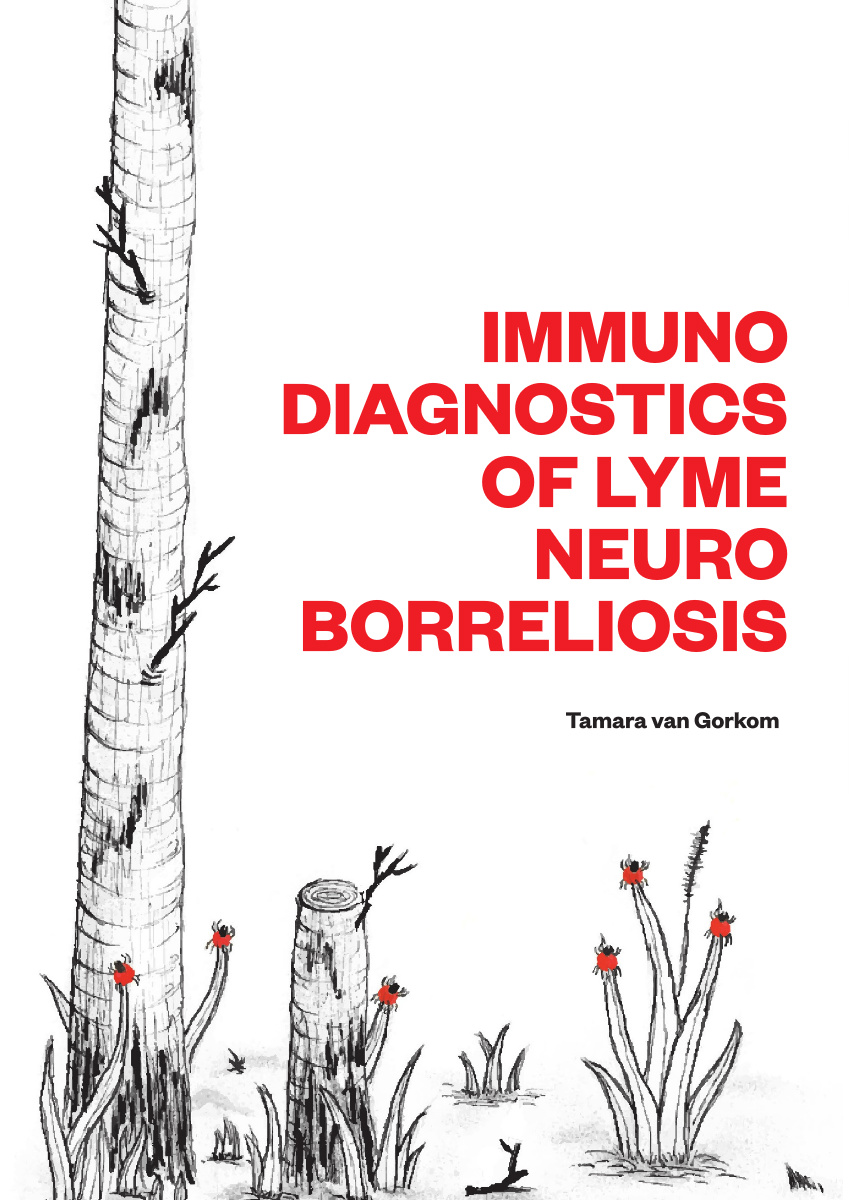


IMMUNODIAGNOSTICS OF LYME NEUROBORRELIOSIS
De ziekte van Lyme wordt veroorzaakt door spiraalvormige bacteriën, zogenaamde spirocheten, die onderdeel zijn van de Borrelia burgdorferi sensu lato (s.l.)-groep [1]. De drie meest voorkomende Borrelia species in Europa zijn: Borrelia afzelii, Borrelia garinii en Borrelia burgdorferi sensu stricto (s.s.), terwijl in Noord-Amerika met name B. burgdorferi s.s. voorkomt [2]. B. burgdorferi s.l. kan op de mens worden overgedragen door de beet van een met B. burgdorferi s.l. geïnfecteerde Ixodes-teek, welke met name voorkomt in gematigde gebieden op het Noordelijk halfrond [3]. Het meest voorkomende klinische beeld in de vroege fase van de infectie wordt gekarakteriseerd door een rode, zich langzaam uitbreidende huiduitslag, ook wel bekend als erythema migrans (EM) [2]. Indien onbehandeld, kan B. burgdorferi s.l. zich door het lichaam verspreiden, met name naar de gewrichten (Lyme artritis), het zenuwstelsel (Lyme neuroborreliose [LNB]), het hart (Lyme carditis) en/of naar andere locaties op de huid (acrodermatitis chronica atrophicans) [2]. De diagnostiek van de ziekte van Lyme richt zich in eerste instantie op de aanwezigheid van klinische symptomen. Het klassieke EM beeld is in principe voldoende om de diagnose te stellen [4, 5]. Is het huidbeeld onduidelijk, of is er sprake van een andere manifestatie van de ziekte van Lyme, dan zijn laboratoriumtesten nodig om de diagnose te kunnen stellen [4, 5]. Deze laboratoriumtesten zijn gebaseerd op het direct of indirect aantonen van B. burgdorferi s.l. [6]. Voor het direct aantonen van B. burgdorferi s.l. kan gebruik worden gemaakt van microscopie, kweek of PCR, echter, omdat de bacterie vaak in lage aantallen aanwezig is in de mens, is de sensitiviteit van directe detectiemethoden vaak laag [6]. Uitzondering hierop is het gebruik van PCR op huidbiopten (bij symptomen die passen bij EM of acrodermatitis chronica atrophicans) of synoviaal vocht (bij symptomen die passen bij Lyme artritis) [6]. Het indirect aantonen van B. burgdorferi s.l. is gebaseerd op de reactie van het immuunsysteem op de bacterie, en dan met name op het aantonen van antistoffen [6]. Het diagnosticeren van actieve Lymeziekte kan uitdagend zijn. Enerzijds zijn de symptomen vaak moeilijk te interpreteren en/of niet Lyme-specifiek [4]. Daarnaast kan de interpretatie van laboratoriumtesten ingewikkeld zijn: een negatieve antistoftest hoeft geen bewijs te zijn voor de afwezigheid van actieve Lymeziekte, en een positieve antistoftest hoeft geen bewijs te zijn voor actieve Lymeziekte [7]. Vanwege deze diagnostische uitdagingen, richt het onderzoek in dit proefschrift zich op de vraag of de huidige diagnostiek van de ziekte van Lyme verbeterd kan worden en of er onderscheidt gemaakt kan worden tussen een actieve infectie en een in het verleden doorgemaakte infectie. Om deze vragen te kunnen beantwoorden zijn huidige en alternatieve diagnostische testen en/of algoritmes geëvalueerd, waaronder veelgebruikte diagnostische testen gebaseerd op de humorale immuunrespons (d.w.z., de detectie van Borrelia-specifieke antistoffen) en alternatieve diagnostische testen gebaseerd op de cellulaire immuunrespons (d.w.z., de detectie van bepaalde signaalstoffen geproduceerd door zogenaamde T cellen). Voor dit onderzoek is een studiepopulatie opgezet bestaande uit goed gedefinieerde patiënten en controles. Omdat er duidelijke criteria bestaan voor het diagnosticeren van patiënten met LNB, hebben we ons met name gericht op deze patiëntengroep. Patiënten hebben LNB als ze voldoen aan ten minste twee van de volgende drie criteria, welke gesteld zijn door de Europese Federatie van Neurologische Verenigingen (European Federation of Neurological Societies [EFNS]) [8]: 1. Aanwezigheid van neurologische symptomen wijzend op LNB zonder een duidelijke andere oorzaak 2. Verhoogde cel aantallen in de liquor (≥5 leukocyten/μl liquor [pleiocytose]) 3. Intrathecale synthese van Borrelia-specifieke antistoffen Voldoet een patiënt aan alle criteria, dan krijgt de patiënt de classificatie ‘definitieve LNB’; voldoet een patiënt aan twee van de drie criteria (waaronder in ieder geval de aanwezigheid van neurologische symptomen wijzend op LNB zonder een duidelijke andere oorzaak), dan krijgt de patiënt de classificatie ‘mogelijke LNB’. De detectie van intrathecaal geproduceerde Borrelia-specifieke antistoffen is dus van belang voor de diagnostiek van LNB. Er zijn echter veel verschillende antistoftesten op de markt en de prestatiekarakteristieken van veel van deze antistoftesten zijn vaak moeilijk te interpreteren vanwege de variabiliteit in studie-opzet, de heterogeniteit van de onderzochte studiepopulaties en de matige rapportage van gebruikte studiekarakteristieken [9]. Idealiter wordt er voor het bepalen van de prestatiekarakteristieken van testen gebruik gemaakt van een prospectieve cross-sectionele studie-opzet in een klinische setting waarin de test uiteindelijk ook gebruikt gaat worden. Desondanks worden er vaker ‘case-control’ (d.w.z., patiënten versus controles) studies uitgevoerd, omdat deze makkelijker zijn uit te voeren [9]. Echter, dergelijke studies hebben wel een groter risico op gebiaste resultaten. Deze bias wordt verklaard doordat de onderzochte controlegroep vaak niet dezelfde klinische achtergrond heeft als de onderzochte patiëntengroep, waardoor de gevonden resultaten geen goede weergave geven van de werkelijkheid [9]. De belangrijkste bevinding van het onderzoek in dit proefschrift zijn de veelbelovende resultaten beschreven in hoofdstuk 6, omdat deze bevindingen artsen zullen helpen bij het diagnosticeren van LNB. In dit hoofdstuk zijn zeven antistoftesten voor de diagnostiek van LNB geëvalueerd. Hierbij is gebruik gemaakt van een cross-sectionele studie-opzet, waarbij retrospectief alle opeenvolgende patiënten van de afdeling neurologie zijn geïncludeerd, waarvan een liquor-serum paar was ingestuurd naar het medisch microbiologisch laboratorium van het Diakonessenhuis gedurende een bepaalde tijdsperiode. Tevens is er voor elke antistoftest een multiparameter analyse uitgevoerd om te onderzoeken of de prestatiekarakteristieken van de antistoftest verbeterd konden worden door het meenemen van extra parameters. Deze extra parameters betroffen een aantal routinematige liquor parameters (pleiocytose, totaal eiwit, bloed-liquor barrière functionaliteit en intrathecale totale antistofsynthese), een Borrelia-specifieke (Borrelia species PCR) en een niet-specifieke liquor parameter (B-cel chemokine (C-X-C motief) ligand 13 [CXCL13]), en een Borrelia-specifieke serum parameter (Borrelia-specifieke antistoffen in het bloed). De resultaten van deze multiparameter analyses laten zien dat het gebruik van additionele parameters voor de diagnostiek van LNB in de meeste gevallen leidt tot een hogere sensitiviteit (variërend van 94,1% tot 100%) en een iets lagere specificiteit (variërend van 92,8% tot 96,4%) dan de sensitiviteit en specificiteit van de gevalideerde antistoftest zelf (variërend van 47,1% tot 100% en van 95,7% tot 100%, respectievelijk). De belangrijkste parameters die bijdragen aan een verbetering van de LNB diagnostiek zijn intrathecaal geproduceerde Borrelia-specifieke antistoffen, bloed-liquor barrière functionaliteit, intrathecale totale antistofsynthese, pleiocytose, CXCL13 in de liquor, en Borrelia-specifieke antistoffen in het bloed. Alhoewel meerdere studies de toegevoegde waarde van deze parameters voor de diagnostiek van LNB laten zien [8, 10-12], is onze studie de eerste die de relatieve bijdrage van deze parameters laat zien. Tevens toont Onze studie aan welke parameters het meeste bijdragen en derhalve geschikt zijn om gebruikt te worden in een diagnostisch algoritme voor het aantonen van actieve LNB. Onze studie laat ook zien dat het meten van zowel de humorale als de cellulaire immuunrespons tegen een infectie met B. burgdorferi s.l. bijdraagt aan de diagnostiek van LNB, en dat individuele parameters (fout) negatief of (fout) positief kunnen zijn, maar toch een toegevoegde waarde hebben in breder verband. We zijn van mening dat deze resultaten dermate veelbelovend en belangrijk zijn dat een validatie met meerdere centra nodig is. We stellen daarom voor om, in samenwerking met andere (inter)nationale laboratoria, een prospectieve studie op te zetten om te onderzoeken of een gestandaardiseerd diagnostisch algoritme ontwikkeld kan worden voor de diagnostiek van LNB gebaseerd op een multiparameter analyse. De resultaten van de multiparameter analyses in hoofdstuk 6 tonen aan dat van de onderzochte parameters, de detectie van intrathecaal geproduceerde Borrelia-specifieke antistoffen het meeste bijdraagt aan de diagnostiek van LNB. Voor de detectie van pathogeen-specifieke antistoffen wordt veelal gebruik gemaakt van een enzym-linked immunosorbent assay (ELISA) [4]. ELISAs kunnen echter last hebben van een zogenaamd ‘randeffect’ [13]. Er is sprake van een randeffect als het resultaat van de metingen van eenzelfde antistofconcentratie in welletjes in de randen van de ELISA plaat hoger (of lager) zijn dan de metingen in welletjes in het midden van de ELISA plaat. Wanneer er sprake is van een randeffect in een ELISA plaat, kan dit gevolgen hebben voor de patiënten materialen die hierin getest worden. In hoofdstuk 5 is aangetoond dat er sprake is van een randeffect bij gebruik van de commerciële Enzygnost Lyme link VlsE/ IgG ELISA. Er is tevens aangetoond dat bij gebruik van deze ELISA voor de diagnostiek van LNB, de gevolgen van dit randeffect verminderd kunnen worden door een kleine aanpassing in het standaardprotocol van de producent. Dit aangepaste protocol werd vervolgens gebruikt om 149 liquor-serumparen te testen, afkomstig van de iets grotere monstercollectie gebruikt in hoofdstuk 6 (en 4). Middels simulatie werd aangetoond dat als het standaardprotocol van de producent zou zijn gebruikt, het randeffect voor deze studiepopulatie in het slechtste scenario had kunnen resulteren in 15 (10,1%) fout-positieve en twee (1,3%) fout-negatieve Borrelia-specifieke immunoglobuline (Ig)G antistof index resultaten. Het aangetoonde randeffect kan dus leiden tot foutieve LNB diagnostiek. De onderzoeksresultaten in hoofdstuk 5 benadrukken het belang van een grondige validatie van ELISA testen voordat ze gebruikt worden voor routine diagnostiek, zoals bijvoorbeeld ook wordt vereist in de voorwaarden voor de ISO 15189-accreditatie [14]. Voor de diagnostiek van de meeste andere Lyme manifestaties wordt gebruik gemaakt van de detectie van Borrelia-specifieke antistoffen in het bloed, waarvoor een twee-staps teststrategie wordt geadviseerd [5, 15]. Deze twee-staps teststrategie heeft tot doel de diagnostische prestaties van antistoftesten te verbeteren door te starten met een test met een hoge sensitiviteit (d.w.z., een screening test) en dubieuze en positieve test uitslagen verkregen met de screening test te confirmeren met een tweede (confirmatie) test met een hoge specificiteit [7, 16, 17]. Vaak wordt voor de screening test gebruik gemaakt van een ELISA en voor de confirmatietest van een western blot (Noord-Amerika) of een immunoblot (Europa) [7]. Antistoftesten kunnen variëren in sensitiviteit, zoals is aangetoond in hoofdstuk 6, bijvoorbeeld doordat de antigenen in de test niet overeenkomen met de antigenen die tot expressie worden gebracht door de Borrelia bacterie die de infectie veroorzaakt. Deze mismatch kan veroorzaakt worden door de intra- en interspecies heterogeniteit van B. burgdorferi s.l [11, 18-22] en/of de antigene variatie van de infecterende stam tijdens het verloop van de infectie [23]. De sensitiviteit van een antistoftest kan ook beïnvloed worden door vroegtijdig antibiotica gebruik, wat de immuunrespons kan afbreken [24-28]. Dit antibiotica effect lijkt antistof-specifiek, aangezien antistoffen tegen het C6-peptide sneller afnemen dan antistoffen gericht tegen een cel lysaat van B. burgdorferi s.l [29, 30] of het p39-eiwit [29]. In hoofdstuk 7 zijn twee screening testen (de C6 ELISA en de Serion ELISA) en twee twee-staps teststrategieën (confirmatie van dubieuze en positieve C6 ELISA en Serion ELISA resultaten met de recomLine immunoblot) voor het detecteren van Borrelia-specifieke antistoffen in bloed geëvalueerd. Het onderzoek in dit hoofdstuk toont aan dat antibiotische behandeling van een infectie met B. burgdorferi s.l sterk geassocieerd is met discordante screening test (ELISA) resultaten en twee-staps teststrategie (ELISA + immunoblot) resultaten (odds ratio [OR]: 10,52; P < 0,001 en OR: 9,98; P = 0,014, respectievelijk). Dit suggereert dat antibiotische behandeling van invloed is op het tempo waarin de antistoffen gericht tegen de verschillende antigenen in de ELISAs afnemen, waarbij antistoffen tegen het C6 peptide iets sneller lijken af te nemen dan die tegen cel lysaten van B. burgdorferi s.l., en bevestigt eerdere bevindingen [29, 30]. De discordante testresultaten in onze studie worden met name verklaard door de aanwezigheid van IgM tegen het buitenmembraan eiwit (outer surface protein) OspC, en in sommige gevallen ook tegen het p41 flagel, zoals ook in eerdere studies is aangetoond [31, 32]. Deze resultaten onderschrijven de uitdagingen rondom de interpretatie van antistoftesten, waarmee men rekening dient te houden bij het gebruik van dergelijke testen voor de diagnostiek van de ziekte van Lyme. In de vroege fase van een infectie zijn de antistoffen vaak nog niet aantoonbaar vanwege de nog opbouwende immuunrespons. Daarom zijn er nieuwe infectiemarkers nodig met een hoge sensitiviteit en specificiteit, met name in de beginfase van een infectie. In de afgelopen twee decennia zijn er steeds meer studies verschenen die de toegevoegde waarde laten zien van het aantonen van verhoogde concentraties van CXCL13 in de liquor van patiënten met een vroege LNB [33, 34]. De detectie van CXCL13 in de liquor is relatief eenvoudig in tegenstelling tot de vaak lastige berekeningen die nodig zijn voor het aantonen van de intrathecale synthese van Borrelia-specifieke antistoffen. In hoofdstuk 4 zijn twee commerciële CXCL13-testen (de Quantikine CXCL13 ELISA en de recomBead CXCL13 test) op liquor voor de diagnostiek van LNB geëvalueerd. Gebruikmakend van dezelfde studiepopulatie als in hoofdstuk 6 (en bijna dezelfde studiepopulatie als die in hoofdstuk 5), is aangetoond dat het meten van CXCL13 in de liquor van toegevoegde waarde kan zijn voor het diagnosticeren van patiënten met een actieve LNB. Verder is aangetoond dat CXCL13 eerder in de liquor kan worden gedetecteerd dan intrathecaal geproduceerde Borrelia-specifieke antistoffen, en dat de bepaling van CXCL13 in de liquor met name van toegevoegde waarde is voor het aantonen van vroege LNB. De cutoff waardes voor beide testen verschillen echter wel, wat mogelijk verklaard kan worden door een verschil in methodiek [35]. Echter, in de literatuur worden ook verschillende cutoff waardes gerapporteerd bij gebruik van dezelfde testen [35-41]. Dit benadrukt de noodzaak voor verder onderzoek naar de oorzaak van deze verschillen en de mogelijkheden om een internationale referentiestandaard vast te stellen voor CXCL13 in de liquor. De productie van CXCL13 in de liquor is onderdeel van de cellulaire immuunrespons. De cellulaire immuunrespons tegen B. burgdorferi s.l. wordt gekarakteriseerd door een sterke T helper (Th)1 respons, waarbij T cellen Th1-cytokines gaan produceren, waaronder interferon-gamma (IFN-γ). In de afgelopen jaren zijn er ook andere testen beschikbaar gekomen die zich richten op de cellulaire immuunrespons. Eén van deze testen is de enzym-linked immunospot (ELISpot) test waarmee Borrelia-specifieke IFN-γ producerende T cellen worden aangetoond. In Hoofdstuk 2 en 3 zijn twee van dergelijke testen voor de diagnostiek van LNB geëvalueerd; een zelf ontwikkelde (zgn. ‘in-house’) Borrelia ELISpot test en de commerciële LymeSpot test. Veel Lymepatiënten gaan naar Duitsland waar commerciële IFN-γ ELISpot testen worden gebruikt, terwijl de klinische validatie van deze testen bij goed gedefinieerde patiëntengroepen ontbreekt. Echter, indien de IFN-γ ELISpot testuitslag bij deze patiënten positief is, wordt er vaak (langdurig) antibiotica gegeven voor de behandeling van actieve Lymeziekte [42]. Voor de evaluatie van de twee IFN-γ ELISpot testen in deze thesis werd gebruik gemaakt van een prospectieve ‘case-control’ studie, bestaande uit actieve LNB patiënten (cases), en drie controlegroepen bestaande uit behandelde LNB patiënten, en gezonde vrijwilligers met, en zonder een voorgeschiedenis van behandelde Lymeziekte (met name cutaan). De studies in hoofdstuk 2 en 3 tonen aan dat de onderzochte IFN-γ ELISpot testen niet geschikt zijn om actieve LNB te diagnosticeren. De aanwezigheid van Borrelia-specifieke T-cel reactiviteit was vergelijkbaar tussen actieve LNB patiënten, behandelde LNB patiënten en behandelde gezonde vrijwilligers, en deze reactiviteit was hoger dan de Borrelia-specifieke T-cel reactiviteit bij onbehandelde gezonde vrijwilligers. De verhoogde Borrelia-specifieke T-cel reactiviteit bij beide behandelde groepen wordt waarschijnlijk verklaard door een eerdere, genezen ziekte van Lyme. De IFN-γ ELISpot test lijkt derhalve onderscheid te maken tussen Borrelia-naïeve en Borrelia-geïnfecteerde individuen. CONCLUSIE Wij zijn van mening dat het onderzoek in dit proefschrift heeft bijgedragen aan de doelen van dit proefschrift. De belangrijkste bevinding van dit proefschrift is het veelbelovende resultaat van het gebruik van meerdere parameters voor de diagnostiek van LNB (hoofdstuk 6), waarbij zowel de humorale als de cellulaire immuunrespons een belangrijke rol spelen (hoofdstukken 4 en 6). Het combineren van verschillende parameters in een diagnostisch algoritme, waarbij verschillende aspecten van het immuunsysteem in ogenschouw worden genomen, geeft concrete en direct uitvoerbare handvatten om een duidelijker onderscheid maken tussen een actieve infectie en een eerdere doorgemaakte infectie en zal de diagnostiek van LNB verbeteren. We zijn ook van mening dat de ontwikkeling van een diagnostisch algoritme van toegevoegde waarde kan zijn voor de diagnostiek van andere Lyme manifestaties. De variatie in de onderzochte ELISA in hoofdstuk 5 benadrukt het belang van het uitvoeren van een gedegen validatie van diagnostische testen alvorens deze worden gebruikt in de routinediagnostiek. Als alle laboratoria dit doen, en dus goed inzicht hebben in de (on) mogelijkheden van de test die zij gebruiken, zal de diagnostiek van de ziekte van Lyme verbeteren. In hoofdstuk 7 is aangetoond dat antibioticagebruik invloed heeft op de humorale immuunrespons. Dit kan eventuele verschillen in de resultaten tussen verschillende antistoftesten verklaren en dit zal zowel de laboratorium-specialisten als de artsen helpen bij het interpreteren van de resultaten van antistoftesten. Tot slot geeft de gedegen evaluatie van twee IFN-γ ELISpot testen (hoofdstukken 2 en 3) inzicht in de beperkingen van deze testen om actieve LNB aan te tonen en dit is van belang voor artsen én patiënten. Hopelijk zal dit het onnodig antibioticagebruik op basis van onterechte diagnoses, gesteld op basis van IFN-γ ELISpot testuitslagen, beperken. De resultaten van beide studies bieden ook een basis waarmee artsen in gesprek kunnen gaan met patiënten in het geval dat patiënten elders met soortgelijke testen gediagnosticeerd zijn.
| Publicatiedatum | 8 december 2022 |
| Universiteit | Universiteit Leiden |
| Auteur | Tamara Van Gorkom |
| Order nummer | FTP-202604101023 |
| ISBN nummer | 978-94-646-9091-0 |