Suzanne Haeyen
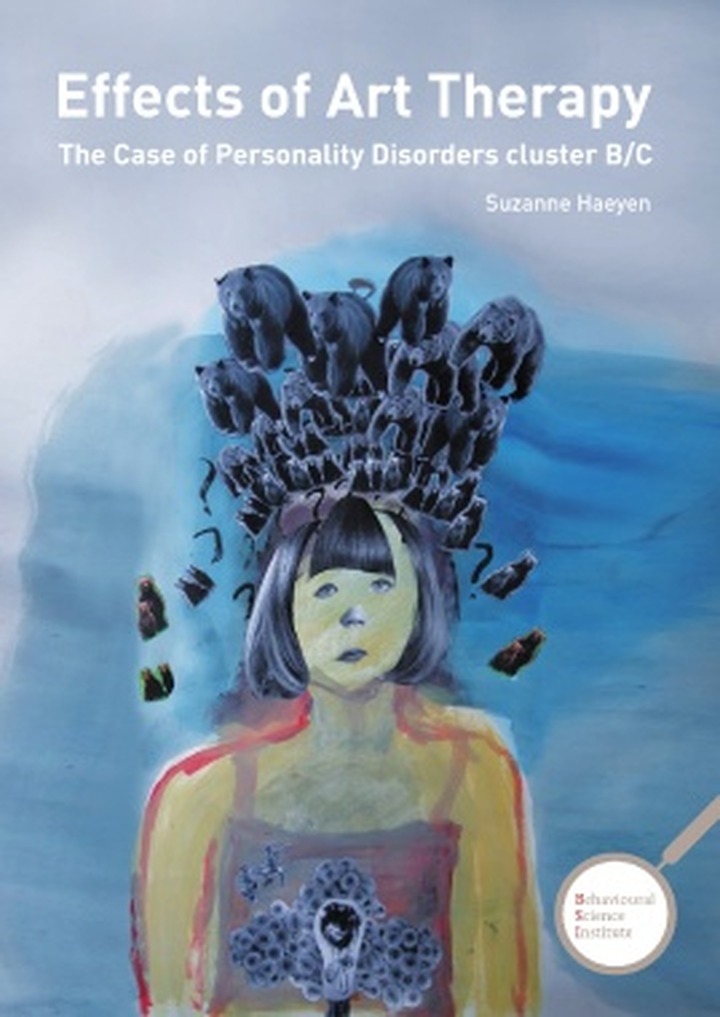


EFFECTS OF ART THERAPY
Quality improvement of art therapy The process of articulating and standardizing (art therapy) interventions in mental health care practice has started several years ago, with the growing substantiation of interventions by implementing evidence-based practice and practice-based evidence. Art therapy is better and more explicitly described, has become more explicit and more transparent, for example, by explicating modules as elements of a treatment programme. For art therapy, this process involves a change in method; less intuitive, less solely process-oriented and more explicit by using predetermined goals often translated in modules with a fixed duration, and methodology. Art therapy opens itself to a measurable and methodically communicable way of working (ZiN, 2015). This process does not necessarily change art therapy itself, as suggested in the quote from Pablo Picasso: “learn the rules like a pro, so you can break them like an artist” (RVS, 2017). Many art therapists feel comfortable with an artist’s perspective. They prefer the creative, revealing an open space in therapy, in which creativity can flourish and new ideas and creations arise. However, art therapists have a responsibility in working towards therapeutic goals of people who seek aid for their mental problems. This requires strategies and plans, as well as tuning-in. Although personality disorder problems are frequently complex, a standardized treatment offers a helpful therapeutic structure, in which tuning-in is still as important as ever. Art therapy will profit from inclining more towards planning, standardizing, using protocols and directives, although some art therapists might perceive this as restrictive or static. For art therapy in general, standardizing is necessary in the steps needed for research and to counter the diverse and diffuse image of this profession. This also means leaving the idea that this profession does not fit research. Based on combined empirical findings, theoretical models, and clinical practice experience, programmes can be constructed, fitting the needs of specific target groups. These art therapy programmes could (and should) be developed, described and tested in a clear and systematic way. Art therapists improve the quality of their interventions by paying systematic attention to the aim of symptom reduction next to enhancing positive mental health. This is a consequence of the perspective on art therapy as also a specific therapy to reduce specific symptoms as described in the findings in Chapter 6. With this pointed out, one should be critical about the traditional theoretical assumptions of art therapy. Further research There is a considerable theoretical, as well as practical need for more investigation into art therapy and its effects. To improve ‘the state of the science and practice’ of art therapy we need to further clarify the impact of art therapy on mental health. This knowledge should be based on an integration of research knowledge, clinical expertise and preferences of patients, i.e. the principles of Evidence Based Practice (RVS, 2017). For example, it would be important to further substantiate the use of art therapy in treatment programmes, not only for patients with personality disorders but also for patients with anxiety, mood and cognitive disorders like schizophrenia and dementia. It also would be interesting to know how art therapy stimulates non-specific effects but, based on our results, we esteem it more urgent to look specific factors and effects of art therapy. What exactly are the specific working mechanisms of art therapy? Effects on other mental disorders. Our study has been on the efficacy of art therapy on personality disorders. The choice for this patient group has been rather practical (my own expertise and interest, availability of patients). It would certainly be of high interest to investigate in research on efficacy of art therapy in other mental disorders. Art therapy is often part of treatment programs for patients with anxiety and mood disorders. Art therapy is also used in the treatment of patients with psychotic symptoms as well as in treatment programs for older patients suffering from dementia. We do not see any reason why art therapy would be less effective in the treatment for those patient groups. We strongly recommend starting research on the efficacy of art therapy for other mental disorders. If comparable designs are used, we could compare the results and use them as a first indicator of the specificity of art therapy. Differentiation of specific and non-specific factors. This could also be a focus of further art therapy research. Of course, art therapy makes use of non-specific factors, like focussed attention, hope, working methodically with treatment goals, as any other therapy does. This helps patients to get moving forward and provides hope. We think that the treatment effects of art therapy as shown in this dissertation cannot be reduced to non-specific factors alone. Also specific factors are at stake, i.e. factors directly related to a specific therapy. We strongly recommend investigating these effects due to art therapy by comparing art therapy directly with another therapy, for example with Dialectical Behaviour Therapy or Acceptance and Commitment Therapy. This research question first needs an appropriate theoretical framework concerning the specific effects of both treatments. Next, it also needs a specific RCT design, in which both treatment groups function at the same time, as experimental group and as control group of each other. Although this design would require a large sample, we would not expect any larger overall differences between both groups. However, we think it would be relatively easy to realize in a specific outpatient clinical setting. Another design to be considered is an ‘add-on’ design, in which treatment as usual (TAU) is compared to TAU combined with additional art therapy. With this design, the added value of art therapy could be explored, as well as the unique and specific effects of art therapy, compared to the treatment as usual. This type of research could also directly provide an insight into the effects of recent trends in mental health care of ruling out art therapy from evidence based treatment programmes. Although this design has high ecological value and provides figures to contribute to the actual political discussion about the usefulness of art therapy in multidisciplinary treatment programmes, we do not think this type of research will easily lead to unambiguous outcomes. First of all, it requires a very large number of participants in order to gain enough power to provide significant differences in outcome. Moreover, it will be difficult to realize such a study in mental health care practice, because daily practice is often inconsistent and shows important transformations over time. Moreover, in these treatment programmes patients quite often discontinue therapy. Also, ethical aspects can be at stake, because this design could imply limitations in other treatment possibilities for patients in need of psychological support. Specific art therapy factors and effects. Further research could also be performed on specific art therapy-factors, like working with different materials and techniques. One question that has been unanswered yet is what role the art medium played in achieving positive outcome. It would be interesting to interview the patients who participated in the RCT to find out what specific art therapy factors were at stake and to what extent e.g. art assignments, material interaction, preferred approach of the art process by evaluating experiences with the art medium from patient and expert perspectives with a focus on emotion regulation. The aim of this would be to determine a causal explanation (Lub, 2014) for why art therapy led to the effects achieved by the RCT intervention to add to the causal relation found in the RCT. It would certainly be interesting to explore if different materials have different physiological effects e.g. on arousal, measured with physiological outcome measures. CONCLUSION This dissertation has been one of the first serious attempts to explore effects of art therapy. Its main conclusion is that art therapy in patients with personality disorders of clusters B or C is effective. We have found that art therapy has several beneficial effects for personality disorder patients (Chapters 2, 5 and 6). First, it is effective in reducing mental illness: in reducing general mental disfunctioning, and in reducing specific symptoms of personality disorders of clusters B or C like early maladaptive behaviours or states (impulsivity, detachment, vulnerability and punitive behaviours). Second, it enhances adaptive modes (pleasant feeling and self-regulation) and ameliorates positive mental health; it increases well being and other positive measures. Finally, unpleasant inner thoughts, feelings, and physical sensations appear to be more easily accepted. Because negative and positive health outcomes are highly correlated this asks for a reappraisal of the relation between negative and positive health outcomes. Some of the effects are the result of non-specific factors, while others appear related to art therapy itself. We think that the strengths of art therapy are: the direct, experiential therapeutic entry, the possibility for the art therapist to approach the patient and his problems in an indirect way and the qualities involved in working with art materials, the art process and art product. Further research is needed to explore the effects of art therapy and to relate them to the underlying working mechanisms of art therapy. Meanwhile we strongly advise mental health care to invest in more art therapy for their patients with personality disorders. It offers good outcomes in a short time.
| Publicatiedatum | 14 maart 2018 |
| Universiteit | Radboud Universiteit |
| Auteur | Suzanne Haeyen |
| Order nummer | FTP-202604100929 |
| ISBN nummer | 978-94-6295-831-9 |