Siyu Sun
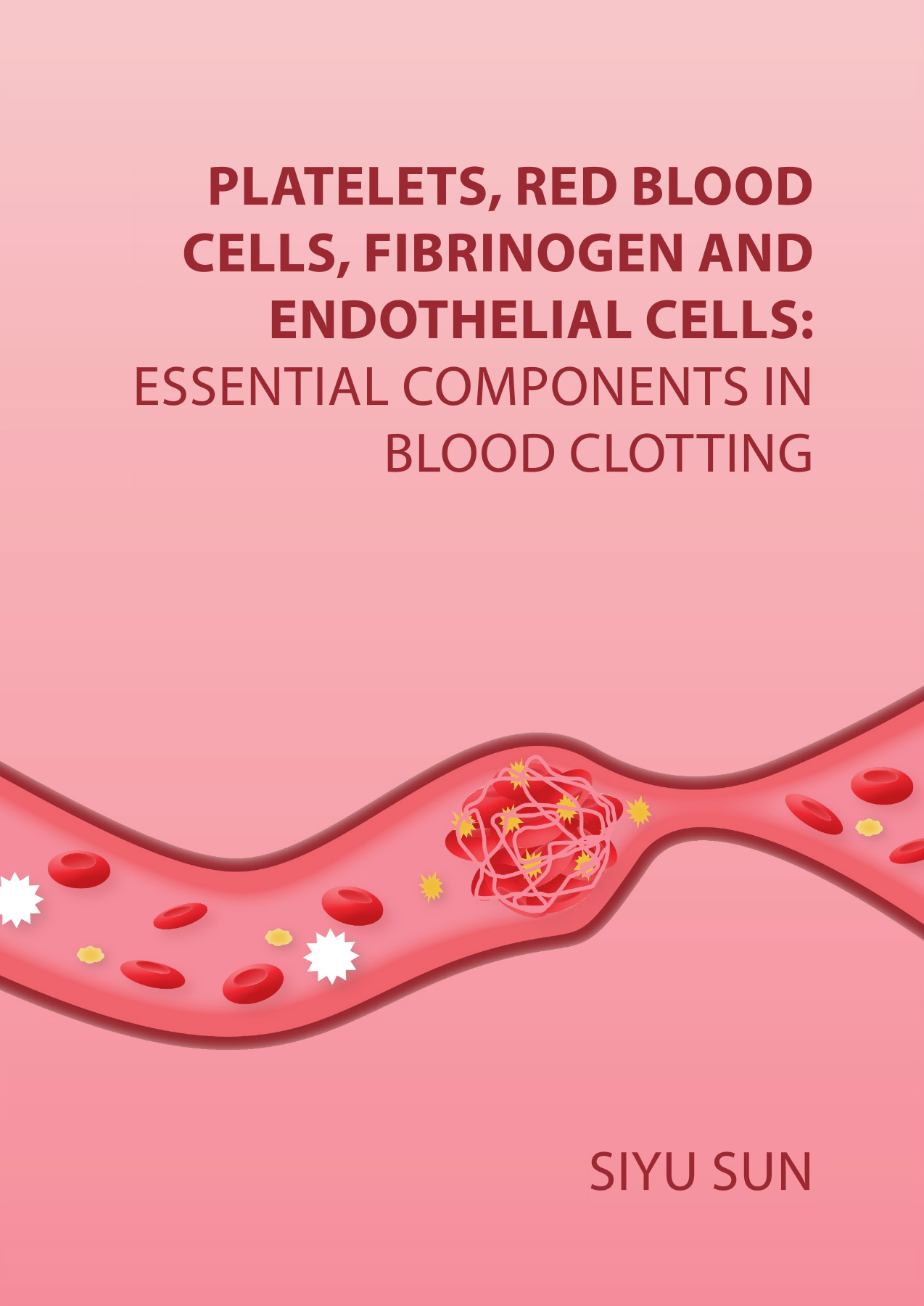


Platelets, Red Blood Cells, Fibrinogen and Endothelial Cells: Essential Components in Blood Clotting
In this thesis, I focus on several of the complex and intricate coagulation processes, to better know the roles of platelets, red blood cells, fibrin and endothelial cells in the context of haemostasis and thrombosis. Chapter 1 provides a general introduction presenting the main pathways of the coagulation process and their importance. Platelet receptors and signalling mechanisms were furthermore introduced, in particular the collagen and fibrin(ogen) receptor glycoprotein VI (GPVI) together with integrin αIIbβ3. Also given is background knowledge on the influence of other blood cells in relation to coagulation, (limitations of) the measurements of thrombin generation, as an integrative coagulation assay, and information on novel camelid-derived single-domain nanobodies for studying platelet and coagulation activation. Chapter 2 presents an overview of the reported molecular causes and consequences of immune-induced thrombocytopenia (i.e. low platelet counts) as most common forms of autoimmune disorders. The disorders described include idiopathic and thrombotic thrombocytopenic purpura, systemic lupus erythematosus, antiphospholipid syndrome, drug-induced thrombocytopenia, heparin-induced thrombocytopenia, Covid-19 vaccine-induced thrombosis with thrombocytopenia, and the so-called HELLP syndrome (haemolysis, elevated liver enzymes and low platelets). For each disease or syndrome, we review the platelet receptors that bind the inducing auto-antibodies, the involved immune complexes, and the evidence for pathogenic effects of damage associated molecular patterns and complement factors. In addition, we review how circulating platelets can serve as a reservoir of immunomodulatory molecules. We conclude that there possibly is a central role of the platelet FcγRIIA receptors, but to which extent is still unclear. The antibody-activated platelets in turn modulate the innate and adaptive immune systems by releasing multiple pro-inflammatory and immune mediators. We highlight that the discussed platelet-based pathways that can predispose for thrombocytopenia as well as thrombotic and bleeding events. In Chapter 3 we aim to elucidate the signalling pathways that differentiate between a permanent or transient activation state of platelets. We explored the pathways induced by GPVI and by the protease-activated receptors (PAR1/4) for thrombin, in each case for their ability to induce time-dependent integrin αIIbβ3 activation and platelet aggregation. We found that pretreatment of the cells with given pharmacological inhibitors suppressed the agonist-induced αIIbβ3 activation (along with P-selectin expression) in the target order of protein kinase C (PKC) > glycogen synthase kinase 3 > β-arrestin > phosphatidylinositol-3-kinase. Posttreatment revealed a secondary αIIbβ3 inactivation (not P-selectin expression) in the same order, but the reversibility was confined to GPVI and PAR1 agonists. Platelet pre- and posttreatment with ticagrelor, blocking the P2Y12 receptors for ADP, caused inactivation of the integrin. Platelet spreading assays showed that the blockage of either PKC or P2Y12 partially induced the conversion from a more activated to a more resting platelet shape. We concluded that both PKC and autocrine ADP signalling contribute to a persistent integrin αIIbβ3 activation and hence a stable platelet aggregation. These findings are relevant for the optimisation of antiplatelet treatment. Chapter 4 concentrates on the coagulation capacity of red blood cells and platelets in the context of bleeding and thrombotic disorders. Using a new high-throughput method of whole-blood thrombin generation, such in comparison to autologous platelet-rich plasma, we could define the contributions of all blood cell to the clotting process. We observed a faster and initially higher generation of thrombin and a shorter coagulation time in whole blood than in platelet-rich plasma. This was the case for a range of low coagulant triggers, including tissue factor, Russell's viper venom, factor Xa, factor XIa and thrombin. Thrombin generation accelerated with the hematocrit level but delayed after prior treatment of red blood cells with the phosphatidylserine-blocking annexin A5. In reconstituted blood samples, a prior selective blockage of phosphatidylserine on red blood cells enhanced the GPVI-dependent platelet procoagulant activity. In patients with anaemia or erythrocytosis, cluster analysis revealed distinct thrombin generation profiles, which still were dependent on phosphatidylserine exposure of the red cells. We concluded that both red blood cells and platelets, in a phosphatidylserine-dependent way, contribute to the thrombin generation. Determination of the whole blood hypo-or hyper-coagulant activity may help to characterise a bleeding or thrombosis risk. The topic of Chapter 5 is assessment of the contribution of plasma fibrinogen and fibrin to the clotting process. We describe the effects of a novel nanobody, Nb106, which recognises an epitope on fibrin but not on fibrinogen. In whole blood or plasma, Nb106 dose-dependently lowered the tissue factor-induced thrombin generation up to 50%, without affecting the kinetics. Importantly, Nb106 was no longer effective in the absence of fibrinogen or antithrombin, while it continued to block thrombin generation in the absence of factors IX-XII, thrombomodulin, activated protein C or oral anticoagulants. We concluded that there exist a considerable pool of proteolytically active, fibrin-bound thrombin that is protected for antithrombin inactivation. Further experiments indicated that this fibrin-bound pool of thrombin is responsible for the formation of fibrin fibers. In the absence of this pool, with Nb106 present, the fibrin fibers distort to clumped structures. Moreover, it is needed for clot retraction and proper flow-dependent fibrin formation at low shear rate. Thrombin generation was less suppressed by Nb106 in plasmas from patients with congenital dysfibrinogenemia, when compared to plasmas from a cohort of control subjects. Collectively, these findings highlight the role of fibrin-bound thrombin in proper clot formation and make it a potential therapeutic target in blood-borne diseases. In Chapter 6, we observed that an increase in fibrinogen level enhanced GPVI-induced platelet activation in terms of P-selectin expression, in particular at low agonist doses. In support of this finding, we determined that fibrinogen dose-dependently increased the process of thrombin generation in platelet-rich plasma both in the presence and absence of external GPVI agonist. These fibrinogen effects were antagonised by the anti-GPVI nanobody Nb2. Prior evidence was obtained that in patients with a protein C deficiency - to a larger extent than with a protein S deficiency - GPVI-dependent thrombus and fibrin formation is impaired, in comparison to healthy subjects. We now determined whether fibrinogen in the patients' plasma was the GPVI activation modulator. In the plasmas supplemented with donor platelets, we indeed measured a reduced GPVI-dependent effect on thrombin generation in cases of protein C deficiency, but not of protein S deficiency. However, this reduction appeared to be independent of the fibrinogen level. In Chapter 7 it is investigated the effect of endothelial cells on the thrombin generation process either in whole blood and in platelet-containing plasma. Strikingly, the presence of an endothelial monolayer delayed and almost fully abrogated thrombin generation in both settings. Mechanistically, we found that the blocking of heparin-like proteoglycans with polybrene or absence of the heparin-effecting antithrombin reverted the endothelial anticoagulant activity. In addition, treatment of the cells with andexanet-α or with antibodies against tissue factor pathway inhibitor (TFPI) also in part reverted the endothelial effect. Taken into consideration the partly additive roles of antithrombin and TFPI in coagulation regulation, our data hence point to a functional non-redundancy of the endothelial anticoagulant activity, in the way that both proteoglycans and surface-expressed TFPI contribute to the repertoire of thrombin inhibition. In Chapter 8, I discuss the key findings and contributions of this thesis. My conclusion is that the current studies on platelets, red blood cells, fibrin and endothelial cells provide additional insights and pathways within the concept of cell-based haemostasis and thrombosis.
| Publicatiedatum | 24 maart 2025 |
| Universiteit | Universiteit Maastricht |
| Auteur | Siyu Sun |
| Order nummer | FTP-202604091456 |
| ISBN nummer | 978-94-6510-466-9 |