Simone Huygens


Early Health Technology Assessment of Tissue-Engineered Heart Valves
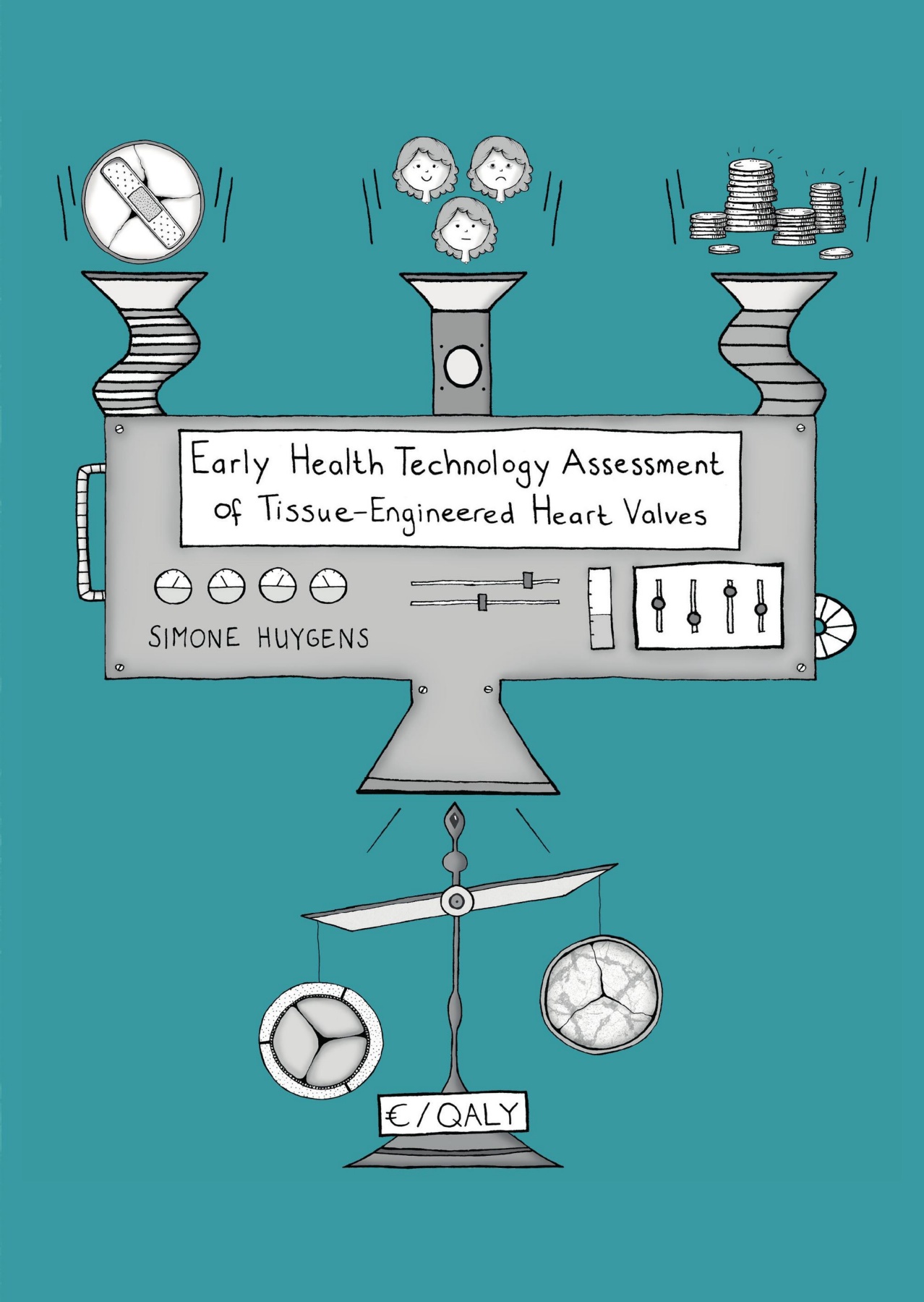
Background Heart valve disease represents a major global health burden. One of the main treatment options for heart valve disease is heart valve replacement with a biological or mechanical heart valve substitute. Existing heart valve substitutes all have their limitations; biological valves have a limited durability with subsequent risk of re-intervention, while mechanical valves are associated with the need of lifelong anticoagulation medication with subsequent risks of bleeding and complications during pregnancy. One of the most promising recent endeavours to solve these problems is the creation of living heart valves through the process of tissue engineering. In this approach, a valve-shaped scaffold implanted in the heart of the patients recruits cells from the bloodstream and surrounding tissues and gradually transforms into a valve while the scaffold degrades. Both surgical and transcatheter implantation of tissue-engineered heart valves (TEHV) are currently explored. TEHV have the potential to reduce or even eliminate the limitations of existing heart valve substitutes. In contrast to existing heart valve substitutes, TEHV are living heart valve prostheses with growth potential. Therefore, re-interventions because patients outgrow the heart valve substitute may no longer occur. In addition, and in contrast to biological valves, they would ideally last a lifetime in the same way as most native heart valves do (durability). Furthermore, and in contrast to mechanical valves, the risk of thromboembolic events is expected to be low and therefore lifelong anticoagulation may not be required (thrombogenicity). Finally, TEHV may be more resistant to infection of the heart valve, since the heart valve substitute is made of the patient’s own tissue (infection resistance). This thesis describes the early Health Technology Assessment (HTA) of TEHV. HTA is the systematic evaluation of social, economic, organizational and ethical issues of a health intervention to inform policy decision making. An important component of HTA is the economic evaluation in which alternative treatment options are compared in terms of their costs and consequences. Economic evaluations can support healthcare decision makers in allocating the limited healthcare budget in a way that maximizes the health of the overall population and avoids implementation of comparatively ineffective or inefficient healthcare interventions. HTA is often performed when a new healthcare intervention is ready for introduction in clinical practice. However, information on cost-effectiveness can also be valuable earlier in the development process. Early HTA is the use of economic evaluation in early stages of the development of new healthcare interventions mainly to guide developers at the time that investment decisions are made, for example by investigating the optimal target population. In addition, patients, clinicians and healthcare decision makers can benefit from timely information on the (cost-)effectiveness of potential interventions that may become available in clinical practice in the future. Model development To be able to perform early HTA of TEHV, we needed a decision-analytic model that could synthesize evidence from different sources on costs and effects of heart valve implantations. The development of this model is described in the first part of this thesis. One of the first steps of model development, reviewing existing models addressing related problems, is described in Chapter 2. This chapter describes the systematic review of model-based economic evaluations of heart valve implantations. This study showed that the methodological quality of currently published model-based economic evaluations of heart valve implantations can be improved by providing more detailed descriptions of sources of input parameters and modelling methods, and using direct utility assessment with a preference-based quality of life instrument instead of indirect utility assessment using New York Heart Association (NYHA) class. Furthermore, this review showed that there is room for patient-simulation models considering the cost-effectiveness of heart valve implantations in other valve positions besides the aortic valve performed from a societal perspective. The development of the conceptual model is described in Chapter 3. This conceptual model served as the foundation for the decision-analytic model that was used in this thesis. The development started with scoping of the decision problem and developing a draft conceptual model within a small workgroup. In this draft conceptual model, the strengths and limitations of existing economic models of heart valve implantations and the opportunities for future models described in Chapter 2 were taken into account. This draft conceptual model was discussed with a Delphi panel of ten experts, including cardiothoracic surgeons, cardiologists and a biomedical scientist. This resulted in a conceptual model reflecting the most important consequences after heart valve interventions based on the views of a multidisciplinary group of experts. In the conceptual model, the patient is followed from the time of the heart valve implantation until death. Patients can survive the intervention or not (i.e. early mortality). When patients survive the intervention, they can remain alive, die from non-valve related causes (i.e. background and excess mortality), or experience a valve-related event. The following events were included during the entire simulation: stroke, bleeding, prosthetic valve dysfunction (structural valve deterioration and non-structural valve dysfunction), -thrombosis and -endocarditis. In addition, the following events were only included within 30 days after the intervention: myocardial infarction, vascular complication, arrhythmias/atrial fibrillation, pacemaker implantation, renal failure/acute kidney injury. Patients experiencing an event can die or survive the event. When patients survive the event they can stay alive, experience another event or die due to non-valve related causes. Health outcomes and costs of existing heart valve substitutes Before we could use our decision-analytic model for the early HTA of TEHV, data needed to be collected on the input parameters of the model: risks of mortality and morbidity, health-related quality of life, and societal costs. Since TEHV are not yet implemented in clinical practice, assumptions had to be made about their performance and costs. On the other hand, the performance and costs of existing heart valve substitutes could be based on evidence from clinical practice, which is reviewed in the second part of this thesis. This thesis includes three systematic reviews and meta-analyses of clinical outcomes after heart valve implantations, two on the outcomes after surgical aortic valve replacement (SAVR) and one on the outcomes after right ventricular outflow tract reconstruction (RVOTR; i.e. surgical pulmonary valve replacement). Chapter 4 describes the systematic review and meta-analysis of outcomes after SAVR with biological valves: allografts (human donor) and bioprostheses (animal donor). The results showed that patients receiving allografts were younger (mean age: 48.8 vs. 71.8 years) and less often had concomitant coronary artery bypass grafting (CABG) (11.9 vs. 40.0%) than patients receiving bioprostheses. Early mortality after SAVR with bioprostheses and allografts was approximately 5%. The most often occurring valve-related event was thromboembolism after SAVR with bioprostheses (1.0%/year) and structural valve deterioration (SVD) after SAVR with allografts (1.1%/year). Re-interventions occurred most often for SVD. Chapter 5 presents the systematic review and meta-analysis on outcomes after SAVR with bioprostheses in elderly patients. The results of the meta-analysis were translated to estimates of life expectancy and lifetime risks on events using our decision-analytic model. As expected, the pooled estimates of early mortality risk (5.4 vs. 5.0%) and linearized occurrence rates of most late events (non-structural valve dysfunction 0.5 vs. 0.2 %/year; thromboembolism 1.8 vs. 1.1%/year; bleeding 0.8 vs. 0.4%/year; endocarditis 0.6 vs. 0.4%/year) were higher, while the linearized occurrence rates of SVD (0.4 vs. 0.5%/year) and re-intervention (0.6 vs. 0.7%/year) after SAVR with bioprostheses were lower in elderly patients than in patients of all ages (Chapter 4). The relatively low occurrence of SVD (lifetime risk 7.2% in 75-year olds and 2.8% in 85-year olds) and re-intervention (lifetime risk 8.8% in 75-year olds and 4.2% in 85-year olds) confirms the recommendation in clinical guidelines to use bioprostheses instead of mechanical prostheses in elderly patients in need of aortic valve replacement. The life expectancy of patients after SAVR with bioprostheses was comparable to the age and sex matched general population, which is probably caused by the careful selection of relatively healthy elderly to undergo SAVR, while frail elderly are rejected for surgery. Chapter 9 describes the systematic review and meta-analysis of RVOTR in children. In most patients younger than two years old at the time of surgery, the etiology was truncus arteriosus communis (TAC; 66.5%) followed by tetralogy of Fallot (TOF, 14.6%). The pulmonary valve was mostly replaced with biological valves (allografts 61.2% or bioprostheses 38.7%) instead of mechanical valves because the risk of valve thrombosis associated with mechanical valves in the pulmonary position is higher than in the aortic position. In contrast, most patients above two years old at the time of surgery had TOF (42.5%) followed by TAC (13.1%) and the pulmonary valve was replaced with allografts (42.1%), bioprostheses (40.3%), or synthetic polytetrafluorethylene (PTFE; 17.1%) prostheses. Early mortality was higher in children below two years old than in those above two years old (11.0% vs. 4.7%). In addition, the re-intervention risk of children below two years old was considerably higher than in children above two years old (five-year freedom from re-intervention 46.1% in age ≤2 years vs. 81.1% age >2 years at RVOTR), while other late events were not reported to occur in the younger children. The impact of heart valve implantations goes beyond the clinical outcomes in terms of mortality and morbidity. This impact is investigated in Chapter 6, which presents the results of a questionnaire measuring patient-reported health-related quality of life, informal care use and productivity of patients after SAVR (n=633), TAVI (n=257), or RVOTR (n=26). The results showed that patients after aortic and pulmonary valve implantations experienced relatively mild limitations in daily life compared to the age and sex matched general population. On average, SAVR and TAVI patients had a lower health-related quality of life than the general population, while RVOTR patients had a slightly higher health-related quality of life than the general population. More specifically, patients reported poorer health-related quality of life on physical health domains than the general population, while their scores were comparable or slightly better on mental health domains. Further, patients reported to use informal care more frequently, but the amount of informal care provided per patient was lower than among the users of informal care in the general population. Finally, the labor participation of patients was comparable to the general population. The vast majority of elderly SAVR and TAVI patients did not have paid employment, but more than one third of these patients reported to perform unpaid work activities (e.g. volunteer work or babysitting). Chapter 7 describes the retrospective analyses of Dutch health insurance claims data of patients who had undergone heart valve implantations in the years 2010 to 2013 (n=18,903) and controls (n=188,925). In this study, costs of heart valve implantations, treatment of complications, and healthcare use in- and outside hospitals in the years following heart valve implantations were assessed for four age groups. The mean costs of the heart valve implantations considered in this thesis were €25,165 for SAVR and €32,209 for TAVI in elderly patients and €21,800 for RVOTR in children. Re-interventions were associated with the highest healthcare costs (comparable to initial intervention costs). In-hospital antibiotic treatment for prosthetic valve endocarditis has the second highest healthcare costs (on average €8,069 for children after RVOTR and €8,923 in elderly patients after aortic valve implantation). Thrombolytic therapy for prosthetic valve thrombosis had the lowest costs of all prosthetic valve related events (€5,824). Multilevel generalized linear models showed that older age, female gender, comorbidities, low socioeconomic status, and complications were associated with increased annual healthcare costs in patients after heart valve implantations. The total healthcare costs of patients after heart valve implantations were compared with total healthcare costs of controls from the general population with comparable age, sex, comorbidities and socioeconomic status. In the three years following the heart valve implantation, healthcare costs of patients were higher than in controls, especially in the year of implantation (children €11,766 vs. €796, young adults €15,060 vs. €2,944, middle aged €16,104 vs. €4,612, and elderly €18,255 vs. €9,236). But also in the following years, healthcare costs of patients were higher than in controls, especially in children (year 2 €5,495 vs. €802; year 3 €5,015 vs. €786). In elderly patients, the costs of nursing homes were lower in SAVR patients than in the general population (€866 in year 1, €1,763 in year 2 and €1,990 in year 3 after the heart valve implantation versus €2,761 per year in controls), reflecting the selection of relatively healthy elderly (and therefore not living in nursing homes) to undergo SAVR. Early Health Technology Assessment of TEHV The third part of this thesis describes the early HTA of TEHV using the patient-level simulation model and input parameters described in the previous parts of this thesis. We focused on the use of TEHV in the aortic and pulmonary position. In the aortic position, we focused on elderly patients because the prevalence of aortic valve disease is the highest in these patients, due to degeneration of the native aortic valve (Chapter 8). In the pulmonary position, we focused on children because pulmonary valve disease is often caused by congenital heart valve disease (Chapter 9). In both studies, we estimated the cost-effectiveness, budget impact, and headroom of TEHV compared to existing heart valve substitutes using various scenarios for the performance of TEHV. The performance of TEHV was divided into three components: durability, thrombogenicity, and infection resistance. In both patient groups, improvement in durability was the most important driver of QALY gain and cost savings (ranging from 0.049-0.152 QALY and €118-€634 per SAVR patient, 0.023-0.074 QALY and €156-€586 per TAVI patient, and 0.031-0.083 QALY and €5,691-€20,568 per RVOTR patient for small improvements in durability to optimal durability of TEHV). Moreover, the headroom (i.e. the maximum increase in the price of TEHV compared to the price of existing heart valve substitutes) was sufficiently large for TEHV to be economically viable. The headroom varied from €38 per surgical aortic TEHV, €35 per transcatheter aortic TEHV, and €12 per pulmonary surgical TEHV if TEHV would only result in a small reduction in thrombogenicity to €6,323 per surgical aortic TEHV, €4,734 per transcatheter aortic TEHV, and €23,041 per pulmonary surgical TEHV if there would be no prosthetic valve related events at all using TEHV. The most individual benefits may be gained in children undergoing pulmonary valve replacement (i.e. right ventricular outflow tract reconstruction; RVOTR) with TEHV because the probability on re-intervention with existing heart valve substitutes is high and associated with high costs. However, the number of patients undergoing RVOTR in the Netherlands is small (85 RVOTR/year). Assuming ‘improved performance’ of TEHV (-50% prosthetic valve-related events), the national cost savings in the next 10 years ranged from €1.9 million when 25% of RVOTR was performed with TEHV to €7.5 million when all RVOTR were performed with TEHV instead of existing heart valve substitutes. The individual benefits that may be gained by using TEHV in elderly patients undergoing aortic valve implantation (SAVR or TAVI) were smaller, because the risk of re-intervention with currently used bioprostheses was low in these patients. However, the relatively small individual QALY gains and cost savings with TEHV in elderly patients can result in large national health care savings due to the relatively large size of this patient population (1,931 SAVR/year; 809-3,745 TAVI/year). The national cost savings in the next 10 years of TEHV with 'improved performance’ (-50% of prosthetic valve-related events) ranged between €2.8 million (SAVR) and €3.2 million (TAVI) when 25% of heart valve implantations was performed with TEHV to €11.2 million (SAVR) and €12.8 million (TAVI) when all heart valve implantations were performed with TEHV instead of bioprostheses. Discussion and conclusion Chapter 10 discusses how decision making in structural heart disease could be optimized from three perspectives. From a clinical perspective, decision making can be optimized by developing and using novel prognostic models that are able to simultaneously combine several longitudinally collected data during patient follow-up with these patients’ outcome. From a patient perspective, supporting shared decision making by implementing patient information portals and decision aids will empower and serve the individual patient in balancing risks and benefits. From a societal perspective, information on cost-effectiveness should be used by policy makers making funding decisions to avoid the reimbursement of comparatively ineffective or inefficient healthcare interventions. Finally, in Chapter 11, the three lines of research in this thesis, implications of our results for different stakeholders, and recommendations for further research were discussed. We concluded that this thesis provided valuable information for different stakeholders. First, it informs biomedical companies developing TEHV about minimum performance requirements and maximum additional costs of TEHV in different target populations, which can guide priority setting of further research initiatives. Developers of TEHV should especially focus on improving durability of TEHV compared to existing heart valve substitutes, since this was the largest driver of QALY gains and cost savings. However, it was noted that the potential improvement in thrombogenicity of TEHV compared to existing heart valve substitutes is expected to result in larger benefits in other patient populations than discussed in this thesis (i.e. young adults or middle-aged patients eligible for mechanical heart valve substitutes). Moreover, the headroom was sufficiently large for TEHV to be economically viable. Second, it provides patients and clinicians with the first estimates of potential improvements in clinical outcomes with TEHV, which may result in faster adoption of TEHV in clinical practice. Finally, it informs healthcare payers about the possible entrance of TEHV to the market, the promising potential cost-effectiveness of TEHV and the expected large cost savings for the national healthcare budget, which may result in more timely decisions about reimbursement.
| Publicatiedatum | 20 februari 2019 |
| Universiteit | Erasmus Universiteit Rotterdam |
| Auteur | Simone Huygens |
| Order nummer | FTP-202604091443 |
| ISBN nummer | 978-94-6380-217-8 |