Seerp Wigboldus
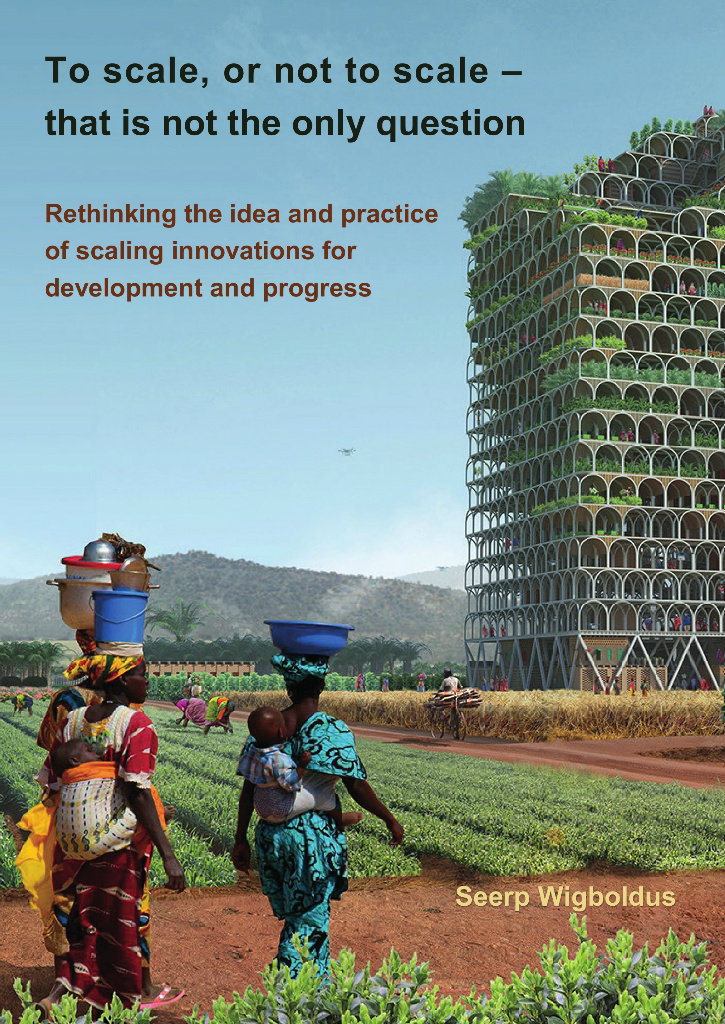


To scale, or not to scale – that is not the only question
This thesis presents the case for the need to approach processes of scaling innovations for the purpose of achieving development and progress more critically than is commonly done. Such includes a need to consider related complexities and potentially negative implications from a more holistic perspective. The thesis discusses related concerns as well as opportunities for developing a practice of responsible scaling of innovations. Chapter 1 presents the backdrop for the research to which this thesis pertains: The term scaling (up) has become increasingly popular over the past three decades in the context of development initiatives and related investment proposals. The object of such scaling (up) is often generalised as innovations, which include (new) technologies, practices (and habits), policies (and wider institutions), and projects. Such innovations are generally considered to be a response to societal challenges. The term is therefore used widely in various (scientific) contexts involving different interpretations and applications. This thesis focuses on how it features in the context of initiatives that are meant to contribute to what is generally framed as ‘development’ and ‘progress’, including to related development goals such as the Sustainable Development Goals (SDGs). Within this focus, particular attention is paid to processes of agricultural development and innovation. Scaling innovations is generally viewed as a critical mechanism to achieve development and progress and consequently is rarely criticised, and certainly not the subject of hot debate. Questions generally focus on how to scale innovations. An initial literature review pointed to a range of critical issues related to the implications of scaling innovations. This resulted in the definition of a number of key research questions that this thesis addresses, including: What kind of thinking and philosophy underpins the idea and practice of scaling innovations for development and progress? Are the high expectations of this mechanism for development and progress warranted? What are the related theories of change? Successes have been claimed, but how serious are potential negative implications? What are the relevant areas of contention? Is there a need to apply guiding frameworks along similar lines as are adopted in relation to responsible innovation? To what extent are development actors aware of how scaling (up) processes sit in a wider context of other development processes and other perspectives on how change happens and/or is preferred to happen? What evaluative frameworks are used to assess the long-term outcomes of scaling innovations? These questions were grouped in relation to two different angles: 1) the roots and fruits of scaling innovations for progress and development, and 2) the practice of doing so. Following up on the above research questions, Chapter 2 focuses on questions related to the ideological roots of the idea and practice of scaling (up), considering implications and ways in which to move towards an ethics of scaling innovations along similar lines as already developed for technology and for innovation. Chapter 3 explores possibilities for devising a framework to guide the development of more comprehensive and systemic perspectives on scaling agricultural innovations to remedy the narrow scope of common perspectives on the same. Chapter 4 applies systemic perspectives from Chapter 3 to the case of scaling green rubber in Southwest China; this pertains to a more prospective analysis of what to consider in developing appropriate scaling strategies. Chapter 5 applies systemic perspectives from Chapter 3 to the case of cocoa farmer field schools in Cameroon with the purpose of finding out how much this adds in terms of understanding relevant factors that play a role in scaling initiatives; this pertains to a retrospective analysis. Chapter 6 further explores opportunities for developing frameworks to guide scaling initiatives towards responsible scaling practice. The focus is on applying the concept of theories of change to a perspective of theories of scaling with the purpose of using this perspective to better inform scaling initiatives and related policymaking. Chapter 7 revisits the research questions and the defined purpose of this study, considering what the various chapters have addressed in that regard, and touching on relevant other topic areas that could not be addressed (fully) in this thesis. This leads to a number of suggestions for further research and development along similar lines as explored in this thesis. Chapter 2 traces the use of the concept of scaling in history and identifies scaling processes as being at the heart of common societal trends, including industrialisation and globalisation. The chapter considers three inherent implications of processes of scaling innovations that characterise the nature of such processes: the technology orientation, the model orientation, and associated shifts in natural and social conditions. Core narratives that motivate the idea of scaling of innovations for development are characterised in terms of rhetoric, paradigm, and ideology. This is followed by a discussion of the areas in which the scaling innovations for development and progress approach should be addressed more critically and how this could be done. Moving from critique to counsel, three fields are suggested for translating critique on the scaling innovations for development and progress approach into guidance for management and policy development. The chapter does not provide a full story of implications and complications of scaling innovations for development and progress, but rather identifies a much-needed direction in which to go to make related thinking and practice the object of critical discussion and debate along similar lines as debates on technology and innovation. Such direction is further specified as the need to improve understanding about what scaling innovations implies and involves, to develop matching normative perspectives to inform and guide scaling ambitions and related change initiatives, and to broaden the idea and concept of responsible innovation towards a perspective on responsible innovation and scaling. Chapter 3 follows up on that last theme by discussing an analytical approach to responsible scaling. Agricultural production involves the scaling of agricultural innovations such as disease-resistant and drought-tolerant maize varieties, zero-tillage techniques, permaculture cultivation practices based on perennial crops, and automated milking systems. Scaling agricultural innovations should take into account complex interactions between biophysical, social, economic, and institutional factors. Actual methods of scaling are rather empirical and based on the premise of ‘find out what works in one place and do more of the same in another place’. These methods thus do not sufficiently take into account complex realities beyond the concepts of innovation transfer, dissemination, diffusion, and adoption. Consequently, scaling initiatives often do not produce the desired effect. They may also produce undesirable effects in the form of negative spill-overs or unanticipated side effects such as environmental degradation, bad labour conditions for farm workers, and farming communities’ loss of control over access to genetic resources. Therefore, here, we conceptualise scaling processes as an integral part of a systemic approach to innovation, to anticipate the possible consequences of scaling efforts. We propose a method that connects the heuristic framework of the multi-level perspective (MLP) on socio-technical transitions to a philosophical modal aspects framework, with the objective of elucidating the connectedness between technologies, processes, and practices. The resultant framework, the PRactice-Oriented Multi-level perspective on Innovation and Scaling (PROMIS), can inform research and policymakers on the complex dynamics involved in scaling. This is illustrated in relation to three cases in which the framework was applied: scaling agro-ecological practices in Nicaragua, farmer field schools on cocoa cultivation in Cameroon, and green rubber cultivation in Southwest China. Chapter 4 discusses the case of green rubber in Southwest China in more detail. The rubber boom across much of Southeast Asia has led to environmental destruction, and the resultant crash in the price of rubber has destabilised livelihoods. We investigated the necessary factors required to enable a transition towards a more sustainable model for rubber cultivation in Southwest China (i.e. the ‘greening’ of rubber cultivation), using the framework for the integrative study of multiple aspects in complex land use issues (PROMIS) developed in Chapter 3. We present findings from stakeholder interviews and a stakeholder workshop and discuss their relevance within and beyond Southwest China. The current focus of researchers and development practitioners tends to be on finding technical solutions to address unsustainable rubber cultivation practices. However, stakeholder consultations revealed that the key barriers were more social: low levels of trust, low levels of knowledge exchange between stakeholder groups, and fragmented visions about the future of the landscape. It is very important to continue the economic prosperity initially brought by rubber, but, without improved communication between government and researchers and smallholder farmers, this will be very difficult to achieve. A wider landscape perspective is needed to address issues in rubber cultivation to avoid repeating the same problems of cash crop boom and bust experienced with other crops, most notably bananas. We conclude that more effort should be put into developing mechanisms that integrate technical knowledge, enhance social relationships, and present a forum for reconciling – or at least acknowledging – the differing needs, knowledge, and objectives of different groups, and transcending the power dynamics between smallholder farmers and government and researchers. Chapter 5 discusses the case of cocoa farmer field schools in Cameroon in more detail. The farmer field school (FFS) concept has been widely adopted, and such schools have the reputation of strengthening farmers’ capacity to innovate. Although their impact has been studied widely, what is involved in their scaling and in their becoming an integral part of agricultural innovation systems has been studied much less. In the case of the Sustainable Tree Crops Programme in Cameroon, we investigate how a public–private partnership did not lead to satisfactory widespread scaling in the cocoa innovation system. We build a detailed understanding of the key dimensions and dynamics involved and the wider lessons that might be learned regarding complex scaling processes in the context of agricultural innovation systems. Original interview data and document analysis inform the case study. A specific analytical approach was used to structure the broad-based exploration of the qualitative dataset. We conclude that scaling and institutionalisation outcomes were impeded by: the lack of an adaptive approach to scaling the FFS curriculum, limited investments and limited genuine buy-in by extension actors, a failure to adapt the management approach between the pilot and the scaling phase, and the lack of strategic competencies to guide the process. Our findings support suggestions from recent literature that pilots need to be translated and adapted in light of specific contextual and institutional conditions, rather than approached as a linear rolling-out process. These findings are relevant for the further spread of similar approaches commonly involved in multi-stakeholder scaling processes, such as innovation platforms. Chapter 6 discusses a framework to guide decision-making processes to make scale work for sustainable development. Theories of change are meant to support the strategic design and guidance of agricultural research and innovation in light of an aspired contribution to impact at scale, i.e. societal objectives such as the SDGs. How scaling beyond the immediate research and innovation context is expected to happen is, however, often scantly elaborated in theories of change. The question of ‘how scaling could happen’ (i.e. a theory of scaling) tends to remain a black box of unarticulated assumptions. Similarly, policymakers often lack a governance sense-making framework to consider the appropriateness of a multitude of scaling initiatives in light of societal goals. Recent studies have drawn attention to the fact that scaling processes involve greater complexity than is generally taken into account. This chapter addresses this situation by unpacking what is in that black box and translating this into a guidance framework along the lines of a theory of scaling as a dedicated component of a wider theory of change. This is meant to support researchers, management decision makers, and policymakers in engaging more effectively and responsibly with scaling initiatives. Apart from that framework, a suggestion is made to develop specific expertise in the field of scaling processes. Chapter 7 reflects on the findings from the earlier chapters, considering the general purpose of this thesis, which is to rethink the idea and practice of scaling innovations for development and progress. It observes that the popularity of scaling innovations for development and progress has increased further in the context of international development and certainly also in the context of agricultural (research for) development. The combined learning on the roots and fruits of scaling innovations (as explored in particular in Chapters 2 and 3) points to possibilities for developing a perspective on, and a practice of, responsible innovation and scaling. First of all, together they point out why ambitions to scale innovations need to move towards clearer perspectives on what makes for responsible practice – notably because of the inherent potential to create distortions due to changes in proportions and ratios – and related reductionisms, because of the limitations in the common linear approaches associated with scaling innovations and because of the misguided pro-scaling bias. Secondly, such perspective and related practice help to take processes of scaling innovations and their implications more seriously along a number of lines: - By addressing logical fallacies and reductionisms involved; - By acknowledging ideologically motivated ambitions; - By connecting the idea of scaling innovations to relevant wider societal concerns and debates; - By extending the concept of responsible innovation, which allows for building on what has already been developed along those lines while offering complementary perspectives on scaling processes; - By offering ways of operationalising principles of responsible (agricultural) investment by linking such principles to the practice of scaling innovations, which features prominently in such investments; - By offering ways of operationalising concepts such as ecosystem tipping points and planetary boundaries by linking such perspectives to the practice of scaling innovations, which contribute significantly to concerns about a safe operating space for humanity; - By offering ways of extending the concept of scale-sensitive governance to the governance of scaling innovations. The experiences with the application of an analytical framework (discussed in Chapter 3) were discussed in Chapters 4 and 5. They led to a realisation that something simpler and perhaps more intuitive would be needed to guide decision making in relation to scaling initiatives – something that would connect to existing practice. This led to the conception of the idea of ‘theories of scaling’ as a variation, or rather a specific application, of the idea of ‘theories of change’, as discussed in Chapter 6. This connects to the broad acquaintance with the concept of theories of change, which means that, with little explanation, many people can easily understand the essential purpose of theories of scaling. Chapter 7 also further reiterates the essential purpose of this thesis, which is to enrich perspectives on scaling innovations, to point to a direction for developing appropriate (analytical) frameworks and to processes for guiding towards responsible scaling practice. For some, such a perspective may be inconvenient, because they are interested mainly in the ‘how to make scaling happen’ question. The chapter argues for making use of several different critical approaches, leading to the development of different types of approaches to responsible innovation and scaling, some of which build on work as presented in this thesis, and some following quite different lines. The chapter closes by suggesting a number of ways in which the idea and practice of responsible scaling of innovations could be further developed. This includes topics such as the governance of responsible scaling of innovations, the use of integrated perspectives and practices (e.g. taking landscape approaches as an example), and the development of a trans-disciplinary approach to scale and scaling innovations.
| Publicatiedatum | 11 september 2018 |
| Universiteit | Wageningen University |
| Auteur | Seerp Wigboldus |
| Order nummer | FTP-202604091336 |
| ISBN nummer | 978-94-6343-290-0 |