Göksel Güven
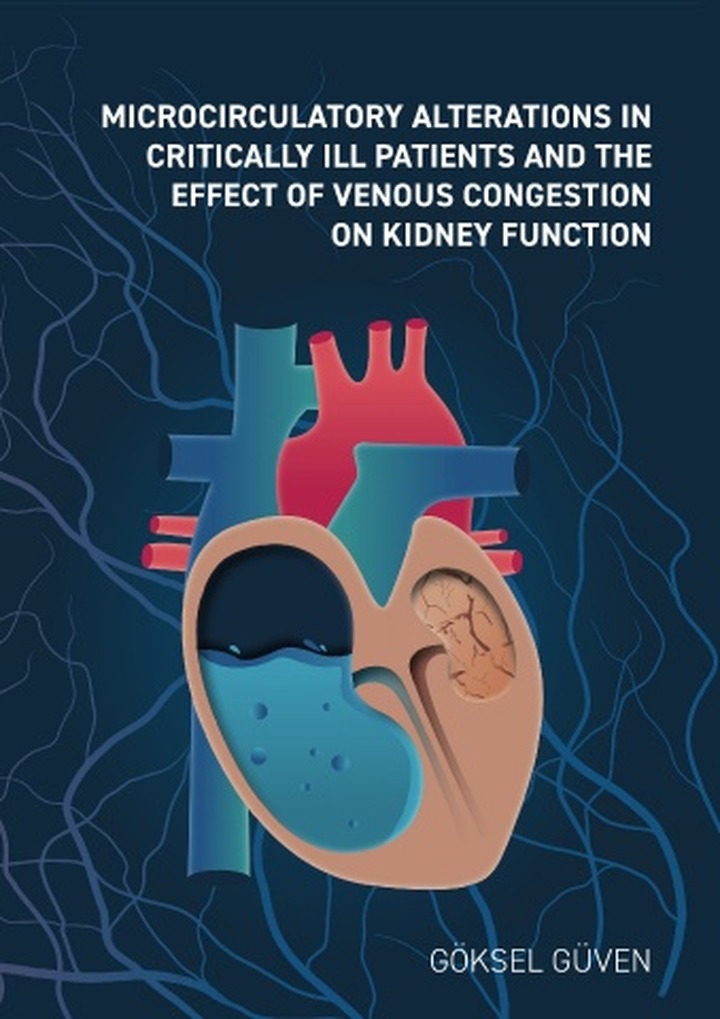


Microcirculatory Alterations in Critically Ill Patients and the Effect of Venous Congestion on Kidney Function
Systemic macrohemodynamic parameters are traditionally measured for the resuscitation of critically ill patients; however, correcting these parameters does not always mean a parallel improvement in microcirculation. Similarly, patients who recover from a critical illness or have a high risk of progressing to a critical illness may have an undetected microcirculatory compromise, even if they have macrohemodynamic parameters in the normal range. Therefore, this thesis aimed to give insights into the clinical application of microcirculatory monitoring tools for the early detection of vulnerable microcirculation and kidney dysfunction. Therefore, in the first part, we focused on improving the bedside use of microcirculatory monitoring techniques by presenting new findings and paths for accurate clinical assessment. In the second part, we investigated the feasibility and relevance of microcirculation monitoring for detecting vulnerable microcirculation during under or over-resuscitation of critically ill patients. Finally, in the third part, we focused on kidney dysfunction in patients with advanced heart failure since we know the kidneys are highly vulnerable to hypoxia and substantially influence survival. The following is a brief and concise of this thesis’s chapters. Chapter 1 includes the current thesis’s introduction, aims, and outline. Chapter 2 is a review article and provides a general overview of the current literature, including the history, clinical application, evolution of microcirculatory monitoring over time, and future prospects. Chapter 3 is a single-center prospective observational study in that we created a morphologic map of sublingual and oral microcirculation within the healthy population. We demonstrated that the sublingual area has a homogenous distribution regarding total vessel density, small and large vessel functional capillary density, and focus depth. However, the area between the incisors and the lingua was more suitable for reproducing sublingual microcirculation measurements in clinical studies. Chapter 4 is a book chapter and discusses the clinical application of handheld vital microscopy-based sublingual microcirculatory assessment as a promising approach for managing patients, especially with sepsis. Handheld vital microscopy can provide clinicians with a more physiologically-based approach to guide therapies and help diagnose circulatory inadequacies early. Chapter 5 is prospective observational research to model the relationship between different laser-based microcirculatory monitoring techniques (LSCI & LDPI) over a wide range of blood flux values. We applied a pharmacologic provocation test (sodium nitroprusside iontophoresis technique) and stepwise vascular occlusion test to obtain higher and lower blood flux values in fifteen healthy volunteers. Ultimately, we demonstrated a high correlation except for blood flux lower than baseline values. In addition, the regression formula was created to convert each technique’s output to another. Chapter 6 is a prospective, observational cohort research comparing LSCI and LDPI techniques in fifty adult burn patients. We identified cut-off levels for LSCI to decide the need for surgical wound closure or conservative treatment. Besides, we confirmed the good performance of the LSCI for predicting burn wound healing potential and created a new color code to introduce LSCI as a diagnostic tool for assessing the wound depth of burns. Chapter 7 is a book chapter that comprehensively summarizes the prominent clinical microcirculatory monitoring techniques for measuring cardiovascular state by outlining their fundamental principles, strengths, and weaknesses. Chapter 8 is clinical research, where we investigated the association between net fluid gain and alterations in tissue microcirculation among twenty-four patients undergoing major cardiac surgery. We used Cytocam-IDF to monitor the sublingual microcirculation and bioimpedance analysis to estimate the fluid distribution within tissue compartments. A significant net fluid gain was recorded during surgery and ICU stay. Although the macrohemodynamic variables (blood pressure, heart rate, cardiac output) were in their normal range, microcirculatory parameters (total vessel density, perfused vessel density, and proportion of perfused vessels) were significantly reduced when the patients were discharged from the ICU. The deterioration in tissue microcirculation was highly correlated with increased extracellular water and total body water. Interestingly, the intracellular water was reduced as a sign of intracellular dehydration. Taken together, the findings indicate fluid overload’s unfavorable and prolonged effect on tissue microcirculation. Therefore, daily monitoring of microcirculatory parameters by Cytocam-IDF might provide valuable information to detect fluid overload even if the patient is hemodynamically stable. Chapter 9 is a single-center study investigating the association of pre-heart transplant right and left-sided hemodynamics with post-heart transplant acute kidney injury (AKI) risk. All consecutive heart transplant recipients between 1984 and 2016 (n = 595) were included in the study. We demonstrated that right-sided hemodynamics (higher right atrial pressure values and lower pulmonary artery pulsatility index) independently predicted postoperative AKI, although the left-sided hemodynamics were not. Remarkably, the patients with RAP ≥6 mmHg were more prone to develop AKI early after heart transplantation, suggesting that patients with renal venous congestion may become more vulnerable to AKI. Chapter 10 is a systematic review regarding the safety and efficacy of temporary right ventricular assist device (t-RVAD) implantation in advanced right-sided heart failure patients. In this chapter, we report AKI as one of the most-seen complications after t-RVAD implantation and discuss its relevant pathophysiological mechanisms. Chapter 11 is a state-of-the-art review on the diagnosis, pathophysiology, and risk factors for AKI in left ventricular assist device (LVAD) patients. The current approaches for the management of post-LVAD AKI and future projects were also discussed in this chapter. Chapter 12 is another state-of-the-art review focusing on the diagnosis, risk factors, and pathophysiology of chronic kidney disease in the long term of LVAD patients. In addition, evidence-based prevention strategies were discussed in this chapter. Chapter 13 briefly overviews pathophysiology, clinical findings, monitoring, and therapeutic interventions in COVID-19 by demonstrating a cause-and-effect relationship between the lungs, heart, and kidneys. In addition, the strategies for protecting the kidneys from the direct and indirect effects of COVID-19 were discussed in this chapter. Chapter 14 is the part where we discuss the chapters mentioned above and give insights into future perspectives.
| Publicatiedatum | 5 september 2024 |
| Universiteit | Erasmus Universiteit Rotterdam |
| Auteur | Göksel Güven |
| ISBN nummer | 978-94-6510-087-6 |