Dré Kampfraath


ON A FATHERLESS SPRINGTAIL AND HER LITTLE COMPANION
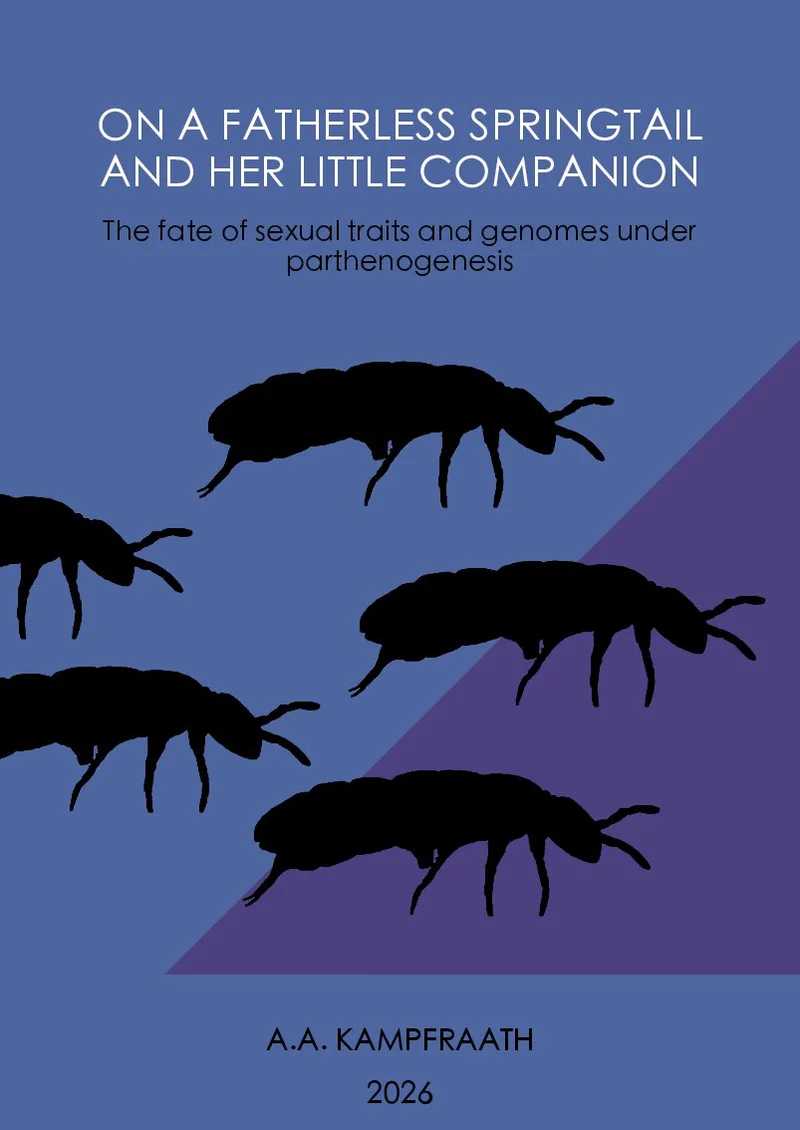
The evolutionary transition from sexual to asexual reproduction represents one of the most profound lifestyle shifts across the tree of life, causing large shifts in selective pressures on phenotypic and genotypic traits. These shifts in pressures could lead to the decay and disappearance of sexual traits no longer needed for asexual reproduction. When asexual reproduction is induced by a symbiotic organism, that organism may compensate for host functions that become redundant after the loss of sexual reproduction. This process, in which the symbiont replaces or maintains functions formerly supported by sexual traits or processes, is termed compensated trait loss. This thesis investigates the multifaceted consequences of the transition to asexuality, with particular emphasis on compensated trait loss, using the springtail Folsomia candida and its endosymbiont Wolbachia as a study system. Wolbachia is known for its reproductive manipulations and there are strong indications it is involved in the asexual reproduction of F. candida. Its transition to reproduction through parthenogenesis was examined through phenotypic, symbiotic, and genomic lenses, to get a full scope of the involved processes and genomic consequences.
The investigation began at the phenotypic level, focusing on the fate of male-specific traits that become redundant in parthenogenetic lineages. Through a comparative analysis of sexual and asexual F. candida populations, it was demonstrated that several key reproductive traits, specifically sperm DNA quantity and the olfactory attractiveness of spermatophores, underwent significant degradation in asexual lines. The observed patterns of decay, which varied between lineages, are highly consistent with the neutral mutation accumulation theory, suggesting that once the selective pressure to maintain these traits is removed, stochastic loss-of-function mutations become the primary driver of phenotypic deterioration. It can be argued that this is a form of compensated trait loss, given the assumption that Wolbachia is allowing parthenogenetic reproduction, which would compensate for these phenotypic traits that are now lost.
Building upon this understanding of trait decay, the research then turned to the endosymbiont driving this reproductive shift: the Wolbachia strain wFol. While the transition to asexuality is often linked to the stability of an endosymbiotic infection, our experiments with transinfection and heat stress revealed a complex interplay between host immunity and symbiont persistence. Notably, we observed that while high temperatures directly reduced Wolbachia titres, they did not necessarily trigger the lytic cycle of the associated bacteriophage WO. Furthermore, the difficulty in establishing stable infections in sexual lineages suggests that the host’s innate immune response may act as a significant barrier to horizontal symbiont transfer, potentially reinforcing the evolutionary boundaries between sexual and asexual populations.
Subsequently, the exploration proceeded at the genomic level where it challenged established paradigms regarding endosymbiont evolution. Contrary to the long-standing symbiont reduction model, which predicts genome streamlining in obligate relationships, we discovered that the wFol genome is exceptionally large and characterized by massive expansions of phage-derived regions. This unexpected expansion, accompanied by an enrichment of DNA-repair and ankyrin-repeat genes, suggests a mode of genome preservation rather than reduction. This pattern of genomic stability in the endosymbiont was mirrored in the host; our comparative analysis of F. candida lineages revealed that while sexual populations maintain a streamlined architecture, asexual lineages exhibit significant genomic expansion. This is characterized by an increased accumulation and retention of repetitive elements, segmental duplications, and mitochondrial DNA remnants.
Ultimately, this thesis hypothesises that the transition to parthenogenesis in F. candida is not merely a process of trait loss, but one of complex genomic restructuring. The decay of sexual traits is compensated for by a unique evolutionary strategy in asexual lineages: the adoption of a genome architecture optimized for the accumulation and preservation of genetic material. This shift from purging to conservation likely serves as an adaptive mechanism to navigate the lack of sexual recombination, providing a window into the broader dynamics of genome evolution during major life-history transitions.
| Publicatiedatum | 25 november 2026 |
| Universiteit | Vrije Universiteit Amsterdam |
| Auteur | Dré Kampfraath |
| ISBN nummer | 978-94-6534-728-8 |
| DOI nummer | 10.5463/thesis.1972 |