Cyril Camaro
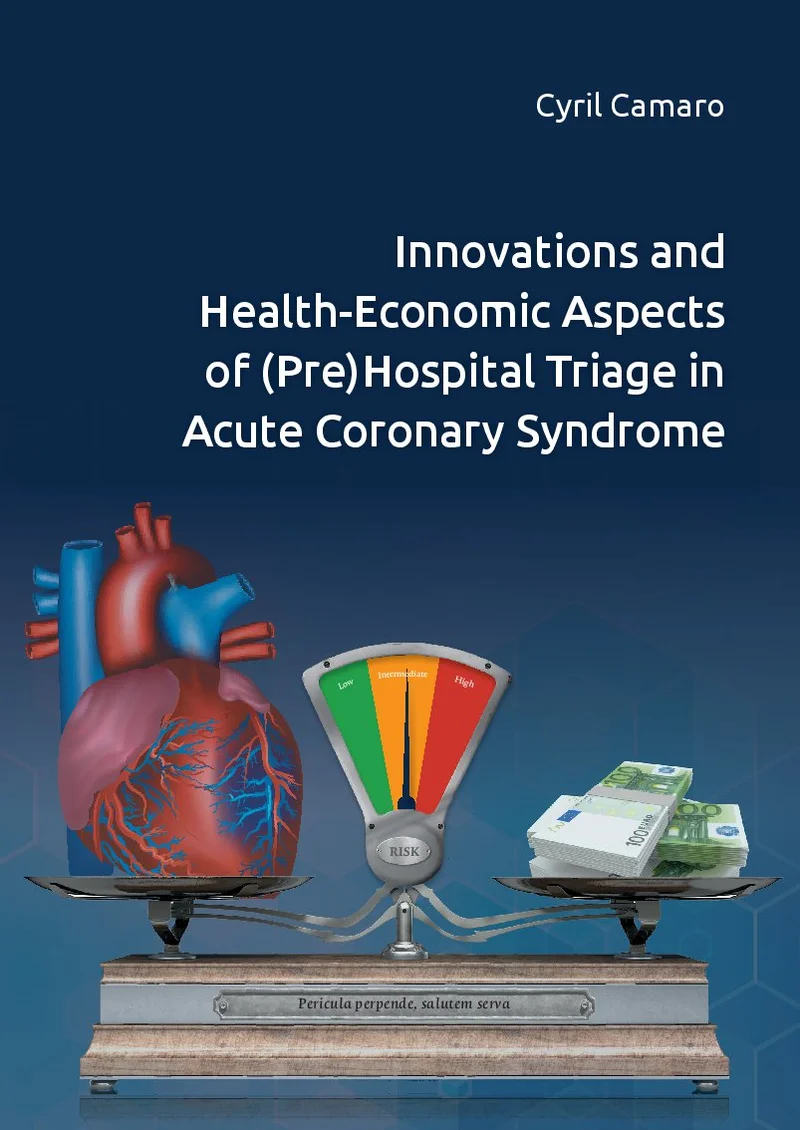


Innovations and Health‑Economic Aspects of (Pre)Hospital Triage in Acute Coronary Syndrome
Chest pain is the most common reason for referral to an emergency department (ED) or cardiac emergency department (CED) in the Netherlands. Chest pain can indicate a myocardial infarction or acute coronary syndrome (ACS), and ruling this out requires an intensive diagnostic process in the hospital, which involves a high burden on available healthcare resources and consequently high healthcare costs. The ARTICA study (Acute Rule-out of Non-ST-segment elevation acute coronary syndrome in the (pre)hospital setting by HEART score assessment and a single point-of-care troponin) forms the first part of this thesis (Chapters 2 to 8). The ARTICA trial examined the efficiency and cost-effectiveness of a triage strategy in the ambulance, where low-risk patients with suspected non-ST-segment elevation acute coronary syndrome (NSTE-ACS) are already identified in the ambulance to avoid transport to the hospital.
In the second part (Chapters 9 to 11), patients diagnosed with NSTE-ACS are discussed in more detail, focusing on two important strategies to improve care for this patient group: antithrombotic treatment and the timing of invasive coronary angiography (CAG). For this purpose, a large nationwide cohort was studied, using data from the Netherlands Heart Registration (NHR) and claims data from all insured individuals in the Netherlands (VEKTIS database). Finally, the healthcare costs of patients resuscitated outside the hospital with a non-ST-segment elevation myocardial infarction (NSTEMI) who underwent early invasive CAG (COACT trial data) were analyzed.
In Chapter 2, the design of the ARTICA study is explained. The ARTICA study was a randomized clinical multicenter study in six ambulance regions involving patients with a low risk of developing an NSTE-ACS. A low-risk profile is characterized by a modified HEART [history-ecg-age-risk-troponin] score of ≤ 3, including a non-elevated point-of-care troponin. This patient group was randomized to hospital evaluation and ruling out of ACS (standard care) versus pre-hospital identification of low risk and avoiding transport to the ED or CED. The outcomes at 30 days and 12 months focused on healthcare costs and the occurrence of major adverse cardiac events (MACE), including the occurrence of a myocardial infarction, death, or unplanned revascularization via percutaneous coronary intervention (PCI) or coronary artery bypass surgery (CABG).
Chapter 3 and Chapter 4 describe the 30-day and 12-month results of the ARTICA study, respectively. These show that in patients with a low-risk profile as identified by the ambulance, there is a clear reduction in healthcare costs (average difference of EUR 611 per patient at 30 days and EUR 717 at 12 months) in favor of the group that could stay at home. No difference was observed between the two groups in the occurrence of MACE, nor in the quality of life. Based on these results, it can be concluded that this pre-hospital strategy is cost-effective and also provides strong indications for safe implementation in clinical practice.
In Chapter 5, the similarities between ambulance paramedics and physicians in assessing the HEAR score were examined. This study showed that ambulance paramedics reached agreement with hospital physicians in the majority of cases (88.9%) when classifying patients as low risk (HEAR score ≤3) for NSTE-ACS. Continuous training in history taking and ECG assessment is strongly recommended to maintain and potentially improve these results of the pre-hospital use of the HEAR score.
In Chapter 6, a response is given to the ARTICA study regarding the use of non-high-sensitivity point-of-care troponin determinations. The conclusion is that the ARTICA algorithm (the combination of HEAR score and point-of-care troponin) is capable of compensating for the lack of sensitivity of a single troponin determination alone in the total population of patients presenting with chest pain. This means that each biomarker should be combined with additional clinical decision rules to arrive at a careful clinical pre-test probability. This is important in the ultimate decision-making to leave patients at home.
Chapter 7 is the result of a collaboration with the Cardiology department of the Catharina Hospital in Eindhoven. In this study, an individual patient data meta-analysis was performed. Various studies using the HEART score algorithm are included in this analysis. HEART-derived clinical risk scores effectively identify patients with a very low risk of 30-day mortality and MACE. However, it should be noted that implementation in healthcare systems outside the Netherlands requires additional validation given the diversity in the structure of healthcare systems, risk stratification, and possibilities for follow-up.
The first part is concluded with Chapter 8, which provides nationwide recommendations for the pre-hospital triage of patients with suspected ACS. In this, the clinical decision rules (HEART and PREHEART) play an important role alongside the use of high-sensitivity handheld troponin systems.
Chapter 9 describes a review of the current state of affairs in the antithrombotic treatment of patients with NSTE-ACS. From this literature analysis, it appears that the optimal timing of ticagrelor has not been adequately studied, while prasugrel is only recommended after invasive CAG prior to PCI. The invasive strategy, including the indication and timing of CAG, depends on the patient's risk profile. A mortality benefit has only been demonstrated in selected high-risk NSTE-ACS patients undergoing early (<24 hours) intervention.
In Chapter 10, a retrospective cohort study of 36,573 patients with an NSTEMI who underwent PCI between 2018 and 2021 is described. The Dutch ACS working group considers a delayed invasive CAG up to 72 hours in patients with NSTEMI as safe and acceptable. European guidelines, however, recommend an invasive strategy within 24 hours, but evidence for better outcomes with this approach is lacking. This study evaluates how quickly an invasive CAG and PCI are performed in NSTEMI patients in the Netherlands, depending on the type of hospital of admission: with or without PCI facilities. Invasive CAG within three days is realized in a very high percentage of patients (92%) in both PCI and non-PCI centers (94% and 87%, respectively). A clearly larger proportion of patients undergo a PCI within three days in the case of direct admission to a PCI center, 87% compared to 50%.
Part 2 concludes with Chapter 11, in which a study was conducted into hospital costs in resuscitated patients outside the hospital with an NSTEMI who were randomized in the context of the COACT trial to early (within 2 hours) invasive CAG versus invasive CAG after neurological recovery. The average total costs in patients who experienced a circulatory arrest outside the hospital, who were randomized to early invasive CAG or a delayed invasive strategy, appeared to be comparable during the initial hospital admission. In light of the higher costs of invasive procedures in the early invasive CAG group, a strategy is defensible in which neurological recovery is first awaited, followed by invasive CAG and, if necessary, additional (planned) revascularization.
| Publicatiedatum | 8 oktober 2026 |
| Universiteit | Radboud Universiteit |
| Auteur | Cyril Camaro |