Casper Zijderhand
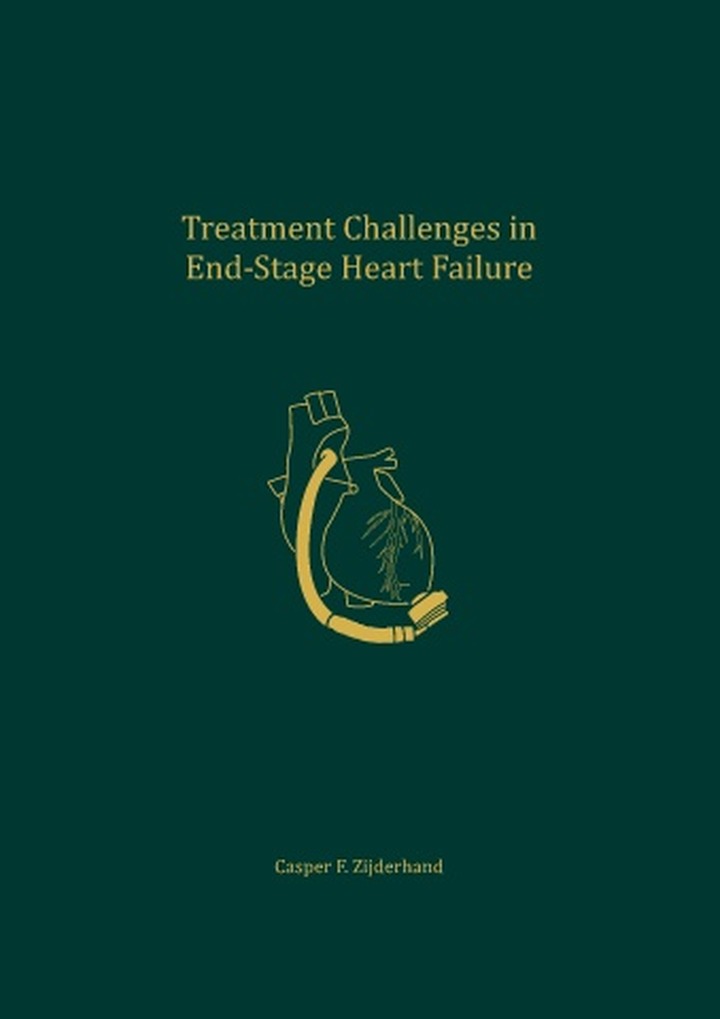


Treatment Challenges in End-Stage Heart Failure
Hoofdstuk 1 geeft een algemene inleiding van dit proefschrift waarbij de doelstellingen worden benoemd en een beknopt overzicht geeft van dit proefschrift. Hoofdstuk 2 onderzocht de veiligheid en effectiviteit van intermitterende levosimendan infusies bij poliklinische patiënten met eindstadium hartfalen in een systematische review. De review bestaat uit 15 studies (8 gerandomiseerde en 7 observationele) met in totaal 984 patiënten. De resultaten toonden dan dat de intermitterende levosimendan infusies geassocieerd zijn met verbeterde functionele klasse volgens de New York Heart Association (NYHA), toegenomen linkerventrikel ejectiefractie en zorgt voor een afname van de B-type natriuretische peptide (BNP). Het algehele overlijdensrisico verschilde niet significant, maar overlijden gerelateerd aan cardiovasculair problematiek kwam minder voor in de groep met levosimendan infusies. Tevens werd er een verbetering van de kwaliteit van leven gevonden in de levosimendan groep. De bijwerkingen waren vergelijkbaar tussen de levosimendan- en placebogroep. Hoofdstuk 3 onderzocht de associatie tussen infecties en trombo-embolische complicaties, met name beroertes, in patiënten met een LVAD. De studie omvatte data vanuit de European Registry for Patients Assisted with Mechanical Circulatory Support, met in totaal 3282 LVAD patiënten. De studie toonde aan dat het optreden van een infectie het risico op een beroerte verhoogd, met een hazard ratio van 1.90. Verdere multivariate analyse bevestigde deze associatie, met een hazard ratio van 1.99. Het verdelen van de infecties aan de hand van de origine in verschillende categorieën toonde aan dat VAD-specifieke en VAD-gerelateerde infecties geassocieerd waren met meer beroertes. Hoofdstuk 4 beschrijft de relatie tussen de hoek van de LVAD inflow-canule en herhaaldelijke lage flow alarmen. De studie bevatte 48 patiënten met een LVAD HMP. Er werd een gestandaardiseerd en reproductief protocol gemaakt om de positie van de inflow-canule te meten met behulp van contrast CT-scans. De studie toonde een significante toename van lage flow alarmen wanneer de septaal-laterale hoek 28° of meer was. De lage flow alarmen namen in de loop van de tijd toe naarmate de hoek zich uitbreidde naar het septaal-laterale vlak, dit had een constante toename van 0,031 lage flow alarmen per maand per graad (P = 0,048). Daarentegen vertoonden de anterieur-posterieur en maximale angulatie van de inflow-canule geen significante verschillen. Dit benadrukt het belang van het juist positioneren van de inflow-canule om herhaaldelijke lage flow alarmen te voorkomen, met het risico op verminderde levenskwaliteit en andere morbiditeit. Hoofdstuk 5 onderzocht de incidentie van mechanische storingen bij het gebruik van de HeartMate II en HeartMate 3. De studie omvatte 163 patiënten, waarvan 39% met een HeartMate II en 61% met een HeartMate 3. De mediane LVAD-ondersteuning tijd was, respectievelijk, 24,6 en 21,1 maanden. Kritische en potentieel kritische mechanische storingen kwamen significant minder voor bij patiënten met een HeartMate 3, met een hazard ratio van 0,37. Er waren eveneens minder pomp- of uitstroom graft vervangingen nodig bij patiënten met een HeartMate 3. Hoewel systeemcontroller defecten minder vaak voorkwamen bij de HeartMate 3, waren batterijklem defecten vaker voorkomend. De studie concludeerde dat de HeartMate 3 minder kritische storingen vertoonde en benadrukte het belang van voortdurende technische controles tijdens LVAD-ondersteuning. Hoofdstuk 6 onderzocht de impact van een pectus excavatum op de vroege en late resultaten, met name rechterventrikel falen, na LVAD-implantatie. De studie bevatte 80 patiënten en deze werden ingedeeld in twee groepen op basis van borstkasafmetingen volgens de Haller-Index: 28 met een normale borstkas en 52 met een pectus excavatum. Vroeg rechterventrikel falen, acuut nierinsufficiëntie en algehele mortaliteit verschilden niet tussen beide groepen. Late heropnames voor rechterventrikel falen kwamen echter wel vaker voor bij patiënten met pectus excavatum. Het begin van laat rechterventrikel falen trad ongeveer 18 maanden na implantatie op en nam daarna geleidelijk toe in de algehele studiepopulatie. De studie laat zien dat pectus excavatum vaak wordt gezien bij LVAD-patiënten en dat het geassocieerd is met een verhoogd risico op laat rechterventrikel falen met de daarbij behorende heropnames. Hoofdstuk 7 presenteert het effect van de positie van de uitstroomgraft op trombo-embolische complicaties en aortaklepinsufficiëntie bij patiënten met een LVAD. De studie omvatte CT-scans met contrast van 59 patiënten. Driedimensionale reconstructies werden gemaakt en gebruikt om de horizontale en verticale hoeken, evenals de relatieve afstand van de uitstroomgraft tussen de aortaklep en de arteria branchiocephalica te berekenen. Een verticale hoek ≥ 107° was significant geassocieerd met een verhoogd risico op beroertes en gastro-intestinale bloedingen gedurende een mediane follow-up van 25 maanden. Er werden geen significante associaties gevonden tussen de verticale hoek en aortaklepinsufficiëntie of de overleving. Hoofdstuk 8 onderzocht de externe compressie van de uitstroomgraft bij patiënten met een HeartMate 3 LVAD. De studie is een multicenteranalyse van 2108 patiënten en is gedaan tussen november 2014 en april 2021 welke werd uitgevoerd in 17 centra in 8 landen. Externe obstructie van de uitstroomgraft werd gedefinieerd als een obstructie van meer dan 25% van de dwarsdoorsnede van de uitstroomgraft. De prevalentie van externe obstructie van de uitstroomgraft was 3,0%, en de incidentie nam toe in de loop van de tijd: 0,6%, 2,8%, 4,0%, 5,2% en 9,1% na respectievelijk 1, 2, 3, 4 en 5 jaar. In totaal werden 62 patiënten gediagnosticeerd met externe obstructie van de uitstroomgraft en er werden verschillende interventies toegepast; observatie, chirurgische revisie, percutane stentplaatsing en harttransplantatie. De mortaliteit bij therapeutische interventie was 17%. Hoewel het relatief weinig voorkomt, kan externe obstructie van de uitstroomgraft voorkomen worden bij LVAD-ondersteunde patiënten. Dit benadrukt het belang van vroegtijdige detectie en alertheid van de artsen. Hoofdstuk 9 beschrijft de associatie tussen anatomische variaties in de aftakkingen van de aortaboog en complicaties, met name het risico op beroertes, bij patiënten met een LVAD. De studie omvatte 101 patiënten, waarbij CT-scans werden gebruikt om de variaties in de aftakkingen van de aortaboog in de zeven typen te classificeren. De studie vond geen significante verschillen in het percentage vroegtijdige exploratie vanwege bloeding na LVAD-implantatie, beroertes en overlijden gedurende de follow-up. De studie suggereert dat, hoewel er geen verschillen waren in nadelige gebeurtenissen, kennis van variaties in de aortaboog zinvol zou kunnen zijn tijdens de operatie. Hoofdstuk 10 presenteert de klinische impact en het lange termijn beloop van tricuspidalisklep insufficiëntie en dynamische aard hiervan bij 572 patiënten na harttransplantatie. Ongeveer 32% van de patiënten hadden direct na de operatie matige tot ernstige tricuspidalisklep insufficiëntie, dit daalde tot 11% na 5 jaar en 9% na 10 jaar na transplantatie. Overlevingspercentages na 1, 5, 10 en 20 jaar waren respectievelijk 97%, 88%, 66% en 23%. Matige tot ernstige tricuspidalisklep insufficiëntie tijdens de follow-up was geassocieerd met een verhoogde mortaliteit. Het verloop van tricuspidalisklep insufficiëntie vertoonde een positieve correlatie met het verloop van creatinine, wat wijst op een associatie met een slechtere nierfunctie. De studie suggereert dat tricuspidalisklep insufficiëntie significant geassocieerd is met een hogere mortaliteit en een slechtere nierfunctie; de kans op tricuspidalisklep insufficiëntie is het hoogst direct na harttransplantatie en neemt in de loop van de tijd af. Hoofdstuk 11 is een systematische review waarbij de biatriale en bicavale harttransplantatie techniek wordt vergeleken in de vroege en late fase. In totaal werden er 36 publicaties (bestaande uit 3555 biatriale- en 3208 bicavale harttransplantaties) geïncludeerd. Vroege resultaten, waaronder mortaliteit, tricuspidalisklep insufficiëntie, mitralisklep insufficiëntie en permanente pacemaker implantatie, kwamen minder vaak voor wanneer er gebruik werd gemaakt van de bicavale techniek. Bovendien was de lange termijn overleving en vrijheid van tricuspidalisklep insufficiëntie superieur bij de bicavale techniek. Hoofdstuk 12 bespreekt de resultaten van de verschillende studies, klinische implicaties, geeft antwoord op de onderzoeksvragen en stelt suggesties voor vervolgonderzoek voor.
| Publicatiedatum | 2 oktober 2024 |
| Universiteit | Erasmus Universiteit Rotterdam |
| Auteur | Casper Zijderhand |
| Order nummer | FTP-202603311137 |
| ISBN nummer | 978-94-6510-151-4 |