
Jan Erik Doornweerd
Digital phenotyping of individual broilers in group-housing
4 september 2026
Wageningen University
Open Ebook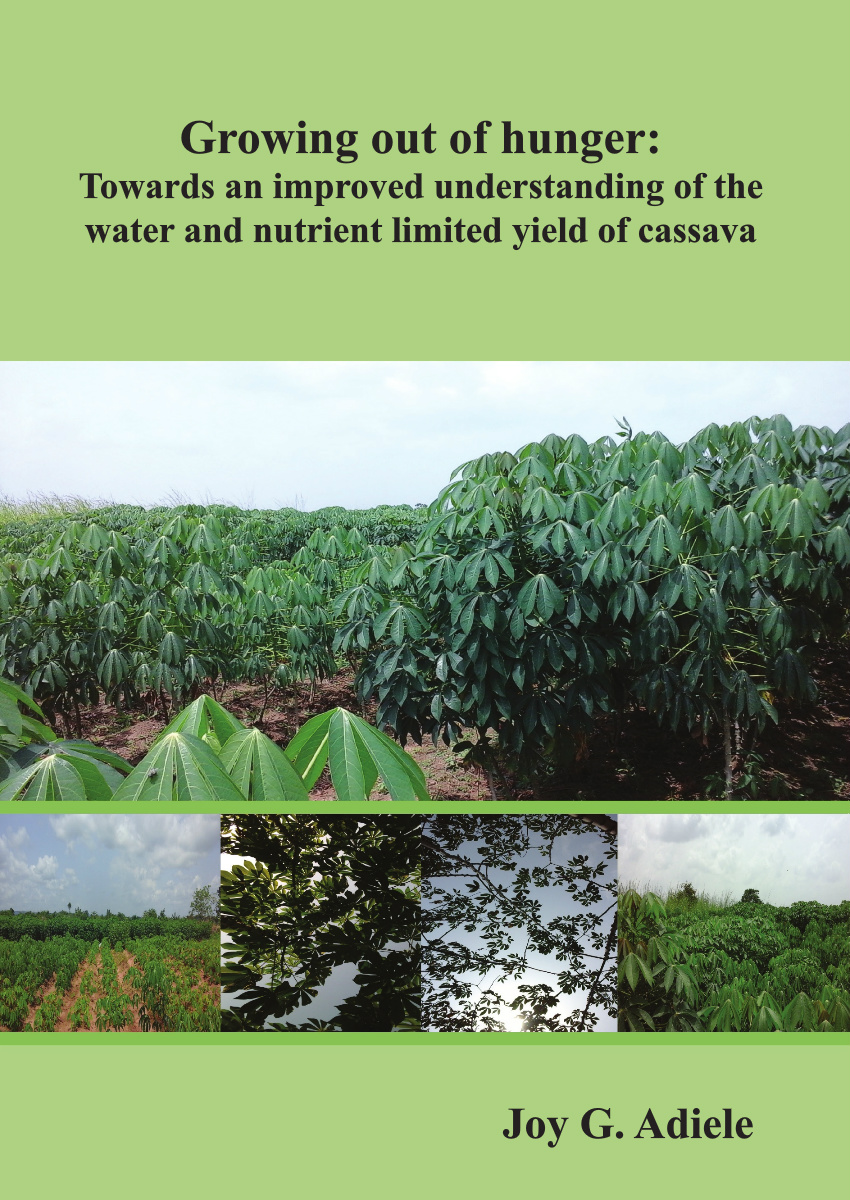
Share this project
Summary
Many studies have been done to elucidate the relevance of cassava for food security and economic growth. Yet, its potential yield in SSA is unknown and the productivity on a land area basis has remained low. Fertilizers can enhance cassava yield tremendously, this is confirmed by large yields reported by scientists from South America, Asia and Australia. To test this knowledge in West African (WA) environment, a two-year on-farm study was done from 2016 to 2018. The experiment fields were located in three agro-ecological zones (AEZs) (Rain Forest – Cross River, Transition Rain Forest - Edo, and Guinea Savanna - Benue). Treatments were N, P, K, secondary and micronutrients applied in different amounts and combinations to cassava cultivar TME 419. Strong responses of cassava to applied N, P and K fertilizers were obtained across the different agro-ecologies, with the largest storage root yield recorded of about 35 t ha-1. The recovery of nutrients and the yield response to K increased with increasing rates of K applied when both N and P were also applied in large amounts. The results show that agronomic and internal utilization efficiency of nutrients by cassava are larger than for cereals. This indicates that environmental risks are less, but at the same time risks of mining soil nutrient reserves are larger with cassava, especially if also stems and leaves are removed from the field.
The observed storage root yields obtained were larger than those previously recorded in experiments and simulated by crop growth models. This indicates that crop parameters used in the simulation models needed to be re-calibrated. So we sought to understand the temporal dynamics of light interception in cassava, determine radiation use efficiency and photo-assimilate partitioning of cassava under optimal conditions. Then calibrate the LINTUL-Cassava model with data from the 2016 experiment in Edo and test the yield prediction accuracy with observations from other field experiments. Measured seasonal average RUE values of 2.8 g DM MJ IPAR, light extinction coefficient (k) of 0.67 and 80 % light intercepted were much larger than reported earlier for cassava. Overall, with re-calibrated parameters the LINTUL-Cassava model accurately estimated the storage root yield at the end of the growing season under rainfed conditions.
Information about nutrient uptake and dilution patterns of cassava during the growth cycle is limited, especially for WA growing conditions. This knowledge is necessary to understand the temporal nutrient demands of cassava and to identify best management practices that prevent nutrient deficiency or excess use. Hence we studied the nutrient uptake of cassava as affected by fertilizer application, quantified the proportions of N, P and K in plant-parts and established nutrient dilution curves and nutrition indices for cassava. Nutrient demand differed across the phenological stages of cassava, providing means to optimize nutritional management and timing of applications for maximum yield response. Nutrient uptake rates peaked at about four months after planting. Also, nutrient dilution curves for N, P and K were quantified for the first time in cassava. We observed stronger nutrient dilution coefficients than those reported for most crops. These insights underpin nutrient-limited crop growth models that are needed to further optimize nutrition and to understand how water and nutrient limitations interact with crop growth rates under a range of environments and nutrient availabilities.
Crop growth modelling has yet to include the simulation of NPK interactions and relation between soil available nutrients and crop demand over time. The knowledge about nutrient (N, P and K) demand and uptake patterns under both ample and deficient conditions in cassava as obtained from this study were used to develop a simulation model. LINTUL-Cassava-NPK, a dynamic crop growth model for cassava that simulates potential, water limited and N, P and K limited growth was developed and tested. The model calculates the stress effects due to inadequate water availability or N, P and K supply on crop growth rates and yield of cassava, and provides estimates of total uptakes of N, P and K. The predicted uptakes of N, P and K and dry matter yields of storage roots were in good agreement with observed values. The modelling results suggest that more N is needed at the onset of the season, while more K needs to be applied at a later stage for maximum growth with minimum losses. Overall, the LINTUL-Cassava-NPK model can help to better understand variations in nutrient recovery and nutrient use efficiency of cassava across sites and seasons. However, it requires further testing, especially under a range of water limited conditions.
Increasing cassava yield requires an in-depth understanding of limitations in growth. Optimum plant population densities are required for good yield. Also, good land preparation such as ‘the ridge land management system’ enhances cassava growth. Canopy development of cassava at the initial growth stage is slow, it takes about 80 days after planting to attain an LAI of one. This makes cassava a poor competitor with weeds, for light, water and nutrients. Hence, enhancing radiation use efficiency is required to increase cassava yield. In our study, LAI and intercepted light were maintained at sufficient high levels for good crop growth. Overall, good land preparation, selection of high-quality planting material from improved cultivars, optimum planting density and appropriate and balanced fertilizer rates, can stimulate early cassava growth and rapid canopy closure. Cassava is often grown by resource-poor farmers who operate under limited resources. Its ability to produce where other crops fail has led many to believe that cassava does not require fertilizers. Fertilizer response trials on cassava show poor yield responses at low nutrient rates. Furthermore, unbalanced N, P and K rates, where in most cases too much N is applied, contribute to the limited response of cassava to applied fertilizers. Our results show that without adequate K supply, cassava responds poorly to N fertilizers. At balanced rates, there is a positive synergistic interaction between N and K on assimilate production, nutrient uptake, yield formation and stress tolerance. Therefore, poor cassava yield responses to fertilizer applications in SSA are related to imbalanced nutrient supply, low application rates, wrong timing of application, poor weed management etc.
Improved crop management practises that improve both NUE and productivity without negative consequences for the long term are essential: increasing yields is the key strategy for food security. Our results show that it is possible to achieve high NUE with cassava at relatively large fertilizer rates, but only when crop nutrient demand is much larger than the indigenous supply and growing conditions are favourable. The lowest agronomic efficiency (AE) and recovery efficiency (RE) obtained from Benue (Guinea Savanna) reflects the need for adjustment of fertilizer applications to the production potential of the different locations (agro-ecologies) as well as to improve management of other factors. Current management practices for growing cassava in WA, for instance Nigeria may be contributing to the low yields. In practice, the most suitable planting time of cassava in a particular locality is usually determined by onset of rains. Insights from our study show that cassava planted with the first rains (April – June) with the intention to harvest at 12 MAP, undergoes enormous yield losses due to the regrowth that occurs with the return of rains from April of the following year. Under rainfed conditions, planting cassava in the middle of the rainy season (August – September) would allow for adequate crop establishment before the onset of the seasonal dry period. Crop growth continues with rapid regeneration and higher photosynthetic capacity with the return of rains, when the crop is still about 7 or 8 months old. This allows an adequate time for recovery from drought and consequently a large yield at harvest, as was the case in Benue during the 2016 growing season.
Results from our study improved the performance of LINTUL-Cassava model under rain-fed systems and formed the empirical and theoretical foundations of nutrient-limited cassava growth modelling. The LINTUL-Cassava-NPK model provides insight in best times of nutrient application in the season. This will help to reduce nutrient losses and maximize yield by applying the required amounts at the proper time. The knowledge provided will be useful and can improve agricultural decision support tools. High-yielding cassava can play a key role towards meeting the increasing demand for food and agro-based products, because of its high energy content and efficiency. Under limited N availability, applying fertilizer to cassava results in more energy per kg N applied with lower environmental risks than for maize. Cassava is produced mainly for the domestic market in Nigeria. Outlook for increased cassava production is promising as it can spur rural and economic development through production, marketing and export of high quality cassava starch and chips to earn foreign exchange. The large yield response obtained in this study indicates that Nigeria economy could still be improved through cassava production. Cassava could become the raw material base for an array of processed products that would increase the demand and contribute to the long sought agricultural transformation and economic growth in Nigeria. Most especially, findings from our work will be useful in developing technologies for good agronomic practices that will support sustainable cassava production.