Share this project
Josh Maiyo
Vrije Universiteit Amsterdam
Publication date: 8 februari 2018
University: Vrije Universiteit Amsterdam
ISBN: 978-94-6295-834-0
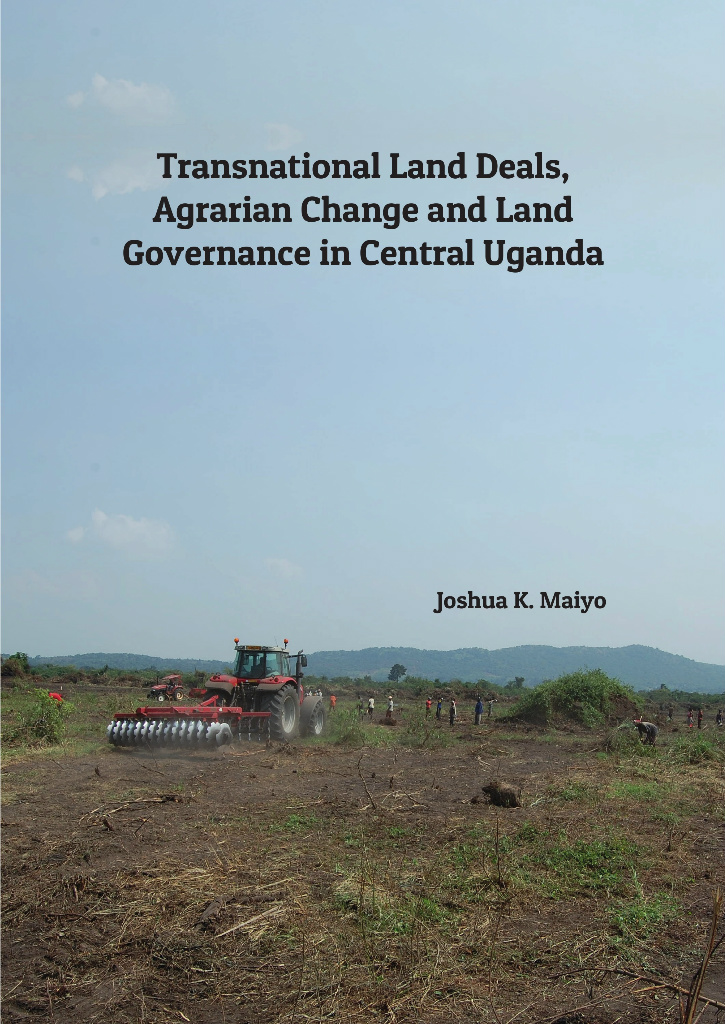
Transnational Land Deals, Agrarian Change and Land Governance in Central Uganda
Summary
This dissertation examines how transnational land deals in central Uganda are embedded within long-term historical processes of social formation and state building, and contemporary patterns of decentralised land governance and agrarian modernisation in central Uganda. Using results from an empirical study of cases in Nakaseke district in central Uganda, I analyse the contextual factors, explore the discourses of legitimation and stakeholder relations, and assess the socio-environmental effects of transnational land deals at the local level. The rationale for the research was premised on the high level of public attention – since the food and financial crises starting from 2008 – on what was believed to be an exponential rise in foreign commercial interest in, and acquisitions of arable land in developing countries, particularly in Africa.
The trend was understood to be historically unprecedented. Due to the size of tracts of land acquired and the intensity of its perceived consequences, the phenomenon came to be known popularly as the ‘land rush’ or ‘global land grab’. This sparked new international debates. While some expressed concerns about potentially adverse socio-ecological consequences, others saw it as defining a new era of increased foreign direct investment (FDI) in Africa’s hitherto neglected agriculture sector, thus shaping new discourses about possibilities for agrarian change and development.
The proliferation of high-profile global debates and increased public attention initially drew on anecdotal media reports. However empirical evidence and detailed knowledge about the actual characteristics, processes, and effects of transnational land deals at remained scant. Some of the glaring gaps that persisted in the start of this research included questions as to whether the phenomenon was more hype than reality. Under what circumstances and in what ways did these land deals emerge? What were their characteristics and how did they unfold at the local level? Who were the principle actors involved and what were their roles? Ultimately, what were the effects of these land deals? In the intervening period, many studies have explored various dimensions of these questions and this book seeks to add to the growing body of knowledge on the multi-dimensional complexity of process and location-specific dynamics of transnational land deals. The knowledge generated is aimed at contributing to the sustained public debates and to inform broader conceptual and theoretical understanding of the phenomenon at a global level.
The book consists of nine chapters. In the introductory chapter one, I chart the contours of the research upon which this book is based, as a component of a larger Integrated Programme on foreign large-scale land acquisitions in Africa supported by a grant from the Dutch Scientific Council NWO-WOTRO. I trace the changes that occurred in the mandate of the research and adjustments in the design from the originally intended case study of a Chinese Free Trade Zone (FTZ) in southern Uganda. I then provide a descriptive account of the process of identifying a new research site and case studies necessitated by altered realities in the field. I briefly introduce the first case study; the Chinese-owned Hanhe Farm, the first of four case studies of transnational land deals in Nakaseke District of central Uganda. I then situate the case-studies and overall research topic within the ontological and epistemological terrain of land-deals research as manifested in contending discourses and conceptual departures of transnational land deals. Here, I argue for and elaborate on the conceptualisation of land deals according to Jan Abbink as practices involving the acquisition by lease or outright transfer of large tracts of arable land, mostly in developing countries, to foreign entities for purposes of agricultural production (Abbink, 2011, p. 1). I conclude by introducing and discussing the main analytical approach used in this study: the Zones of intermediality approach developed by Sandra Evers, which facilitates the analysis of discursive processes of mediation and relational practices between individuals and groups claiming a stake (stakeholders) in land deals.
Chapter two outlines the research methodology including the process and rationale for the selection of research sites at the local government (district), the farms and adjacent villages. This is followed by a more detailed description of the main characteristics of the case-study farms and the research participants at the various sites and levels of analysis. Subsequently, I reflect on the process and strategies used in establishing contact and negotiating access at the various research sites, and the challenges that I encountered and how these influenced the conduct and outcome of the research. I conclude by reflecting on the ethical concerns of confidentiality and protecting the identity of research participants and interrogating my own positionality based on my upbringing immediate post-colonial rural Kenya in Rift-Valley, home of the former white-highlands occupied by colonial settler farmers. I also explore the strengths and deficits of my position as an African, but non-Ugandan researcher starkly deficient in the understanding of the customs and language of the local Baganda people.
In chapter three, I review the literature and recent research on transnational land deals and agriculture modernisation. Here, I interrogate the ways in which dominant and increasingly hegemonic discourses of legitimation are constructed by various transnational actors that frame land deals as necessary components of agrarian modernisation upon which new pathways to economic growth, social transformation and development can be achieved. From a critical agrarian studies standpoint, I examine the role of the Ugandan state and governmental actors in drawing on the orthodoxy of modernist development discourses to structure policies and programmes in accordance with these ideologies. Relatedly, I explore the trajectory of land-deals scholarship that initially focused on exploratory fact-finding research grounded in associated scalar and causal conceptual paradigms such as ‘drivers and motivations’, and the size of land-deals. The departure point for my research is informed by the epistemology of political ecology, which adopts a critical stance towards the developmental discourse deployed by various stakeholders. The focus thus shifts to questions of power as manifested in the discourses and practices in transnational land deals and the ways in which stakeholder interactions symbolise and reproduce power asymmetries in processes of land access and control.
Chapter four locates the analysis of transnational land deals in a wider social-historical context of land relations and agrarian change in central Uganda. I examine the socio-historical trajectories and how the longue durée effects shape contemporary characteristics of multi-level land governance and processes of transnational land deals in central Uganda. The chapter begins by locating the sociocultural origins, composition and identity of the peoples that inhabit Nakaseke district in the wider context of pre-colonial social formation of Buganda, colonial-era transformations of land tenure arrangements and their disruptive effects on land relations. I then analyse the history of land politics, agrarian changes, and land tenure reform in the post-colonial period epitomised by the Buganda agreement of 1900 and that created the feudal style Mailo tenure system of landlord-tenant relations. This analysis aims to trace elements of continuity and change in the structuring of contemporary land relations and the embeddedness of recent transnational land deals within trajectories of (commercial) land pressures and role of land in ethno-political identity formation, post-colonial state-building, and elite exercise of power and authority.
Chapter five analyses the institutional arrangements of multi-level land governance in the processes of decentralised land administration. Here, examine whether and how structural-institutional arrangements of land governance of and specifically land administration at the local level shape processes of land access. This analysis examines how asymmetrical power hierarchies influence land relations in the context of increasing commercial pressures on land. At the core of this investigation is the role of decentralised land governance institutions in the administration of land tenure. By focusing on the analysis of perceptions and experiences of autonomy, efficiency and effectiveness of land administration institutions, this chapter tests assumptions behind normative claims about the effects of decentralisation in democratising land governance and increasing land access and tenure security. Finally, I examine whether and how patterns of increased commercial pressures, including the entry of transnational land deals, result from the patterns of power in local-central relations. I conclude that structural approaches have limited explanatory scope for our understanding of processes and outcomes of transnational land deals.
Chapter six addresses the shortcomings of institutional approaches by undertaking an actor oriented social practice analysis. Here, I examine how stakeholders at the local government level perceive and exercise their roles in land administration and the management of commercial pressures on land in the context of transnational land deals. I ask whether and how local land governance actors exercise their room to manoeuvre in navigating between increasing commercial pressures for arable land, while meeting the demands for, and protecting the rights of local residents. Since local land governance actors are also stakeholders in processes of transnational land deals, I examine whether and how stakeholder relations and the interests and motivations of individual actors influence their exercise of power and authority in governing land deals. Some salient questions arising include whether and how possibilities for elite capture of local institutions and alliances of power, might skew local land governance processes in favour of powerful interests.
Chapter seven draws on empirical results from studies of specific land deals to analyse the discourses of claim making and practices of land acquisition at the local level. Various actors seek to lay diverse and often competing claims of legitimacy, access and control of land, or respond to effects arising from changes in access. From a discursive and practice-oriented approach, I examine the discourses of legitimation, strategies of access and stakeholder relations in transnational land deals. Results show that global discourses and policy propositions of transnational actors are appropriated and deployed to legitimise practices of land control. Secondly, evidence shows the various ways in which diverse stakeholders mediate their claims through various media and discursive practices. Thirdly, I describe the process by which various individuals stake their claims through multiple and diverse interactions with other stakeholders in ways that (re)produce multiple and complex power configurations in pursuit or defense of motives and interests that promote or respond to specific land claims. I conclude that the complexity of stakeholder relations characterised by overlapping and competing interests and motivations, directly shape processes and social outcomes of transnational land deals.
Chapter eight examines whether and how enclosures and access restrictions, ensuing land-use changes, and environmental effects of transnational land deals shape the perceptions and lived realities of local land dwellers. The chapter analyses the discursive and embodied response strategies of various groups of stakeholders to practices of land control at the local level. Results show that land-use changes associated with transnational land deals raise concerns about potentially adverse socio-ecological effects and trigger discourses about ‘proper’ environmental governance. Furthermore, location-specific claims over communal access and usufruct rights are intertwined with environmental concerns, as ecological effects spill over the boundaries of enclosed spaces. However, variations in perceptions and lived experiences of access restrictions and rights violations as well as power configurations between stakeholders shape local-level responses in differentiated ways. Focusing on stakeholders’ exercise political power, critical dimensions of patterns and effects of socio-ecological distribution and inequality come to the fore. This demonstrates the political effects of transnational land deals in reconfiguring power relations, delineating winners and losers and transforming social cleavages and vulnerability at the local level.
Chapter nine concludes the study with a post-script that review progress of the land deals and traces their varying trajectories in relation to assumptions underlying popular discourses on foreign land acquisitions. First, these trajectories as examined based on discourses of legitimation that are largely rooted in the discursive construction of agrarian modernisation and neoliberal developmentalism. Secondly, I observe that land deals are embedded within a structural alliance between transnational capital and state elites in Uganda that constitutes a continuum of the process of state formation. Transnational land deals thus constitute zones of intermediality: conceptual fields in which complex state-society relations are shaped and contested. Third, diverse complexity in the discourses and practices of claim-making about transnational land deals reveals the heterogeneity in categories and dichotomies of land deals. While the notion of ‘transnationality’ demarcates the conceptual and empirical starting point of the research, I conclude that a stakeholder-oriented approach deconstructs binary distinctions between foreign and local, questions assumptions about emasculated ‘local communities’ and challenges generalisations about the role of predatory states in land deals. Transnational land deals are instead understood as manifestations of broader processes of social change in which various stakeholders, characterised by diverse origins, identities, networks and power positions, exercise their agency within complex structural contexts in the process of agrarian change and rural transformation.
In conclusion, this book argues for a deeper examination of contextually situated historical, social, political and economic factors in the analysis of transnational land deals. In central Uganda, historical trajectories of social formation, and legacies of political conflict, displacement and social vulnerability, alongside enduring reproduction of a predatory rentier state, constitute important factors that shape patterns and outcomes of land deals. The centrality of power in these dynamics accounts for the detailed interrogation of governance dimensions of land deals. Consequently, I argue that the distribution of social power — the ability of an actor to control their own interaction with the environment and the interaction of other actors with the environment (Bryant & Bailey, 1997, p. 37) — among and within various groups of stakeholders, is necessary for a deeper understanding of the nature and outcomes of transnational land deals and more generally processes of agrarian change land relations in central Uganda.
Abbreviations
AAA American Anthropological Association
AGRA Alliance for a Green Revolution in Africa
ALC Area Land Committee
AU African Union
CAADP Common African Agriculture Development Programme
CAO Chief Administrative Officer
DDT Dichlorodiphenyltrichloroethane
DEC District Executive Committee
DEO District Environment Office(r)
DFI Development Finance Institution
DLB District Land Board
DLO District Land Office(r)
EIA Environmental Impact Assessment
FAO Food and Agriculture Organisation
FDI Foreign Direct Investment
FIAN FoodFirst Information and Action Network
FTZ Free Trade Zone
GIS Geographic Information Systems
GLAD Farm Great Lakes Africa Development Farm
GPS Global Positioning System
IBC Imperial British Company
IFAD International Fund for Agriculture and Development
IFPRI International Food Policy Research Institute
IGG Inspector General of Government
IMF International Monetary Fund
JASAR Joint Agricultural Sector Annual Review
KCCA Kampala Capital City Authority
KDLB Kampala District Land Board
LC Local Council
LEC Local Environmental Committee
LGAF Land Governance Assessment Framework
LPPU Land Protection Police Unit
LIS Land Information System
LSLA Large Scale Land Acquisition
LVFTZ Lake Victoria Free Trade Zone
MAAIF Ministry of Agriculture, Animal Industry and Fisheries
MISR Makerere Institute of Social Research
MLHUD Ministry of Lands, Housing & Urban Development
MP Member of Parliament
NEMA National Environment Management Authority
NEPAD New Partnership for African Development
NFA National Forestry Authority
NGO Non-Governmental Organisation
NRA National Resistance Army
NRC National Resistance Council
NRM National Resistance Movement
NWA National Wildlife Authority
PEAP Poverty Eradication Action Plan
PMA Plan for Modernization of Agriculture
PRSP Poverty Reduction Strategy Programme
RC Resistance Councils
RDC Resident District Commissioner
RoU Republic of Uganda
UBOS Uganda Bureau of Statistics
UIA Uganda Investment Authority
ULA Uganda Land Alliance
UNCST Uganda National Council for Science and Technology
UNCTAD United Nations Conference on Trade and Development
UNECA United Nations Economic Commission for Africa
UNFFE Uganda National Farmers Federation
UPC Uganda People’s Congress
URN Uganda Radio Network
See also these dissertations
Toby van Gastelen
Structure-Preserving Data-Driven Methods for Modeling Turbulent Flows
19 mei 2026
TU Eindhoven
Open Ebook
Ton Winkelmolen
Molecular insights into the role of VRS5 in tillering and lateral spikelet development in barley
12 juni 2026
Wageningen University
Open Ebook
Selcuk Peker
Gamma Knife Radiosurgery for Skull Base Tumors
10 juni 2026
Universiteit Maastricht
Open Ebook
Tonny Manalal
Reimagining petrochemical clusters by defossilising chemical building blocks
18 mei 2026
Overig
Open Ebook



Cora De Gol
Microbial stabilization and protein functionality of plant-based liquids using pulsed electric fields
17 juni 2026
Wageningen University
Open Ebook
We print for the following universities