Share this project
Johanna Ospel
Universiteit van Amsterdam
Publication date: 3 november 2021
University: Universiteit van Amsterdam
ISBN: 978-94-6423-460-2
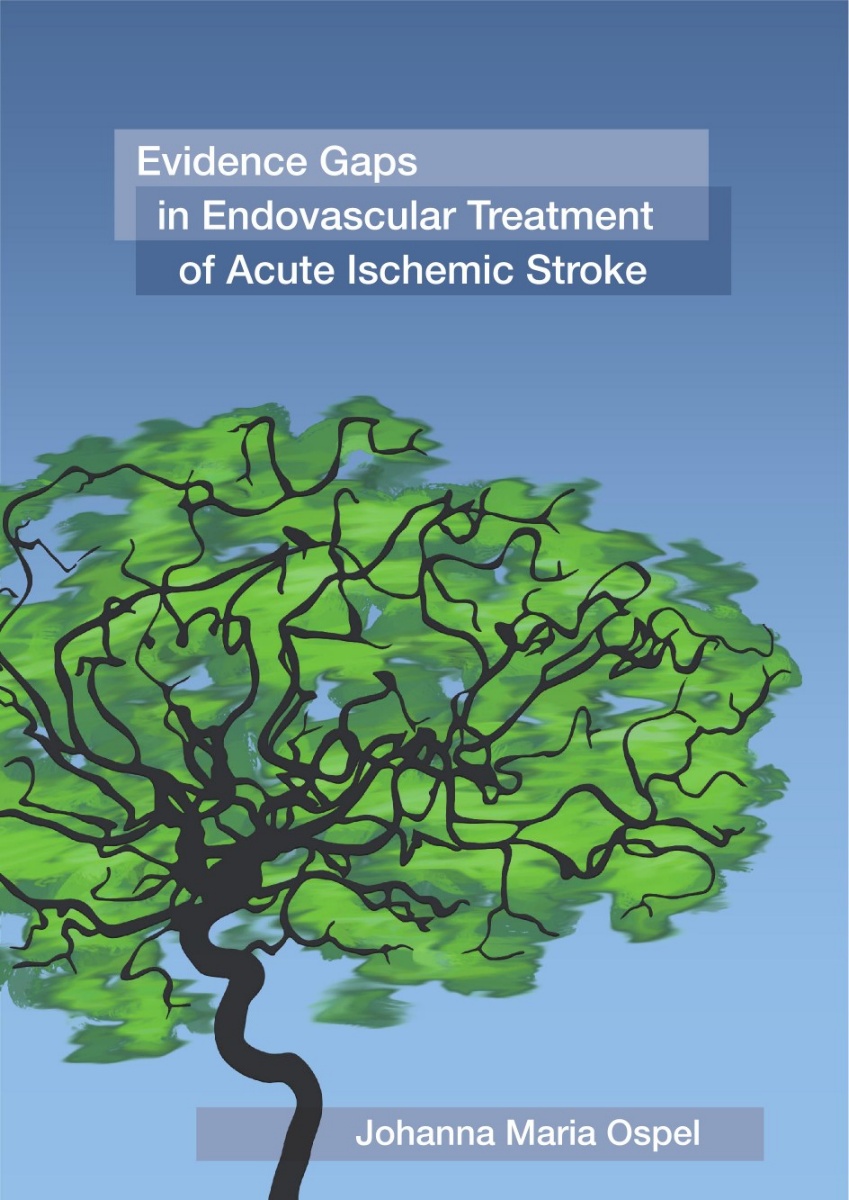
Evidence Gaps in Endovascular Treatment of Acute Ischemic Stroke
Summary
Evidence Gaps in Endovascular Treatment of Acute Ischemic Stroke
Chapter 1 provides a brief introduction and outline of the thesis.
Chapter 2 investigates the clinical course of medium vessel occlusion (MeVO) stroke with and without intravenous alteplase. Clinical baseline characteristics, angiographic and clinical outcomes of 258 MeVO patients from the PRove-IT and INTERRSeCT cohort studies were analyzed, 72% of which received intravenous alteplase. The median baseline National Institutes of Health Stroke Scale (NIHSS) was 7 (interquartile range 5 – 12). One out of 2 patients achieved an excellent outcome and a good outcome was achieved by 2/3 of patients. Early repeat vascular imaging was available for 80% of patients and showed that early recanalization occurred in 42% of patients. Early recanalization rates were higher in patients with intravenous alteplase compared to those not treated with intravenous alteplase (47% vs. 21%). There was no association of intravenous alteplase treatment with excellent outcome (adjusted OR 1.70 [95% CI 0.88 – 3.25]) and good outcome (adjusted OR 1.54 [95% CI 0.70 – 3.36]). These results show that intravenous alteplase has limited efficacy in the setting of MeVO stroke and emphasize the need for an alternative, more effective treatment option such as endovascular treatment (EVT).
In chapter 3, we investigated the combined effect of age and Alberta Stroke Program Early CT Score (ASPECTS) on clinical outcome and assessed the benefit of successful reperfusion in EVT across age and ASPECTS subgroups in the MR CLEAN registry (n = 3279). We found no evidence of interaction between age and ASPECTS. Outcomes were poorest in patients above the median age (≥71.8 years) and low ASPECTS (0 – 5), with 64% of patients suffering poor outcomes, defined as mRS 5 – 6. The benefit of successful reperfusion was preserved across all age/ASPECTS subgroups. These results confirm that the prognosis of old patients with extensive ischemic changes at baseline is poor, but they provide no evidence of an interaction between the two variables and, in principle, do not support withholding EVT based on a combination of old age and low ASPECTS.
In chapter 4, we set out to investigate how the prognostic impact of age and NIHSS compare to each other in large vessel occlusion patients treated with and without EVT in the HERMES collaboration (n = 1750), and assessed treatment effect of EVT based on a weighted index, which reflects the relative importance of age and NIHSS with regard to patient prognosis. We performed adjusted logistic regression with good outcome (modified Rankin Score [mRS] 0-2) as dependent variable and obtained the effect coefficients for age (-0.032) and NIHSS (-0.111), corresponding to an NIHSS/age effect coefficient ratio of approximately 3. This was translated into the following formula: (3*NIHSS) + age. Cumulative EVT effect size estimates across all patient subgroups defined by this formula consistently showed a favorable effect of EVT, with a number needed to treat between 5.3 and 8.7. Our findings indicate that the impact of a one-point increase in NIHSS on chances of good outcome is roughly equal to a 3-year increase in age, and that EVT seems to be beneficial across all weighted age/NIHSS subgroups.
In chapter 5, we analyzed total infarct volume and qualitative infarct variables (infarct pattern, gray and white matter involvement and involvement of the corticospinal tract) visually in all patients from the ESCAPE-NAN trial with available 24h follow-up imaging (n = 1026). Additionally, quantitative infarct variables (infarct volumes in the grey and white matter) were assessed in patients with available 24h diffusion-weighted magnetic resonance imaging (n = 358). Our results showed that involvement of both gray and white matter compared to gray matter only (adjusted OR 0.19 [95% CI 0.14 – 0.25]), corticospinal tract involvement (adjusted OR 0.06 [95% CI 0.04 – 0.10]) and a territorial rather than a scattered infarct pattern (adjusted OR 0.22 [95% CI 0.14 – 0.32]) were associated with decreased chances of good outcome (mRS 0-2), even after adjusting for total infarct volume.
In chapter 6, we analyzed clinical and imaging baseline data from control arm patients of the ESCAPE trial with available early follow-up imaging and
See also these dissertations




Karlijn Doorenspleet
Improving North Sea biodiversity monitoring using novel molecular approaches
25 juni 2026
Wageningen University
Open Ebook
Haojie Lu
Omics Studies of Cardiometabolic and Skeletal Traits
25 juni 2026
Erasmus Universiteit Rotterdam
Open Ebook
Evans Mudibo
Interaction between acute illness and malnutrition in children in sub-Saharan Africa and South Asia
24 juni 2024
Wageningen University
Open Ebook
Anniek Stuut
The Balancing Act of Allogeneic Haematopoietic Stem Cell Transplantation
10 juli 2026
Universiteit Utrecht
Open Ebook
Danny van den Eertwegh
Charge Transport and Bubble Dynamics in Electrolysis Applications
17 juni 2026
TU Eindhoven
Open Ebook
We print for the following universities