Yussif Baba Kassim
Enhancing crop response to fertilization in northern Ghana
4 september 2026
Wageningen University
Open Ebook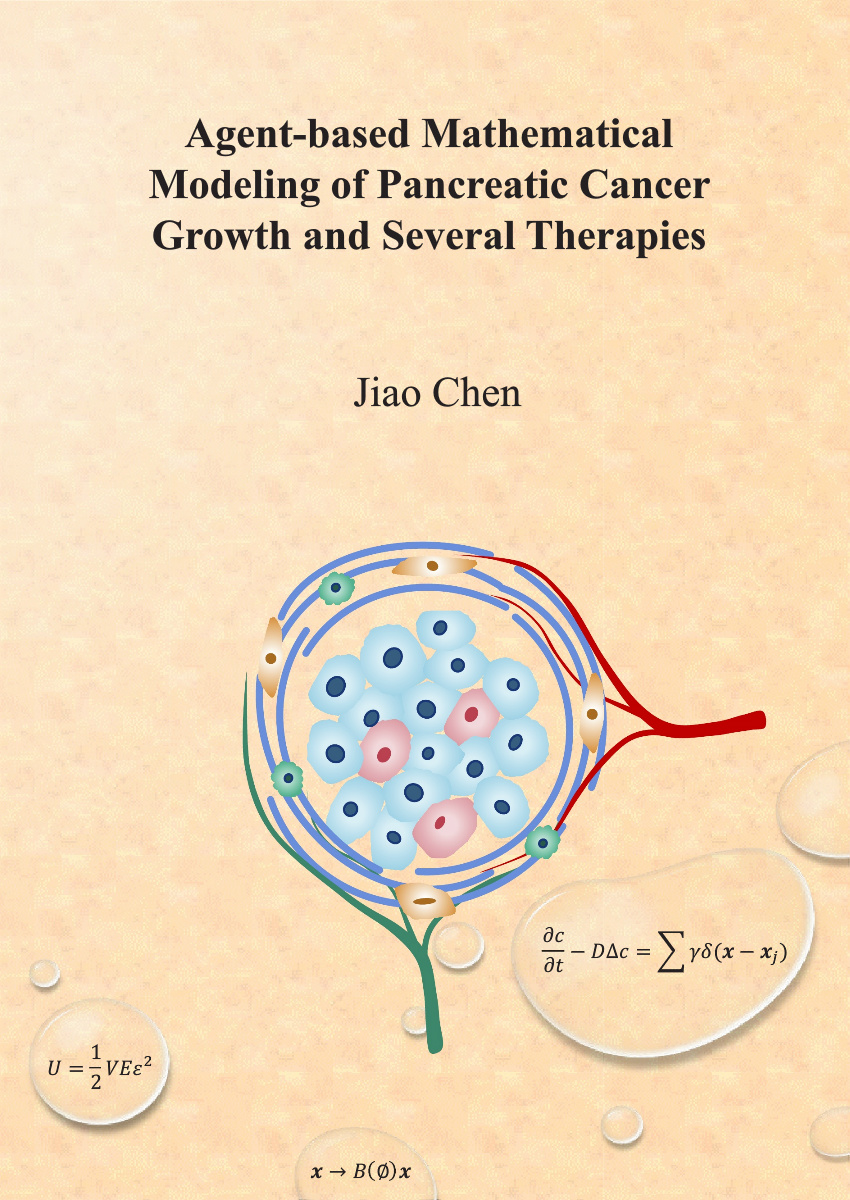
Share this project
Summary
Cancer is known as one of the leading causes of death in the world with difficult diagnose at early stages, poor prognosis and high mortality. Animal-based experiments and clinical trials have always been the main approach for cancer research, albeit they may have limitations and ethical issues. Mathematical modeling as an efficient method is used to predict results, optimize experimental design and reduce animal use. Our work focuses on the phenomenological simulation of cancer progression and therapies at the cell scale level.
Pancreatic cancer has a rare structure where cancer cells preferably accumulate into clusters at early stages and cause a cancer-associated desmoplastic extracellular matrix (ECM) to be produced circumferentially around it. This desmoplastic ECM is anisotropic and plays as a physical defense for cancer cells against the entry of some agents, e.g. immune cells, drugs, etc. To investigate the impacts of anisotropic ECM on the migration of immune cell T-lymphocytes at early stages, we develop a model on cell migration in T-lymphocytes mediated antitumor response with an application to pancreatic cancer in Chapter 2. Cell displacement is updated by solving a large system of stochastic differential equations with the Euler-Maruyama method. As expected, our cell-based model is able to show the phenomenon successfully, where T-lymphocytes can hardly invade cancer cells under anisotropic ECM orientation. Furthermore, the obstructing effect of ECM orientation enhances the progression of the tumor with the increase in the degree of anisotropy. In addition, the model predicts cancer growth under various immune conditions.
As an extension in Chapter 3, the model is refined and applied to the stage of treatment. Gemcitabine is known as the front-line drug for pancreatic cancer therapy, which inhibits the proliferation of cancer cells. Since this drug is often used in conjunction with other drugs, we combine gemcitabine with another drug that can weaken the anisotropic ECM orientation. The enzyme PEGPH2O aims at depleting hyaluronan in desmoplastic ECM and hence increases the penetration of many different agents. Therefore, the therapeutic model of PEGPH2O + gemcitabine is considered and compared with the corresponding mouse-based experiments in the literature. The concentration of drugs is based on Green’s fundamental solutions of the reaction-diffusion equation. The administration of drugs is assumed to be given by injections, and the results show that PEGPH2O enzyme-mediated therapy facilitates the anti-tumor immune response. However, the likelihood of success of a cure relies on the stage of diagnosis and timely treatment. To investigate the correlations of possibilities of success of the therapy and uncertainties of input parameters, Monte Carlo simulations are performed in a two-dimensional model. To conclude, the likelihood of healing significantly reduces as the treatment is postponed. Moreover, the model is able to predict the likelihood of success of the therapy and to provide a reference for experiment design regarding the drug dose according to different stages of cancer progression.
To mimic a larger scale like tissue level, we set up a three-dimensional cellular automata model with an application to pancreatic cancer in Chapter 4. This chapter presents a simulation of oncolytic virotherapy, which employs genetically modified viruses that selectively kill cancer cells. The spread of viruses is modeled by using the diffusion-reaction equation that is discretized by the finite difference method and integrated by the IMEX approach. Furthermore, some cell biomedical processes are dealt with using probabilistic principles. As we expected, this cellular automata model can simulate the cancer progression at early stages and cancer attenuation under viral intervention well. Since the residual viruses may have toxicity to patients, Monte Carlo simulations are performed to investigate the correlations between input variables and numerical results (total residual viruses and cancer area).
Albeit desmoplastic ECM inhibits the entry of agents, cancer cells are able to degrade the ECM by secreting enzyme MMPs once they start to metastasis. Metastasis is a major cause of cancer mortality, and cells normally undergo many morphological changes during the transmigration. Therefore, we develop a model of cell deformation where also the deformation of the nucleus is incorporated in two and three-dimensions in Chapter 5. The movement of migrating cells is chemotaxis/ durotaxis treated by using Green’s fundamental solutions and an IMEX time integration method is used to update the displacement of cells. In addition, Poisseuille flow is incorporated to simulate a microvascular flow, where the bloodstream is treated as an incompressible fluid. As a result, this is a successful model to describe morphological evolution of one cell and its nucleus when it encounters the specific obstacles or paths during the metastasis. Analogously, Monte Carlo simulations are carried out to quantitatively evaluate the impact of uncertainties on numerical results.
Mathematical modeling reshapes the understanding of cancer and it will definitely be a useful tool for the optimization of cancer therapy and for cancer research in the future.