Share this project
Gabriele Laudadio
Overig
Publication date: 27 mei 2020
University: Overig
ISBN: 978-90-386-5044-9
New synthetic methods enabled by photochemistry and electrochemistry in flow
Summary
The research presented in this thesis focused on the development of new synthetic methods enabled by photochemistry and electrochemistry. The employment of traceless reagents like photons or electrons allows more selective and effective transformations. Furthermore, combining these approaches with continuous-flow technology, acceleration of reaction kinetics and improved selectivity can be achieved.
The work described in this dissertation can be divided in two main research lines. Firstly, photochemical hydrogen atom transfer (HAT) reactions were discussed. Owing to the powerful combination of decatungstate catalysis with continuous flow technology, methods suitable for C(sp3)–H oxidation reactions and alkylation of Michael acceptors with volatile gases were presented.
In Chapter 2, a continuous-flow protocol for the aerobic oxidation of both activated and unactivated C(sp3)-H bonds was described. The implementation of a continuous-flow microreactor afforded an enhanced gas-liquid mass transfer between the two immiscible phases, while allowing a safe handling of gaseous reactants, together with a uniform irradiation of the reaction mixture. With this method many natural scaffolds could be selectively oxidized, such as (-)-ambroxide, pregnenolone acetate, (+)-sclareolide and artemisinin.
In Chapter 3, an innovative and selective photochemical activation of light alkanes was presented. In this chapter, isobutane, propane, ethane and methane were efficiently incorporated to organic molecules (36 examples) via Decatungstate catalysis employing a commercially available photoreactor. High selectivity was observed in the case of isobutane and propane towards the more stabilized radicals.
In the second part of the thesis, a parallel research line focused on the development of new electrochemical reactions was presented. In this, continuous-flow technology was adopted to overcome some of the major drawbacks currently limiting the reproducibility and the scalability of electrochemical transformations.
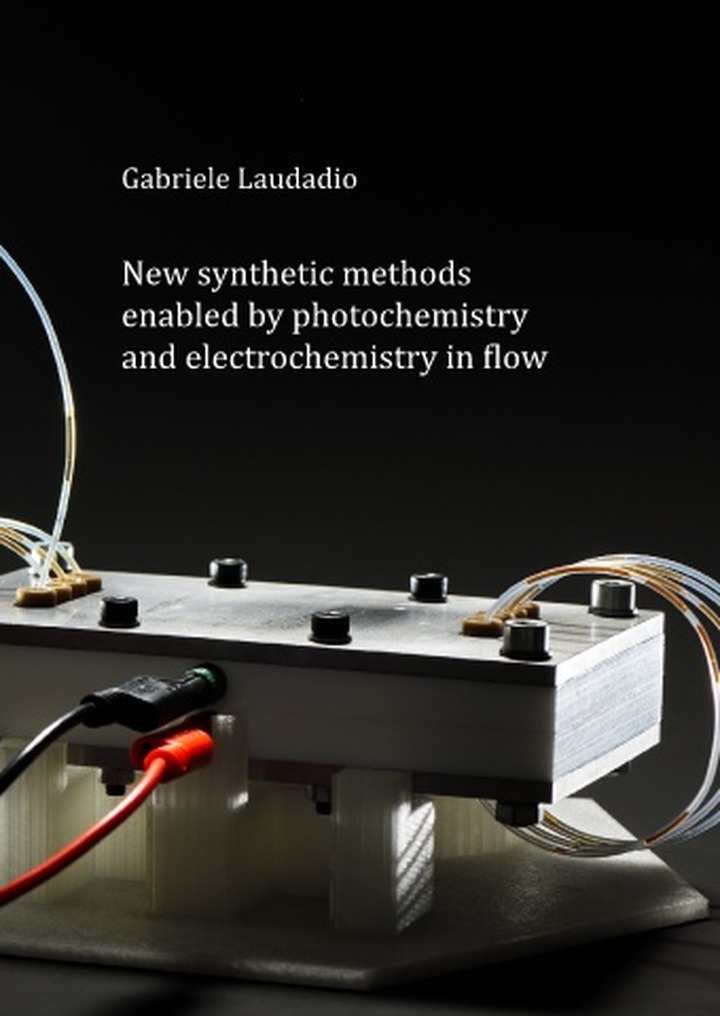
In Chapter 4, a newly designed, undivided-cell electrochemical flow reactor was presented. In particular, the electrochemical cell could be used both in serial and parallel mode thanks to the flexible reactor volume. The continuous-flow system was subsequently assessed in two synthetic transformations, which confirms its versatility and scale-up potential.
Next, in Chapter 5 a selective electrochemical synthesis of sulfoxides, sulfones and disulfides was described. The reaction was solely governed by the applied potential, exhibiting a broad scope and good functional group compatibility. The use of continuous flow allowed to rapidly assess the optimal reaction parameters (e.g. residence time, applied potential), to avoid mass-transfer limitations and to scale the electrochemistry.
After this, an environmentally benign electrochemical method which enables the oxidative coupling between thiols and amines was reported in Chapter 6. Sulfonamides could be synthesized by commodity chemicals like thiols, disulfides and amines, and the reaction displays a broad substrate scope and functional group compatibility. In this case, the continuous-flow approach displayed higher selectivity and faster kinetics compared to the corresponding batch reaction.
With a similar approach, in Chapter 7 a novel synthesis of sulfonyl fluorides was presented. In this chapter thiols or disulfides could be employed as starting materials, and potassium fluoride was used both as fluorine source and supportive electrolyte. Even in this case, continuous-flow reactions showed faster kinetics due to high mass transfer.
Finally, in Chapter 8 a versatile electrochemical synthesis of aziridines was presented. In this chapter, it was observed that a continuous-flow approach could enhance the selectivity towards the desired product compared to the corresponding batch reaction. Moreover, the hydrogen produced at the cathode was efficiently used to reduce the reactive intermediate leading to the corresponding hydroaminated product. The reaction showed a broad scope, with 26 different examples.
In conclusion, the positive combination of photochemistry and electrochemistry with continuous-flow technology resulted in the development of different methodologies. Nowadays, the chemistry community has already embraced the idea that green approaches like photochemistry and electrochemistry can be dramatically improved by carrying them out in a microenvironment. This can be demonstrated by the rising attention that both academia and fine chemical industries are giving to these important topics. Despite this interest, further improvements to ameliorate the applicability of electrochemical technology are necessary. For example, standardization of batch and flow setups might boost reaction discovery, improving the reproducibility of the results. Reactor designs for divided-cell and photoelectrochemical microreactors might also be explored to open up new chemical possibilities, further reducing the impact of old and energetically non affordable processes.
From the chemical point of view, new gas-liquid photochemical hydrogen atom transfer reactions can be investigated, introducing selectively different functional groups starting from strong C(sp3)-H bonds. Moreover, different electrochemical transformations can be studied, from cross coupling reactions to new electrochemical C-H functionalization. In both cases, continuous-flow approaches can accelerate dramatically the discovery and the optimization of novel methodologies, thanks to the limited amount of materials needed for optimization and the improved kinetic profiles. These processes might also be significantly facilitated by the implementation of automated platforms both for photochemical and electrochemical applications in the reactor technology.
List of abbreviations
Ac Acetyl
BDE Bond Dissociation Energy
BF3⋅OEt2 Boron Trifluoride Diethyl Etherate
BHT 2,6-di-tert-butyl-4-methylphenol
Bu4NClO4 Tetrabutylammonium Perchlorate
CD3CN Deuterated Acetonitrile
CDCl3 Deuterated Chloroform
CE Counter Electrode
CH3CN Acetonitrile
CrO3 Chromium Trioxide
CsF Cesium Fluoride
CSTR Continuous Stirring Tank Reactor
DABSO 1,4-diazabicyclo[2.2.2]octane bis(sulfur dioxide)
DCM Dichloromethane
DIY Do-It-Yourself
DMSO Dimethylsulfoxide
DT Decatungstate
Et3N Triethylamine
EtOAc Ethyl Acetate
GC-FID Gas Chromatography – Flame Ionization Detector
GC-MS Gas Chromatography – Mass Spectrometry
H2 Hydrogen
H2O Water
H2O2 Water Peroxide
HAT Hydrogen Atom Transfer
HCl Hydrochloric Acid
HFIP 1,1,1,3,3,3-hexafluoro-2-propanol
HPLC High-Pressure Liquid Chromatography
HRMS High Resolution Mass Spectrometry
ID Inner diameter
KF Potassium Fluoride
KMnO4 Potassium Permanganate
LC-MS Liquid Chromatography – Mass Spectrometry
LED Light Emitting Diode
m-CPBA meta-chloroperbenzoic Acid
Me4NBF4 Tetramethylammonium Tetrafluoroborate
MeOH Methanol
MFC Mass flow controller
MgSO4 Magnesium Sulfate
NaF Sodium Fluoride
NaIO4 Sodium Periodate
NFSI N-Fluorobenzenesulfonimide
NH3 Ammonia
NMR Nuclear Magnetic Resonance
O2 Oxygen
OD Outer diameter
Pd/C Palladium on Carbon
PEEK Polyether Ether Ketone
PFA Perfluoroalkoxy alkane
pRS-SDR Photochemical Rotor-Stator Spinning Disk Reactor
PTFE Polytetrafluoroethylene
Py Pyridine
RE Reference Electrode
rt Room Temperature
SCE Saturated Calomel Electrode
SET Single Electron Transfer
SI Supporting Information
SO2 Sulfur Dioxide
SS Stainless Steel
SuFEx Sulfur Fluoride Exchange
TBADT Tetrabutylammonium Decatungstate
TBAF Tetrabutylammonium Fluoride
TEMPO 2,2,6,6-Tetramethylpiperidine 1-oxyl
TFA Trifluoroacetic Acid
TFDO Methyl(trifluoromethyl) dioxirane
TiO2 Titanium Oxide
TLC Thin Layer Chromatography
tR Residence Time
TsOH para-toluenesulfonic Acid
UV Ultraviolet light
VIS Visible light
WE Working Electrode
ZnO Zinc Oxide
Publication list
Peer-reviewed articles
Published
1. Noël, T.; Cao, Y. and Laudadio, G. The Fundamentals Behind the Use of Flow Reactors in Electrochemistry, Accounts of Chemical Research, 2019, 52 (10), 2858-2869. DOI: 10.1021/acs.accounts.9b00412 (Highlighted by OPRCD).
2. Laudadio, G.; de Andrade Bartolomeu, A.; Verwijlen, L.M.H.M., Cao, Y., de Oliveira, K. and Noël, T. Sulfonyl Fluoride Synthesis through Electrochemical Oxidative Coupling of Thiols and Potassium Fluoride. Journal of American Chemical Society, 2019, 141 (30), 11832-11836. DOI: 10.1021/jacs.9b06126 (Highlighted by Synfacts).
3. Laudadio, G.; Barmptoutis E.; Schotten, C.; Struik, L.; Govaerts, S.; Browne, D.L. and Noël, T. Sulfonamide Synthesis through Electrochemical Oxidative Coupling of Amines and Thiols. Journal of American Chemical Society, 2019, 141 (14), 5664-5668. DOI: 10.1021/jacs.9b02266 (Highlighted by OPRCD).
4. Laudadio, G.; de Smet, W.; Struik, L.; Cao, Y. and Noël, T. Design and application of a modular and scalable electrochemical flow microreactor. Journal of Flow Chemistry, 2018, 8 (3-4), 157-165. DOI: 10.1007/s41981-018-0024-3.
5. Laudadio, G.; Govaerts, S.; Wang, Y.; Ravelli, D.; Koolman, H; Fagnoni, M.; Djuric, S. and Noël, T. Selective C(sp3)–H Aerobic Oxidation enabled by Decatungstate Photocatalysis in Flow. Angewandte Chemie International Edition, 2018, 130 (15), 4142-4146. DOI: 10.1002/anie.201800818.
6. Laudadio, G.; Straathof, N.J.W.; Lanting, M.D.; Knoops, B.; Hessel, V. and Noël, T. An environmentally benign and selective electrochemical oxidation of sulfides and thiols in a continuous-flow microreactor. Green Chemistry, 2017, 19 (17), 4061-4066. DOI: 10.1039/C7GC00971D (Selected as Hot Article).
7. Kockmann, N.; Thenée, P.; Fleischer-Trebes, C.; Laudadio G. and Noël T. Safety assessment in development and operation of modular continuous-flow processes. Reaction and Chemical Engineering, 2017, 2, 258-280. DOI: 10.1039/C7RE00021A (RCE Most Read Article, Q3 2017).
* Combined First Authorship
Out of the thesis:
8. Cao, Y.; Adriaenssens, B.; de Andrade Bartolomeu, A.; Laudadio, G.; de Oliveira, K. and Noël, T. Accelerating Sulfonyl Fluoride Synthesis through Electrochemical Oxidative Coupling of Thiols and Potassium Fluoride in Flow. Journal of Flow Chemistry, 2020, 10, 191-197, 10.1007/s41981-019-00070-9.
9. Hell, S.H.; Meyer, C.F.; Laudadio, G.; Misale, A.; Willis, M.C.; Noël, T.; Trabanco, A.A. and Gouverneur, V. Silyl Radical-Mediated Activation of Sulfamoyl Chlorides Enables Direct Access to Aliphatic Sulfonamides from Alkenes. Journal of American Chemical Society, 2019, 142 (2), 720-725. DOI: 10.1021/jacs.9b13071.
10. Laudadio, G.; Fusini, G.; Casotti, G.; Evangelisti, C.; Angelici, G. and Carpita, A. Synthesis of Pterostilbene through supported-catalyst promoted Mizoroki-Heck reaction, and its transposition in continuous flow reactor. Journal of Flow Chemistry, 2019, 9 (2), 133-143. DOI: 10.1007/s41981-019-00033-0.
11. van Schie, M.M.C.H.; Pedroso de Almeida, T.; Laudadio, G.; Tieves, F.; Fernández-Fueyo, E.; Noël, T.; Arends, I.W.C.E. and Hollman, F. Biocatalytic synthesis of the Green Note trans-2-hexenal in a continuous-flow microreactor. Beilstein Journal of Organic Chemistry, 2018, 14 (1), 697-703. DOI: 10.3762/bjoc.14.58.
12. Laudadio, G.; Gemoets, H.P.L.; Hessel, V. and Noël, T. Flow Synthesis of Diaryliodonium Triflates. Journal of Organic Chemistry, 2017, 82 (22), 11735-11741. DOI: 10.1021/acs.joc.7b01346 (Highlighted by OPRCD).
13. Gemoets, H.P.L.; Laudadio, G.; Verstraete, K.; Hessel, V. and Noël, T. A Modular Flow Design for the meta-Selective C–H Arylation of Anilines. Angewandte Chemie International Edition, 2017, 56 (25), 7161-7165. DOI: 10.1002/anie.201703369.
Submitted/In Preparation:
14. Laudadio, G.; Deng, Y.; van der Wal, K.; Ravelli, D.; Nuno, M.; Fagnoni, M.; Guthrie, D.; Sun, Y.; and Noël, T. C(sp3)–H functionalizations of light hydrocarbons using decatungstate photocatalysis in flow. Submitted.
* Combined First Authorship
15. Oseka, M.; Laudadio, G.; van Leest, N. P.; Dyga, M.; de Andrade Bartolomeu, A.; Gooßen, L.J.; de Bruin, B.; de Oliveira, K. T. and Noël, T. Electrochemical Aziridination of Internal Alkenes with non-activated amines in flow. Manuscript in preparation.
Book Chapters:
16. Laudadio, G. and Noël, T. Flow Chemistry Perspective for C–H Bond Functionalization. Strategies for Palladium-Catalyzed Non-Directed and Directed C–H Bond Functionalization, 2017, 275-288. DOI: 10.1016/B978-0-12-805254-9.00007-4.
* Combined First Authorship
Conference presentations
Oral
1. Laudadio, G. and Noël, T. Photochemical Activation of gaseous alkanes in continuous-flow. The Netherlands’ Catalysis and Chemistry Conference (NCCC), 2nd – 4th March 2020, Noordwijkerhout, The Netherlands.
2. Laudadio, G. and Noël, T. Combining electrochemical methodology development with flow technology - The best of two worlds? CHemistry as INnovative Science (CHAINS), 10th – 11th December 2019, Veldhoven, The Netherlands.
3. Laudadio, G.; Govaerts, S. and Noël, T. Photochemical Csp3 Oxidation in a Continuous-Flow Microreactor. CHemistry as INnovative Science (CHAINS), 3rd – 5th December 2018, Veldhoven, The Netherlands.
4. Laudadio, G.; Govaerts, S. and Noël, T. Photochemical Csp3 Oxidation in a Continuous-Flow Microreactor. The Netherlands’ Catalysis and Chemistry Conference (NCCC), 5th – 7th March 2018, Noordwijkerhout, The Netherlands.
Poster
1. Laudadio, G. and Noël, T. Electrochemical Sulfonamide Synthesis - Oxidative Coupling of Amines and Thiols. Beilstein Organic Chemistry Symposium 2019 - Electrifying Organic Synthesis, 9th - 11th April 2019, Mainz, Germany.
2. Laudadio, G.; de Smet, W.; Struik, L.; Cao, Y. and Noël, T. Electrochemical Flow Microreactor - Design and Application. #RSCPoster 2019 (Virtual Conference), 5th March 2019 (Poster Award).
3. Laudadio, G.; Govaerts, S.; and Noël, T. Selective sp3 C-H Aerobic Oxidation enabled by Decatungstate Photocatalysis in Flow. Photo4Future: Final Symposium on Photochemistry, 12th - 13th November 2019, Eindhoven, The Netherlands.
4. Laudadio, G.; Govaerts, S.; and Noël, T. Selective sp3 C-H Aerobic Oxidation enabled by Decatungstate Photocatalysis in Flow. Photo4Future: Final Symposium on Photochemistry, 12th - 13th November 2018, Eindhoven, The Netherlands.
5. Laudadio, G.; Govaerts, S.; and Noël, T. Selective sp3 C-H Aerobic Oxidation enabled by Decatungstate Photocatalysis in Flow. Belgian Organic Synthesis Symposium 2018, 8th - 13th July 2018, Bruxelles, Belgium.
6. Laudadio, G.; Govaerts, S.; and Noël, T. Selective sp3 C-H Aerobic Oxidation enabled by Decatungstate Photocatalysis in Flow. #RSCPoster 2018 (Virtual Conference), 6th March 2018.
7. Laudadio, G. and Noël, T. An environmentally benign and selective electrochemical oxidation of sulfides and thiols in a continuous-flow microreactor. Flow Chemistry Europe 2018, 6th - 7th February 2018, Cambridge, United Kingdom.
8. Laudadio, G. and Noël, T. An environmentally benign and selective electrochemical oxidation of sulfides and thiols in a continuous-flow microreactor. 7th German-Japanese Symposium on Electrochemistry, 14th - 15th September 2017, Mainz, Germany (Poster Award).
See also these dissertations


Toby van Gastelen
Structure-Preserving Data-Driven Methods for Modeling Turbulent Flows
19 mei 2026
TU Eindhoven
Open Ebook
Ton Winkelmolen
Molecular insights into the role of VRS5 in tillering and lateral spikelet development in barley
12 juni 2026
Wageningen University
Open Ebook
Selcuk Peker
Gamma Knife Radiosurgery for Skull Base Tumors
10 juni 2026
Universiteit Maastricht
Open Ebook
Tonny Manalal
Reimagining petrochemical clusters by defossilising chemical building blocks
18 mei 2026
Overig
Open Ebook
Cora De Gol
Microbial stabilization and protein functionality of plant-based liquids using pulsed electric fields
17 juni 2026
Wageningen University
Open Ebook
We print for the following universities