Share this project
Sven Van Den Bosch
Radboud Universiteit
Publication date: 6 oktober 2020
University: Radboud Universiteit
ISBN: 978-94-6380-905-4
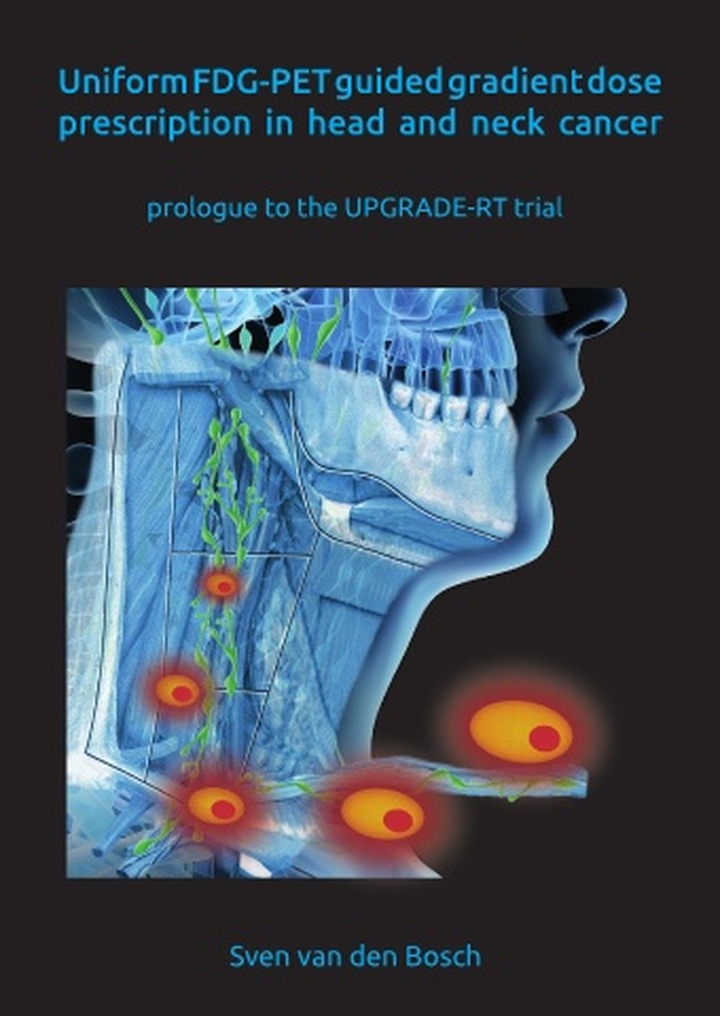
Uniform FDG-PET guided gradient dose prescription in head and neck cancer
Summary
The research described in this thesis forms the basis for the UPGRADE-RT trial. The UPGRADE-RT trial is a multicenter randomized controlled trial evaluating the safety and efficacy of the FDG-PET guided ‘gradient-dose’ prescription concept in curative radiotherapy for head and neck squamous cell carcinoma (HNSCC).
Chapter 1 and 2 describe the background and implementation methods of the ‘gradient-dose’ prescription concept in curative (chemo)radiotherapy (CRT) for HNSCC. Current radiation dose prescription practice in curative CRT for HNSCC generally consists of two dose levels and is based on the distinction of macroscopic- and microscopic disease (i.e. tumor deposits that can or cannot be detected by diagnostic imaging). The current prevailing dose levels for macroscopic disease (70 Gy in 2 Gy fractions) and for elective nodal treatment (45–50 Gy in 2 Gy fractions) were empirically determined in the 1950s, and have not changed ever since.
However, technological developments and multimodal imaging approaches have significantly improved the detection threshold of small tumor deposits and extensions. As a result, small tumor deposits and extensions that remained subclinical in the past and were included in the clinical target volume (CTV), are nowadays detected and added to the gross tumor volume (GTV). As such, this leads to changes in tumor burden in various radiation target volumes and has implications for the radiotherapy dose prescribed to these volumes. The consequences of these target volume transformations are the following. First, small nodal metastases and tumor extensions are nowadays detected and irradiated with the boost-dose. For such low tumor burden, the boost-dose is presumably unnecessarily high. Second, the CTV will nowadays contain less tumor burden because smaller nodal metastases and tumor extensions are detected. The dose to the CTV is therefore also likely to be higher than necessary. Irradiation of areas with a decreasing tumor burden using an unnecessarily high radiation dose can be considered as overtreatment. Because the radiation dose required to achieve tumor control is directly dependent on tumor burden, this overtreatment can be addressed by replacing the current ‘two-dose-level’ concept by a ‘gradient-dose’ concept in which dose is prescribed proportional to tumor burden. Quantitative functional imaging with FDG-PET can help to guide such ‘gradient-dose’ prescription, because FDG-uptake reflects the number and metabolic activity of tumor cells, and thus tumor burden.
In the FDG-PET guided ‘gradient-dose’ prescription concept, radiation treatment will be increasingly individualized by the following interventions. The highest radiation dose will be delivered to areas with high tumor burden, identified by FDG-PET based segmentation. A slightly de-escalated dose gradient will be delivered toward the edges of the CTV that surround the GTV. An intermediate dose will be delivered to lymph nodes with low-volume macroscopic disease, and a de-escalated dose will be delivered to the elective nodal target volume. This approach is expected to result in lower volumes of healthy tissues being irradiated to unnecessarily high doses, while maintaining tumor control. The ultimate goal is to minimize treatment related toxicity and to improve quality of life (QoL). The safety and efficacy of the FDG-PET guided ‘gradient-dose’ prescription concept is prospectively evaluated in the randomized controlled UPGRADE-RT trial.
Chapter 3 provides a comprehensive risk assessment on the patterns of recurrence in the elective nodal target volume after curative intensity modulated radiation therapy (IMRT) for HNSCC. In 264 patients, the exact sites of regional recurrences were reconstructed by performing co-registration of the diagnostic imaging localizing the recurrence with the initial radiation treatment planning CT-scan. The actuarial rate of recurrence in the elective nodal target volume at 2 years was 5.1%. This rate serves as a reference for evaluation of safety in the UPGRADE-RT trial.
Based on the results reported in Chapter 3 and 5, a risk assessment algorithm was defined for standardized evaluation of lymph nodes based on the estimated nodal tumor burden. This risk assessment algorithm is used in the interventional treatment arm of the UPGRADE-RT trial to select nodes for treatment with elective-, intermediate- or high-dose. In Chapter 3, volumetric analysis of 1166 nodes in the elective nodal target volume demonstrated an increased risk of recurrence with increasing nodal volume (hazard ratio: 3.1; p<0.001). Receiver operating characteristic analysis demonstrated that the summed long- and short-axis diameter is a good alternative for laborious volume calculations, using ≥17 mm as cut-off to identify nodes with an increased risk of recurrence after elective irradiation with the traditional elective dose of 45 Gy (equivalent dose in 2 Gy fractions = EQD2) (hazard ratio: 17.8; p<0.001). However, a relevant proportion of nodes with a summed diameter ≥17 mm are false positive. Because FDG-uptake reflects the number and metabolic activity of tumor cells, and thus tumor burden, FDG-PET has the potential to discriminate between nodes with low-, moderate- or high tumor burden. In Chapter 5, qualitative visual analysis of 101 lymph nodes on the FDG-PET scans of 12 patients with HNSCC was performed by 2 expert nuclear medicine physicians. The likelihood of containing metastatic tumor burden was scored on a 4-point scale (1–definitely benign, 2–possibly benign, 3–possibly malignant, 4–definitely malignant). Nodes with a presumed high- (‘4–definitely malignant’) and moderate- tumor burden (3–possibly malignant) had a maximum FDG-uptake ≥ 2.0 and ≥ 1.5 respectively. A nodal risk assessment algorithm for standardized evaluation of lymph nodes based on the estimated nodal tumor burden was defined by combining the FDG-uptake thresholds with the previously mentioned nodal size criterion. Because nodal FDG-uptake is a decisive parameter in the risk assessment algorithm for dose prescription to lymph nodes, reproducibility of quantitative FDG-PET data is of utmost importance in the multicenter UPGRADE-RT trial. Reproducibility of quantitative FDG-PET data such as the standardized uptake value (SUV) can be improved by normalization with an internal, image-derived standard (i.e. tumor to background ratio). In Chapter 4, the cervical spinal cord is investigated as an internal standard that is within the field of view of the radiation treatment planning FDG-PET/CT-scan in HNSCC. Bland–Altman analysis demonstrate that the use of the tumor to cervical spinal cord standardized uptake ratio (SUR) instead of SUV improves the reproducibility of a segmentation model to determine the metabolic tumor volume (MTV) on FDG-PET/CT in a multicenter cohort consisting of 95 patients with HNSCC. The results were confirmed in an independent multicenter validation dataset consisting of 62 patients. In the UPGRADE-RT trial, the SUR will be used instead of SUV for evaluation of quantitative FDG-uptake in the nodal risk assessment algorithm. Moreover, the SUR-based segmentation model is used to identify the MTV of the primary tumor, demarcating the area with the highest tumor burden. The highest boost-dose will be delivered to these areas. Based on the work reported in Chapter 2 and 3, dose levels were selected for the treatment of lymph nodes in the interventional study arm of the UPGRADE-RT trial. The radiobiologic models described in Chapter 2 give an estimation of the dose required to eradicate microscopic nodal disease of various size and prevalence in the population. Based on the estimated detection threshold and prevalence of occult disease with current multimodal diagnostic imaging approaches, an elective dose of approximately 34-36 Gy (EQD2) is expected to achieve a 95% control rate. This dose is prescribed to low-risk lymph nodes in the study arm of the UPGRADE-RT trial. Analysis of 1166 electively irradiated lymph nodes in Chapter 3 demonstrated that, irrespective of nodal size, no recurrences occurred in nodes receiving a dose ≥ 60 Gy (EQD2). This dose is prescribed to intermediate-risk lymph nodes in the study arm of the UPGRADE-RT trial. The work reported in Chapter 6 provides clinical evidence of the impact of target volume transformation on radiation treatment outcomes. A total of 633 patients treated for HNSCC with definitive (chemo)radiotherapy using IMRT/VMAT techniques were retrospectively analyzed. A FDG-PET/CT in treatment position was acquired in 46% of the patients. The exact sites of regional recurrences were reconstructed by performing co-registration of the diagnostic imaging localizing the recurrence with the initial treatment planning scan. Nodes identified on the initial planning scan at the exact same position of the regional recurrence had a significantly smaller volume in patients with FDG-PET versus CT-only (median: 0.46 cc versus 1.02 cc, p<0.001) and illustrates the improved detection of small nodal metastases by FDG-PET. Multivariate Cox regression analysis demonstrated a significantly increased regional control in the elective nodal target volume (HR: 0.33, p=0.026), overall regional control (HR: 0.62, p=0.027) and overall survival (HR: 0.71, p=0.033) in patients with FDG-PET versus CT-only for radiotherapy planning. Finally, in Chapter 7, all the evidence provided by the research described in this thesis is consolidated in the clinical trial protocol of the UPGRADE-RT trial. In total, 300 patients with stage II-IV oropharyngeal, laryngeal and hypopharyngeal SCC will be randomized (ratio 2:1) to gradient dose prescription or to traditional dose prescription, irrespective of HPV-status. A FDG-PET/CT will be acquired for radiation treatment planning in all patients. In the intervention-arm, nodes are selected for treatment with an intermediate dose level of 60 Gy (EQD2) based on the previously mentioned risk-assessment algorithm using nodal size and FDG-uptake. Dose to the elective neck is de-escalated to 35 Gy (EQD2) versus 45 Gy (EQD2) in the control-arm. Dose to gross tumor will be 73 Gy (EQD2) in both treatment arms and will be identified by the previously mentioned FDG-PET based segmentation model. The primary outcome of the trial is dysphagia measured using a ‘normalcy of diet’ score. The secondary outcome is safety, evaluating the number of recurrences in elective nodal target volume. Other outcomes are acute and late toxicity, and quality of life. The UPGRADE-RT trial started recruitment in August 2016 and the last patient is expected to be recruited 5 years later (around August 2021). After completing the 2-year follow-up period, final data analysis can be performed (around August 2023). The data generated by the UPGRADE-RT trial will demonstrate if this implementation of the ‘gradient-dose’ concept is safe and if it reduces the overall burden of treatment in terms of reduced toxicity and improved quality of life. Moreover, the nodal risk assessment algorithm and radiation dose levels may be refined based on the results of the trial. Ultimately, with further perfection of diagnostic imaging, only metastatic nodes will be irradiated and dose to such nodes will be attuned to its individual tumor burden. Elective irradiation of large anatomical areas as it is currently performed becomes obsolete and will be abandoned.
See also these dissertations




Nicola Pontillo
Aminoglycoside resistance mechanisms and strategies to overcome them
30 juni 2026
Rijksuniversiteit Groningen
Open Ebook




Xiaolong Zhong
Plant domestication reshapes rhizosphere microbiome-mediated adaptation to nitrogen stress
2 juli 2026
Universiteit van Amsterdam
Open EbookWe print for the following universities