Yussif Baba Kassim
Enhancing crop response to fertilization in northern Ghana
4 september 2026
Wageningen University
Open Ebook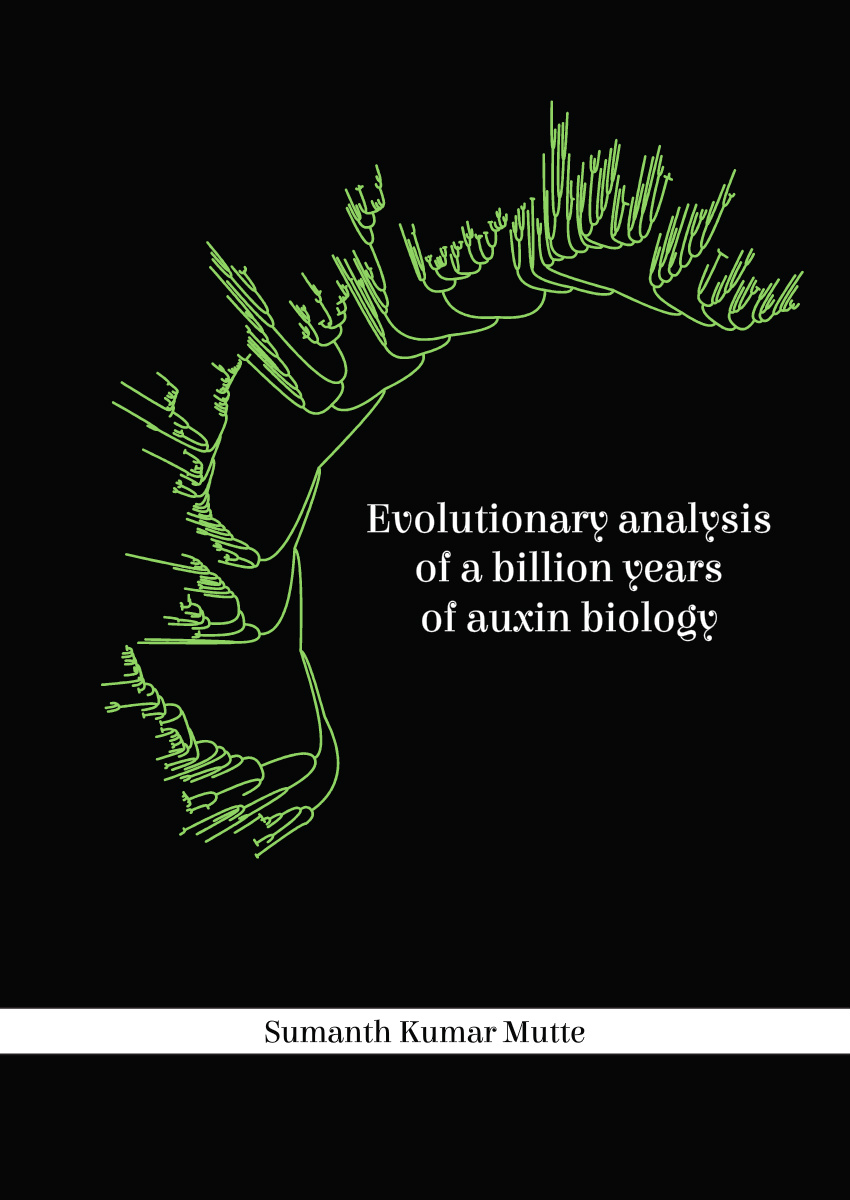
Share this project
Summary
Auxin is a key phytohormone for growth and development across many plant species. With the advances in next-generation sequencing, and ever-growing data of genomes and transcriptomes in the last decade across all plant lineages, helped us infer the detailed origin and evolution of plant auxin biology in this thesis. Chapter 1 provides an overview of the major forms of life on earth, from an evolutionary perspective. We also provided detailed insight about multiple phyla in the plant evolution, and the corresponding morpho-physiological innovations. We then introduced various proteins and pathways involved in the synthesis, transport, homeostasis and signal transduction of auxin, followed by the scope of this thesis.
Large ‘omics’ data resources, especially transcriptomics as a result of advancement in RNA-Seq technologies, generated more than 1300 transcriptomes from more than a thousand species over a billion years of plant evolution. Even though the transcriptome data is inherently limited than the genome data, it is possible to estimate ancestral copies i.e. the minimal gene complement in the ancestor of that particular lineage under consideration. While many methods were developed that either focus on combining single copy genes to estimate species relationships, or focus on a specific gene family, needs substantial modification to apply as a general method to other gene families. Hence, in Chapter 2 we have developed a simple yet effective methodology to reconstruct the origin and evolution of various genes families across all plant lineages, including the algal ancestors.
We first tested this protocol in Chapter 3 to study the evolution of auxin biosynthesis gene families Tryptophan aminotransferase of Arabidopsis (TAA) and YUCCA (YUC). This has not only confirmed the previous findings, that TAA and its homologous Alliinase proteins had a common ancestor in charophyte algae, but also revealed that the core TAA clade has never duplicated in their ancestral states during the plant evolution. YUC family in early diverged species contain a sister clade that is lost in the recently diverged species, angiosperms. Further, we exploited the evolution of Gretchen Hagen 3 (GH3) protein family involved in the auxin homeostasis that conjugate amino acids to hormones. This analysis revealed a striking correlation between the emergence of auxin or jasmonate specific GH3 family members to the evolution of specialized hormone receptors at the onset of land plant evolution. Moreover, we also showed that this method could be applied to proteins with unknown or novel domains, by studying the evolution and annotation of SOSEKI proteins. Auxin elicit both genomic and non-genomic responses, through nuclear auxin pathway and Auxin binding protein 1 (ABP1), respectively. Hence, we also studied the origin and evolution of ABP1, that appear to have evolved in red algae, with auxin binding capacity predicted to appear as early as in chlorophytes.
In Chapter 4, we focused on the nuclear auxin pathway, the major auxin signal transduction pathway in plants. We studied both the origin and deep evolution of Auxin Response Factor (ARF), Auxin/Indole-3-acetic acid (Aux/IAA) and Transport inhibitor response 1/Auxin-signaling F-box (TIR1/AFB) gene families. Based on the evolutionary patterns, we hypothesized that genomic response pathway components were evolved in charophytes but functional only in land plants. We tested this hypothesis by studying the auxin response capacity of green algae, hornworts, liverworts, mosses and ferns, comparing the auxin treated transcriptome to the untreated plants using RNA-Seq. Indeed, we found that the auxin response genes were conserved across land plants, but not in green algae, confirming the predictions from evolutionary analysis. To our surprise, we also found deeply conserved non-canonical components (ncARF and ncIAA), which we tested for their role in auxin dependent responses by studying the mutants in early diverged bryophyte, Marchantia. Interestingly, ncARF appeared as a positive contributor to the auxin dependent growth and development.
A key step in the nuclear auxin pathway, is the interaction between ARF and Aux/IAA proteins through C-terminal Phox and Bem1 (PB1) domain. During our search for homologs of these two gene families, we found many other proteins in plants that are neither ARFs nor Aux/IAAs, and contain a PB1 domain. As PB1 domain is also identified in protozoans, fungi as well as in animals, in Chapter 5 we studied if the PB1 domain is originated in Last Eukaryote Common Ancestor (LECA). Indeed, we found that LECA consisted preferably three PB1 copies that diverged further and gave rise to multiple copies in various kingdoms. We found co-evolved PB1 pairs that might interact, where we also found common conserved amino acids among these predicted interaction pairs, for e.g. Kinase and Kinase-derived PB1 domains. We have also successfully applied amino acid descriptor based Random Forest classification to differentiate various PB1 domains across land plants. Taken together, these results revealed the broader presence of PB1 domain containing proteins in plants, with insights into their deep evolution.
Finally, in Chapter 6 we discussed how this study contributes to what is known about the evolution of various auxin pathway components and their functions. The results in this thesis collectively show the step-wise origins of auxin biology in green algae and subsequent functionality in land plants. We also highlighted questions that still remain and synchronize these findings with the on-going efforts to understand ‘non-canonical’ routes of auxin action in plants.