Emily ter ter Steeg
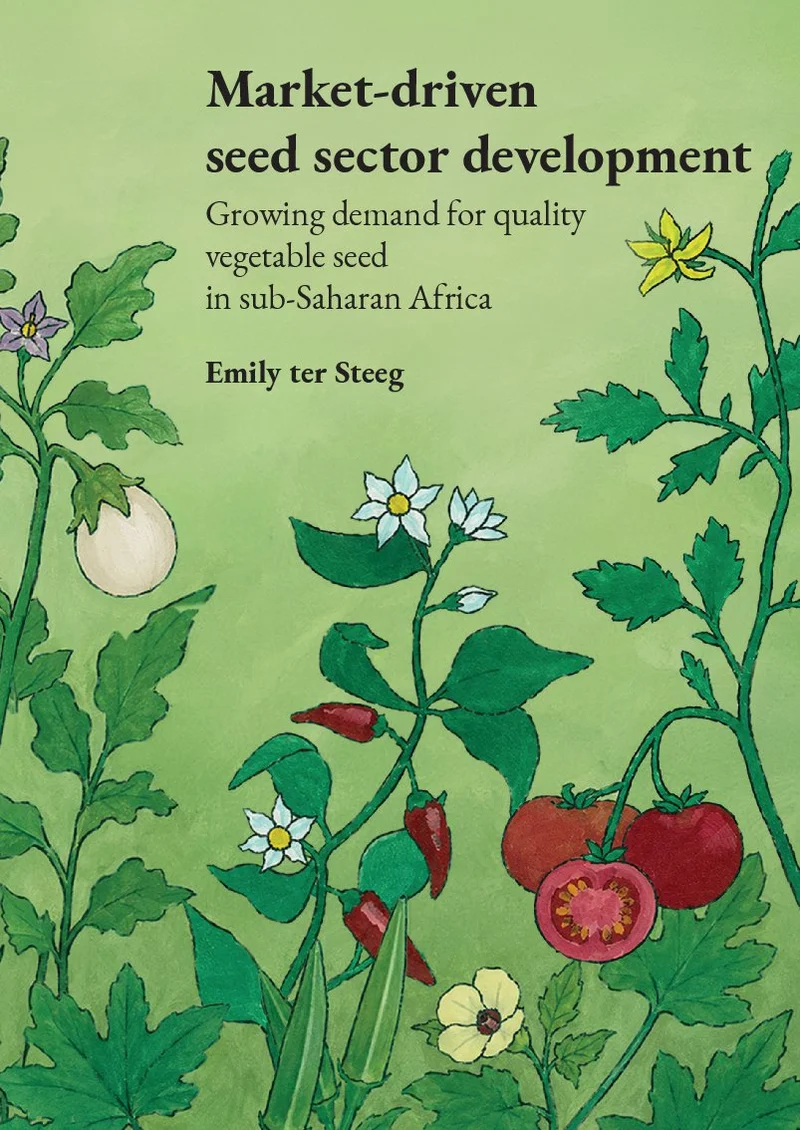


Market-driven seed sector development
This thesis examines how a market-driven approach shapes the development of vegetable seed systems in sub-Saharan Africa (SSA), and how this affects farmer seed sourcing, livelihoods, and sector performance. It addresses a blind spot in the literature at the intersection of two underexplored areas. First, despite their importance for nutrition and income generation, vegetable crops have received far less scholarly and policy attention than staple crops such as cereals. Second, although private actors are increasingly expected to drive seed sector development, there is still understanding of what reliance on market-based approaches means in practice. Against this background, the thesis investigates how a market-driven approach impacts the development of vegetable seed systems in SSA, and how this shapes farmer seed sourcing, livelihoods, and sector performance. Three underlying objectives guide the analysis. The first is to improve understanding of the business models of vegetable seed companies operating in a development context. The second is to assess the impact of a large-scale intervention in the vegetable seed sector by a corporate foundation on technology adoption and livelihood outcomes among different groups of farmers. The third is to evaluate the extent to which product and agrodealer characteristics influence farmers’ trust in seed quality and seed purchasing decisions. To address these objectives, the thesis combines multiple methods and perspectives. It moves from upstream questions of breeding feasibility and company strategy to farmer-level intervention effects, and finally to the last mile of seed distribution. The research design combines literature review, qualitative methods, a randomized controlled trial (RCT), and experiments. Across the chapters, the analysis draws on data from SSA more broadly and from northern Nigeria, with four chapters focusing specifically on vegetable seed systems in Kano and Kaduna states. The first part of the thesis examines how private incentives shape vegetable seed sector development. Chapter 2 analyses the conditions under which commercial plant breeders invest in hybrid breeding programmes for food crops. Hybrid breeding is often associated with technological progress because it can increase yields, improve product quality, and strengthen resistance to biotic and abiotic stresses. At the same time, it remains socially and politically contested, especially where it is seen as aligned primarily with high-input, commercial agriculture. By combining insights from breeding science and business economics, the chapter shows that the feasibility of hybrid breeding depends on both biological and economic conditions. Whether hybrid breeding is commercially attractive varies by crop and business case. The chapter concludes that the most important constraint is often the high cost of seed production. This finding helps explain why commercial breeding efforts are concentrated in some crops and not in others, and why public or donor support may remain necessary for crops that are technically possible to improve but commercially unattractive. For the broader argument of the thesis, the chapter demonstrates that market-driven seed sector development starts from a logic of commercial feasibility rather than from public goals such as inclusion or nutrition. Chapter 3 extends this analysis by examining the business models of leading vegetable seed companies operating in SSA. Based on in-depth interviews with company representatives, it demonstrates that the private seed sector is not a homogeneous group of profit-driven actors with a single strategy. Using ideal-type analysis, the chapter identifies a set of business model typologies and shows that these different models jointly shape seed sector development. The chapter shows how seed companies in SSA have specialized in the four seed system functions: variety development, seed production, seed dissemination, and seed use. These specializations mean that firms currently play complementary roles with different companies applying different business models and serving different market segments. At the same time, the chapter finds that companies broadly share a common vision of seed sector development as a linear transition in which farmers gradually move towards increasingly advanced seed types, especially hybrids. In this view, open pollinated varieties are often treated as transitional products rather than endpoints in themselves. Moreover, whilst companies are investing in breeding and market development for hybrid seed, they tend to not invest in open-pollinated varieties because these do not allow them to gain a return on their investments. Companies tend to be focused on commercial crops and commercial farmers who can invest in quality seed based on their market sales. The chapter therefore contributes two important insights. First, the private sector is heterogeneous and second, despite this diversity, the dominant private-sector vision remains oriented towards commercially viable crops, commercially oriented farmers, and seed types that allow firms to recover investments. Together, Chapters 2 and 3 show that private-sector engagement can stimulate innovation and market formation, but that it is selective by design. The second part of the thesis evaluates whether such market-driven trajectories generate meaningful benefits for farmers. Chapters 4 and 5 study a large-scale agricultural extension programme implemented by East-West Seed Knowledge Transfer (EWS-KT) in northern Nigeria. This programme is particularly relevant because it combines development and commercial logics. This extension programme is ‘market-driven’ because it contributes to the development of a viable product market for East-West Seed as well as other seed companies. Moreover, the programme focuses on commercial vegetable production and hence, farmer attendance is also driven by commercial motives. Both chapters draw on a RCT implemented in 150 communities, with a control group, a treatment group receiving agricultural extension, and a second treatment group receiving extension combined with a test-based public certification component. Chapter 4 assesses the direct effects of this intervention on targeted farmers. The results show that the intervention led to a substantial increase in the number of farmers cultivating vegetables, the adoption of improved vegetable varieties and the uptake of good agricultural practices. In addition, targeted farmers experienced gains in vegetable revenues, which seem primarily driven by tomato, onion, and chili pepper production. Amongst targeted farmers, test-based public certification did not generate consistent additional gains in technology adoption. Furthermore, no program effects were detected for vegetable cultivation in home gardens or for household food and nutrition security outcomes. This finding confirms that interventions focused on commercial vegetable production primarily serve poverty alleviation rather than directly strengthening food security. This chapter may constitute the core empirical contribution of the thesis: it confirms that market-driven seed sector development can shift behaviour under real-world conditions. Farmers adopt both the low-cost good agricultural practices as well as expensive practices like the use of improved vegetable varieties, which then translates into financial gains. However, while commercial vegetable production may improve economic outcomes, broader effects on food and nutrition are not automatic or immediate. Subsequently, Chapter 5 tests whether the benefits of market-driven interventions extend beyond direct beneficiaries through social learning. While Chapter 4 focuses on the comparison of targeted farmers in treatment communities with farmers in control communities, Chapter 5 focuses on the comparison of untargeted farmers in treatment communities with farmers in control communities. Moreover, it checks whether the test-based certification treatment might have enhanced spillover effects among untargeted farmers by signalling which farmers have received training. However, we find little evidence that the intervention led to meaningful diffusion of technologies to non-targeted farmers in the study period, indicating that social learning mechanisms were insufficient. Alternatively, it could be the case that the one-year timeline is simply insufficient for spillover effects to occur. There was no significant effect on vegetable cultivation, use of improved seed, use of government-certified seeds, or the adoption of GAPs among untargeted farmers. Moreover, public certification did not meaningfully enhance diffusion, apart from a small effect on the use of government-certified seed. These findings challenge the assumption that knowledge generated through market-driven interventions will automatically spread through communities. Still, the absence of observable spillover effects should not be interpreted as evidence that social learning or certification mechanisms are inherently ineffective. Rather, the findings suggest that diffusion processes may require more time or interventions must facilitate information exchange more explicitly. Taken together, Chapters 4 and 5 indicate that market-driven approaches can work, but that they are not self-scaling. Impact tends to remain concentrated among directly targeted farmers, at least in the short run. The third part of the thesis turns to the role of trust in seed markets. This is an important addition because even where improved seeds are available and potentially profitable, adoption may remain low if farmers do not trust the quality of the products being sold. Chapters 6 and 7 therefore analyse how trust operates in the last mile of vegetable seed distribution, with a particular focus on agrodealers. Chapter 6 uses a qualitative research design to examine how farmers assess seed quality and decide where to purchase seed in northern Nigeria. It shows that farmers rely on a combination of product signals and seller characteristics when making purchasing decisions. Product-level signals include packaging, branding, and labelling. Agrodealer-level signals include reputation, knowledge, shop appearance, social embeddedness, and accountability. The findings further show that trust develops gradually through repeated interaction. Moreover, it shows that agrodealers are not merely input suppliers: they often provide information, offer credit, and adapt products to farmer needs, for example by repackaging seed into smaller quantities. The chapter also finds that trust in product brands can partially substitute for trust in the seller, especially where farmers are familiar with specific seed products. Overall, the chapter demonstrates that vegetable seed markets are socially embedded rather than purely transactional. This matters for seed sector development because it implies that last-mile distribution, retailer reliability, and farmer literacy regarding product signals are central to market functioning. standard insecticide. However, the analysis does not find that perceived agrodealer trustworthiness affects farmers’ willingness to pay for maize or tomato seed. This result is consistent with the seed quality tests conducted in the study, which suggest that seed quality was generally high across agrodealer types. In other words, while farmers appear to screen sellers and use trust-related signals, actual differences in product quality were limited in the sample studied. Together, Chapters 6 and 7 suggest that trust remains central to farmer decision-making, but also that its role may be more about enabling participation in input markets than about generating price differentiation under conditions where product quality is already reasonably assured. The synthesis across chapters leads to a nuanced conclusion. The thesis does not support a simple claim that market-driven approaches either succeed or fail. Rather, it shows that their effects are conditional. Market-driven vegetable seed sector development can stimulate innovation, promote technology adoption and improve some farmer livelihood outcomes. At the same time, these effects are uneven and selective. They are strongest where three conditions align: first, where there is a viable business case for private investment; second, where farmers have the capability to capture gains from the technology; and third, where trust and quality assurance mechanisms allow farmers to engage with seed markets confidently. This synthesis has several implications. In terms of farmer seed sourcing, market-driven approaches can expand options by increasing the availability of improved seed and strengthening retail channels. Yet they can also narrow trajectories by steering farmers towards particular crops, varieties, and brands. The private-sector vision documented in the thesis assumes a relatively linear progression towards more advanced seed types, especially hybrids. However, farmer practices are often more flexible. Farmers combine seed buying with saving and manage risk through diversification. Market-driven development therefore both broadens and channels farmer choice. With respect to livelihoods, the thesis finds that market-driven interventions can support income generation, particularly where technologies are profitable, and farmers can adopt them. However, these gains do not automatically translate into broader food and nutrition security outcomes. This reflects a deeper tension in market-driven seed sector development. Commercial actors tend to prioritise crops and farmer segments where demand is already strong, and returns can be recovered. In practice, this often means a focus on a relatively narrow set of vegetables and on more commercially oriented farmers. Similarly, regarding sector performance, the thesis shows that market-driven approaches can improve efficiency, strengthen innovation, and contribute to the emergence of functional markets for quality seed. However, performance gains are also selective rather inclusive. The thesis therefore highlights a structural tension between public objectives, such as inclusion and food security, and private incentives, which depend on excludability and rivalry to sustain business models. A final cross-cutting insight is that market-driven seed sector development depends fundamentally on public involvement. Throughout the thesis, public action appears not as an alternative to markets, but as a precondition for their functioning. Public support remains important in breeding, especially for less commercially attractive crops; in regulation and quality assurance; and in farmer capacity building. The intervention evaluated in northern Nigeria itself illustrates this hybrid character, combining private-sector incentives with public-private funding for agricultural extension. The broader conclusion is therefore not that public actors should withdraw and let markets take over, nor that private actors should be sidelined. Rather, the most promising pathway is a ‘hybrid’ approach in which private-sector dynamism is leveraged where incentives align, while public actors deliberately support functions, crops, and farmer groups that markets alone are unlikely to serve. In conclusion, this thesis contributes to the literature by placing vegetable seed systems and private-sector development at the centre of analysis. It shows that market-driven approaches can play a meaningful role in strengthening vegetable seed systems in SSA, but that their effects are conditional, selective, and dependent on public support. Market-driven approaches are most effective where commercial viability, farmer capability, and trust in markets reinforce one another. Where one or more of these conditions is absent, their impact is likely to remain limited. The thesis therefore argues for a more differentiated understanding of market-driven seed sector development: one that recognises both its potential and its boundaries, and that treats public and private action as complementary rather than competing pathways towards inclusive and resilient vegetable seed systems.
| Publicatiedatum | 15 oktober 2026 |
| Universiteit | Wageningen University |
| Auteur | Emily ter ter Steeg |
| DOI nummer | 10.18174/681444 |