Publication date: 30 juni 2022
University: Wageningen University
ISBN: 978-94-6447-211-0

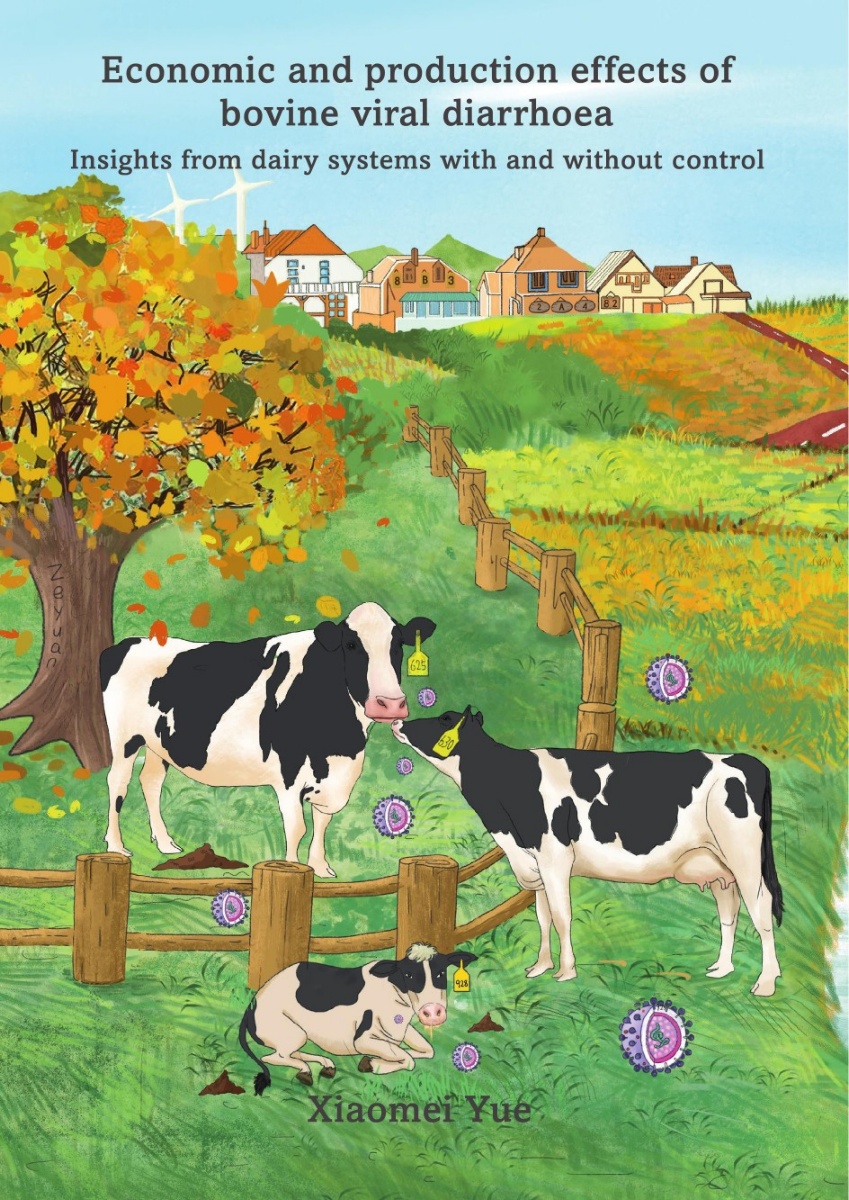
Economic and production effects of bovine viral diarrhoea

Summary

Bovine viral diarrhoea (BVD) is a viral cattle disease that presents in most cattle-raising countries worldwide and is listed by the World Organisation for Animal Health as a notifiable disease. Bovine viral diarrhoea virus (BVDV) can cause significant production and economic losses. Many countries and regions developed BVDV control or eradication programmes and are at different stages of BVDV control. Therefore, information required for decision making in these countries on the production and economic performance of dairy herds in order to support decision making is needed. A systematic BVDV monitoring to assess progress is essential. This thesis was divided into the following five sub-objectives:

- BVDV-free certification in Dutch dairy herds.
- Determine the effects of a new BVDV introduction on milk yield in BVDV-free herds participating in the Dutch BVDV-free programme.
- Determine the effects on other indicators of herd performance (somatic cell count (SCC), calving interval (CIV), culling risk (CR), and calf mortality rate (CMR)) in BVDV-free herds participating in the Dutch BVDV-free programme.
- Determine the within-herd seroprevalence of BVDV in North China.
- Simulate the dynamics of BVDV infection and the associated production and economic losses in a large-scale Chinese dairy herd using a bio-economic simulation model.

In Chapter 2, the economic (gross margin) and production effects (milk yield, SCC, CIV, CR and CMR) of BVDV-free certification were determined based on longitudinal annual accounting and herd performance data. The study was designed as a case-control study: case herds were defined as herds where the BVDV status changed from unknown to BVDV-free during the study period, while control herds were BVDV-free during the whole study period. Selection bias between the two herd groups was reduced by matching case and control herds using the propensity score matching (PSM) technique. To estimate the effects of BVDV-free certification, time-varying Difference-in-Differences estimation (DID) methodology was used. The results indicate that there were no significant changes in milk yield, SCC, CIV, and gross margin upon BVDV-free certification. There are several possible explanations for the non-significant effects, such as the unknown status for case herds, not knowing the true BVDV infection situation in case herds and not knowing if control measures were implemented in case herds prior to participating in the BVDV-free programme. The effects of BVDV-free certification might have been underestimated, given that the Dutch BVDV control programme became mandatory during the study period, and some of the case herds might have never experienced any BVDV infection.

In Chapter 3 and 4, the effects of a new BVDV introduction in BVDV-free herds participating in the Dutch BVDV-free programme on herd performance (average daily milk yield (ADMY) (Chapter 3) SCC, CIV, CR, CMR (Chapter 4)) were determined. Longitudinal herd-level surveillance data were combined with herd information data to create 5 unique datasets for the 5 indicators of herd performance. Each database contained 2 types of herds: herds that remained BVDV free during the whole study period (defined as free-herds), and herds that lost their BVDV-free status during the study period (defined as breakdown-herds). The date of losing the BVDV-free status was defined as breakdown date. To define the possible BVDV-introduction dates, 4 scenarios were developed. In the default scenario, the breakdown date was assumed as the BVDV-introduction date. For the other 3 scenarios, the BVDV-introduction dates were set at 4, 6, and 9 months before the breakdown date, based on the estimated birth date of a persistently infected calf. To compare breakdown-herds with free herds, a random breakdown date was artificially generated for free herds by simple random sampling from the distribution of the breakdown month of the breakdown-herds. The ADMY, SCC and CIV before and after a new introduction of BVDV were compared through linear mixed-effects models with a Gaussian distribution, and the CR and CMR were modelled using a negative binomial distribution in generalized linear mixed-effects models. Of the 4 scenarios developed, the default scenario on average appeared to be most closely aligned with the true period of BVDV infection. Specifically, free herds have lower SCC, CR, CMR, and shorter CIV than the breakdown-herds. Within the breakdown-herds, the new BVDV introduction affected the ADMY, SCC and CMR. The loss in ADMY occurred mainly in the first year after breakdown, with a reduction in yield of 0.08 kg/cow per day compared with the last year before breakdown. Similarly, the SCC was higher in the first year after breakdown than that in the last year before breakdown, with a factor of 1.011. Compared with the last year before breakdown, the CMR in the year of breakdown and the year after breakdown was higher, with factors of 1.170 and 1.096, respectively. Chapters 3 and 4 revealed that a new introduction of BVDV had a negative but on average relatively small effect on herd performance in herds participating in a BVDV control programme.

In Chapter 5, a study survey on the seroprevalence of BVDV was carried out in 3 large commercial dairy herds in North China in July 2019. In total 98 blood samples were randomly collected from first and second parity cows. In each pen on the farm and for each parity, an equal number of animals was sampled. Samples were tested for BVDV antibodies by blocking antibody enzyme-linked immunosorbent assay. The results showed that the true BVDV seroprevalence was 96.3% in one herd and 100.0% in the other two herds. The high values indicated a very high within-herd seroprevalence of BVDV and calls on Chinese dairy farmers to increase their awareness of BVDV prevention and control to reduce the associated production and economic losses.

In Chapter 6 the effects of BVDV introduction on large-scale intensive Chinese dairy herds (300 cows) were simulated, and subsequently the production and economic effects of BVDV introduction were estimated. An individual cow-based dynamic, stochastic bio-economic simulation model with daily time steps was used. The model simulated the average production and economic losses over 3 years after a PI heifer entered into a fully susceptible herd. Production effects due to BVDV introduction consisted of a reduced milk production, reduced feed intake, increased probability of abortion, and a mortality probability of the PI animal. Subsequently, associated economic effects were calculated. Three scenarios were modelled: 1 scenario without BVDV introduction and 2 scenarios with BVDV introduction (i.e., literature-based scenario and expertise-based scenario). In the literature-based scenario, the input values for the BVDV infection dynamics were retrieved from literature, while in the expertise-based scenario, the input values were calibrated based on expert opinion to mimic the situation in large Chinese dairy herds observed in Chapter 5. The effects of BVDV introduction were calculated by comparing the model outputs of the scenarios with and without BVDV introduction. The mean annual economic losses in the 3 years after BVDV introduction were 52, 98, 54 €/cow/year in the literature-based scenario, and 255, 89, 45 €/cow/year in the expertise-based scenario, respectively. Estimates provided evidence that BVDV introduction caused significant losses in large-scale intensive dairy herds in China.

In Chapter 7 the results, the used data, and methodological approaches in this thesis were synthesized. This chapter also discussed the potential implications. Overall, this thesis determined the effects of BVDV infection on the production and economic performance of dairy herds to support decision making in countries with and without a systematic BVDV control programme. Based on the main results of the research presented in this thesis, the main conclusions are drawn:

- The milk yield, SCC, CIV and gross margin did not change when the dairy herds changed from an unknown BVDV status to a BVDV-free status (Chapter 2).
- The new introduction of BVDV had a negative, but on average a relatively small, effect on milk production in BVDV-free herds participating in the Dutch BVDV-free programme (Chapter 3).
- The new introduction of BVDV had a negative, but on average a relatively small, effect on herd performance (mainly on SCC and CMR) in BVDV-free herds participating in the Dutch BVDV-free programme (Chapter 4).
- The within-herd seroprevalence of BVDV in 3 large commercial dairy herds in North China was very high, ranging between 96.3% and 100.0% (Chapter 5).
- BVDV introduction in a large-scale Chinese dairy herd caused large production and economic losses (Chapter 6).

See also these dissertations

We print for the following universities