Peter Visser


Active corrosion protection of aerospace aluminium alloys by lithium-leaching coatings
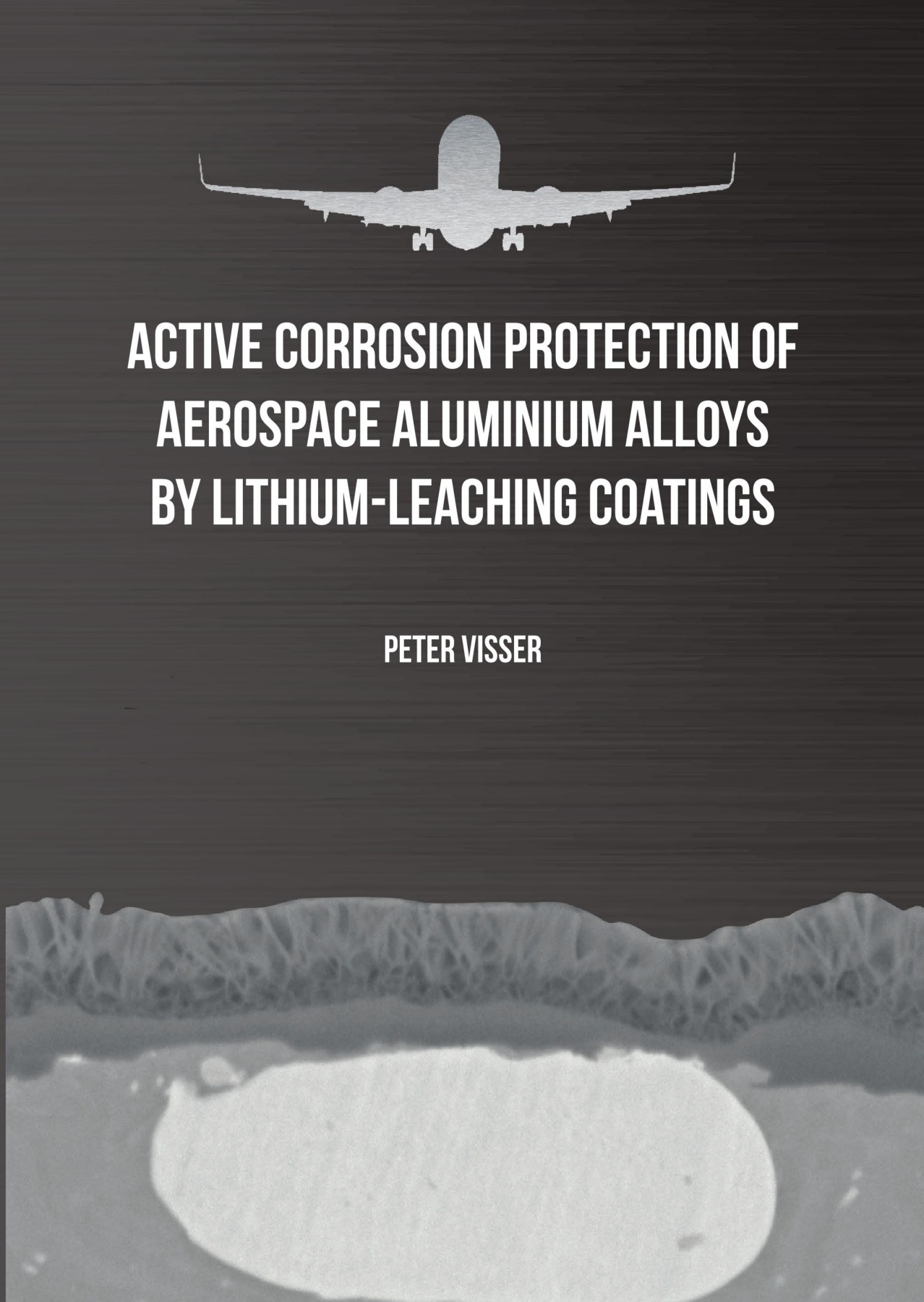
For decades, scientists and engineers are searching for a safe and environmentally friendly alternative for the toxic chromate corrosion inhibitors in active protective coatings for the protection of aerospace aluminium alloys. In this search many different compounds have been investigated as leachable corrosion inhibitor, but no alternative with equal or better performance compared to chromates has been found yet. In 2010 it was discovered that organic coatings loaded with lithium-salts (Li) as leachable corrosion inhibitor provided very effective and promising corrosion inhibition on aluminium alloys when exposed to industrial accelerated corrosion tests. Initial investigations showed the formation of a corrosion protective layer on the aluminium alloy in a defect area, which appears to be a key feature of these Li-leaching coatings. The scientific objective of this PhD thesis was to gain a deep understanding of the layer formation mechanism and to link its chemical and physical properties with the corrosion protective performance of these layers when generated in a defect area from Li-leaching coatings. The knowledge and understanding of this mechanism is essential for the future industrial development and implementation of this novel active protective coating technology for the protection of aluminium alloys in the aerospace industry. The active protective properties of the Li-leaching coating technology were investigated using a combined approach of surface analytical and (local) electrochemical techniques. The study can be divided in three parts: (I) characterization of the chemical composition and morphology of the protective layer, (II) the mechanism of formation, (III) performance properties of the corrosion inhibiting layer. The first part of the investigation involved the characterization of the corrosion protective layer generated in a coating defect when Li-salts are used as leachable corrosion inhibitor in organic coatings. Cross-sectional scanning electron microscopy (SEM) of the protective layer revealed a characteristic three-layered morphology comprising a dense layer near the aluminium substrate, a porous middle layer and a columnar outer layer. High-resolution transmission electron microscopy (TEM) and electron energy loss spectroscopy (EELS) showed that the protective layer mainly consisted of aluminium and oxygen. Lithium was distributed throughout the layer indicating that lithium leached from the coating matrix and was involved in the formation of the protective layer. Based on the characterization a possible mechanism for the formation of such a protective layer was proposed. With this hypothesis, a combined approach of electrochemical and surface analytical investigations was used to study the formation mechanism of the protective layer in a coating defect when exposed to corrosive conditions and under controlled conditions in an electrochemical cell. Results showed that the formation mechanism of this protective layer have the characteristics of a conversion coating, involving three stages: (I) oxide thinning in the early stages due to the exposure to the corrosive environment (II) anodic dissolution of aluminium from the matrix and the formation of an aluminium hydroxide gel film on the substrate, followed by (III) film growth through a competitive growth-dissolution process. The development of the electrochemical properties of the protective layers were studied during the formation and an electrochemical analysis provided a quantitative link between the electrochemical behaviour and the physical model of the protective layer at the different stages of the formation. This study revealed that the corrosion protective properties of the layer originate from the dense inner layer near the aluminium substrate. Complementary analysis with (local) electrochemical techniques demonstrated that the Li-leaching coatings provide fast, effective and irreversible corrosion inhibition resulting in long-term corrosion protection. The chemical throwing power or the distance over which an inhibitor is able to effectively protect a defect was investigated for the Li-leaching coatings. Coatings with different Li-inhibitors and leaching behaviours were applied on samples with increasing defect widths. Time-of-flight secondary ion mass spectrometry (ToF-SIMS) was applied to investigate the lateral Li-spread and chemical composition of the corrosion protective layers in the defect areas. The results demonstrated that Li-leaching coatings were able to effectively protect defect areas up to about 6mm in neutral salt spray tests. Lithium was detected throughout the protected defect areas. Furthermore, it was found that the surface composition of the protective layer is related to the lithium-release rate of the coating and the width of the defect. It was demonstrated that only a low amount of leached Li-ions is needed to obtain effective corrosion inhibition. Furthermore, the active protective properties of the Li-leaching coatings were investigated on different aluminium alloys with a different electrochemical activity. It was demonstrated that the Li-leaching coatings effectively provided corrosion inhibition on a range of aluminium alloys despite their different physical metallurgy and electrochemical activity by the formation of the protective layer in the defect area. In this thesis it was demonstrated that Li-leaching coatings possess all the key criteria, such as inhibitor solubility, fast, irreversible and effective corrosion inhibition. The results demonstrate that Li-salts are promising corrosion inhibitors which potentially can become a new class of corrosion inhibitors for the chromate-free protection of aluminium alloys.
| Publicatiedatum | 10 april 2019 |
| Universiteit | Overig |
| Auteur | Peter Visser |
| ISBN nummer | 978-94-6380-267-3 |