Deel dit project
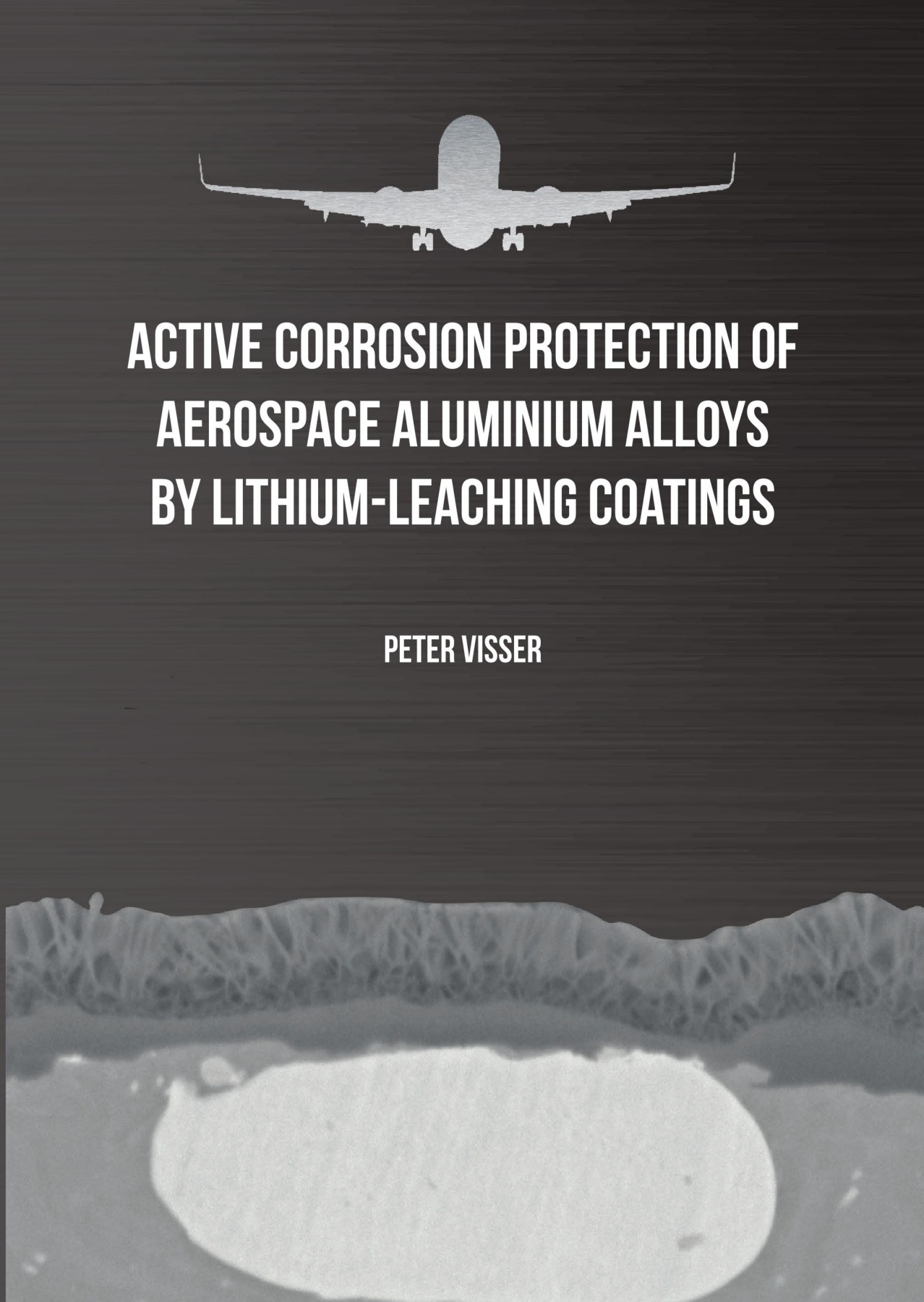
Active corrosion protection of aerospace aluminium alloys by lithium-leaching coatings
Samenvatting
Al tientallen jaren zoeken wetenschappers en ingenieurs naar een veilig en milieuvriendelijk alternatief voor de giftige chromaathoudende corrosie-inhibitoren die worden toegepast in actief beschermende coatings voor aluminium legeringen in de vliegtuigindustrie. In deze zoektocht zijn al veel verschillende verbindingen onderzocht voor de toepassing als uitloogbare (leaching) corrosie-inhibitor, maar tot nu toe is er nog geen geschikt alternatief gevonden met een gelijke of betere corrosiewerende werking als de chromaathoudende corrosie inhibitoren. In 2010 werd ontdekt dat organische coatings geladen met lithium zouten als uitlogende corrosie-inhibitor een zeer effectieve en veelbelovende corrosiebescherming opleverden wanneer aluminiumlegeringen met deze coatings werden blootgesteld aan industriële versnelde corrosietesten. Verkennend onderzoek toonde aan dat er een corrosiewerende laag was gevormd op het aluminium van een beschadigde coating. Deze laagvorming blijkt een kenmerkende eigenschap te zijn van deze lithium-leaching coatings.
Het wetenschappelijke doel van dit proefschrift was om een beter begrip te verkrijgen van het mechanisme van de laagvorming en tevens om een verband te leggen tussen de chemische en fysische eigenschappen en de corrosiewerende werking van deze lagen, gedurende de vorming op het aluminium substraat in een coating defect vanuit de lithium-leaching coatings. De kennis en het begrip van dit vormingsmechanisme is essentieel voor de toekomstige industriële ontwikkeling en implementatie van deze nieuwe actief beschermende coatingtechnologie voor de bescherming van aluminiumlegeringen in de luchtvaartindustrie.
De actief beschermende eigenschappen van deze lithium-leaching coatings zijn onderzocht middels een gecombineerde benadering van oppervlakteanalyses en (lokale) elektrochemische technieken. In algemene zin kan het onderzoek van dit proefschrift in drie delen worden verdeeld: (I) karakterisering van de chemische samenstelling en morfologie van de beschermende laag, (II) het mechanisme van de vorming van de laag, (III) de corrosiewerende eigenschappen van de gevormde laag.
Het eerste deel van het onderzoek richt zich op de karakterisering van de corrosiewerende laag die in een coatingdefect wordt gevormd wanneer lithium zouten worden gebruikt als leaching corrosie-inhibitor in organische coatings. De analyse van dwarsdoorsnedes van de corrosiewerende laag met een scanning elektronen microscoop (SEM) onthulde een karakteristieke morfologie met drie lagen, een laag met een dichte morfologie nabij het aluminiumsubstraat, een poreuze middenlaag en een kolomvormige morfologie aan de buitenzijde van de laag. Met behulp van hoge resolutie transmissie-elektronen microscopie (TEM) gekoppeld met electron energy loss spectroscopy (EELS) was het mogelijk om aan te tonen dat de corrosiewerende laag voornamelijk bestond uit aluminium, zuurstof en lithium. Het lithium was door de hele laag verdeeld, wat erop wijst dat lithium uit de coatingmatrix is geloogd en betrokken was bij de vorming van de beschermende laag. Op basis van deze karakterisering en observaties werd een mogelijk mechanisme voor de vorming van een dergelijke beschermende laag voorgesteld.
Met deze hypothese is het vormingsmechanisme van de laag bestudeerd met behulp van elektrochemische en oppervlakte-analytische technieken. Eerst werd de vorming van de corrosiewerende laag bestudeerd in een coatingdefect als gevolg van blootstelling aan de corrosieve omstandigheden van een versnelde corrosie test. Tevens werd de vorming bestudeerd onder gecontroleerde omstandigheden in een elektrochemische cel. De resultaten tonen aan dat de vorming van de corrosiewerende laag de karakteristieken heeft van een conversie coating en in het algemeen drie stappen omvat: (I) in het vroege stadium van het proces, het oplossen en dunner worden van de oxide laag als gevolg van de blootstelling aan de corrosieve omgeving (OH- en Cl-), (II) anodische oplossing van aluminium van de matrix en de formatie van een aluminium hydroxide gel conversie laag op het substraat, gevolgd door (III) groei van de conversielaag door een competitief groei en oplossingsproces.
De ontwikkeling van de elektrochemische eigenschappen van de corrosiewerende conversie laag werd gevolgd tijdens de formatie en met behulp van elektrochemische analyse was het mogelijk om een kwantitatief verband te leggen tussen het elektrochemische gedrag en het fysieke model van de corrosiewerende laag gedurende de verschillende stadia van de formatie. Deze studie onthulde dat de corrosiewerende eigenschappen van de laag zijn toe te schrijven aan de dichte binnenlaag nabij het aluminium substraat. Complementaire experimenten met (lokale) elektrochemische technieken toonden aan dat de lithium-leaching coatings zorgen voor een snelle, effectieve vorming van een irreversibele corrosiewerende laag resulterend in een langdurige corrosiebescherming.
De chemische throwing power oftewel, de afstand waarover een corrosie-inhibitor een defect effectief kan beschermen, werd onderzocht door formuleringen van de lithium-leaching coatings met verschillende lithium zouten en verschillend uitlooggedrag aan te brengen op panelen en deze te voorzien van defecten met een toenemende breedte. Met behulp van Time-of-flight secundaire ionen massaspectrometrie (ToF-SIMS) was het mogelijk om de laterale lithium distributie en de oppervlakte chemie van de corrosiewerende lagen in de coating defecten te onderzoeken. De resultaten na blootstelling aan de neutrale zoutsproeitest tonen aan dat lithium-leaching coatings in staat zijn om defecten tot een breedte van ongeveer 6 mm effectief te beschermen. Daarnaast werd er lithium gedetecteerd in alle defecten waar de corrosie-werende laag was gevormd. Bovendien is uit dit onderzoek gebleken dat de oppervlaktechemie van de corrosie-werende laag gerelateerd is aan de hoeveelheid lithium die uit de coating kan logen en de breedte van het defect. Uiteindelijk is aangetoond dat er slechts een lage hoeveelheid of concentratie lithium-ionen nodig is om effectieve corrosie-inhibitie te verkrijgen.
Tevens werden de actief beschermende eigenschappen van lithium-leaching coating technologie onderzocht op diverse aluminium legeringen met een verschillende fysische metallurgie en elektrochemische activiteit. Hierbij werd aangetoond dat de lithium-leaching coatings in staat zijn om een reeks aluminiumlegeringen effectief te beschermen door de vorming van de corrosie-werende laag in het coating defect ondanks de verschillende fysische metallurgie en elektrochemische activiteit van deze legeringen.
Dit proefschrift toont aan dat de lithium-uitlogende coatings alle belangrijke criteria bezitten voor actief beschermende coatings, zoals de oplosbaarheid van de inhibitor, snelle, effectieve en irreversibele corrosiebescherming in het coating defect. De resultaten van deze studie laten zien dat lithium-zouten veelbelovende corrosie-inhibitoren zijn die mogelijk een nieuwe klasse van corrosie-inhibitoren kunnen worden voor de bescherming van aluminium legeringen zonder het giftige chromaat.
Abbreviations and acronyms
AA Aluminium Alloy
AAS Atomic Absorption Spectrometry
AES Auger Electron Spectroscopy
at.% Atomic percent
BE Binding Energy
BSAA Boric-Sulphuric Acid Anodising
BTA Benzotriazole
CAA Chromic Acid Anodising
CIC Corrosion Inhibiting Compound
Cr(VI) Hexavalent chromium
EELS Electron Energy Loss Spectroscopy
EIS Electrochemical Impedance Spectroscopy
EC Electrical Equivalent Circuit
EDS Energy Dispersive X-ray Spectroscopy
FWHM Full-width at Half-Maximum
HVLP High Volume Low Pressure
ISO International Organization for Standardization
Li Lithium
Li-LDH Lithium based Layered Double Hydroxide
Li-PB Lithium mixed Pseudo Boehmite
MVA MultiVariate Analysis
NMF Non-negative Matrix Factorization
MRO Maintenance Repair and Overhaul
NSS Neutral Salt Spray test
OEM Original Equipment Manufacturer
PAA Phosphoric Acid Anodizing
PB Pseudo Boehmite
PSA Phosphoric-Sulphuric Acid anodizing
PVC Pigment Volume Concentration
R&D Research and Development
REACH Registration, Evaluation, Authorization and Restriction of Chemicals
RT Room Temperature
SAA Sulphuric Acid Anodizing
SEM Scanning Electron Microscopy
TEM Transmission Electron Microscopy
ToF SIMS Time-of-Flight Secondary Ion Mass Spectrometry
TSA Tartaric Sulphuric Acid anodizing
VOC Volatile Organic Compound
Vol. % Volume percent
Wt. % Weight percent
XPS X-ray Photoelectron Spectroscopy
2-MBT 2-mercaptobenzotiazole
Chapter 1 Introduction
1.1 Background and industrial relevance
Aluminium is the most dominant material used in current structural aircraft design because of its lightweight properties and high strength-to-weight ratio. The mechanical, physical and chemical properties of aluminium alloys depend on their composition and microstructure. The desired properties for the intended application can be achieved by the addition of alloying elements in combination with specific mechanical and thermal treatments (tempering). The structural designs of today’s aircraft make extensive use of high-strength aluminium alloys such as AA2024-T3 and AA7075-T6. However, the alloying elements used to provide the good mechanical properties also render these alloys susceptible to localized corrosion. Therefore, a corrosion protective scheme is an important element of the aircraft design to prevent corrosion of these alloys and ensure the structural integrity during the service life of an aircraft. The corrosion protective scheme for aerospace aluminium alloys consists of multiple layers, which typically involve a pre-treatment and an organic coating system (Figure 1.1). The corrosion protective scheme forms a physical-chemical barrier between the alloy and the corrosive environment during aircraft operations, i.e. passive protection. However, in case of a damage, the corrosion protective scheme needs to provide active corrosion protection as well.
Figure 1.1 Schematic illustration of the corrosion protective scheme for aerospace aluminium alloys with passive and active corrosion protection
Leaching is the main active protective mechanism of corrosion inhibiting primers in the aerospace industry. These primers are loaded with sparingly soluble salts to provide a reservoir of corrosion inhibiting ions, which can be released when the coating is subjected to humid conditions. The aerospace industry has been, and still is using hexavalent chromium-based compounds (chromates) as the active corrosion inhibiting material in the corrosion protective scheme. Strontium chromate is a highly effective corrosion inhibitor and therefore widely used as leachable corrosion inhibitor in primers used on the structure and exterior aircraft areas with excellent performance. In case of a defect, the coating will be exposed to the environment and absorb moisture, the chromate inhibitor will be dissolved and released from the coating matrix into the coating defect (Fig. 1.1).
The soluble chromate-ion (CrO4 2-) interacts with the aluminium substrate and suppresses the oxygen reduction reaction and inhibits the corrosion process. However, these hexavalent chromium compounds are toxic and known carcinogens, and need to be replaced by environmentally friendly alternatives. Recent strict international regulations and legislations are putting increasing pressure on the industry to find alternative solutions.
The unique properties of hexavalent chromium make the replacement of these chromate inhibitor pigments in organic coatings a very difficult task. Since the early 1990s, many different compounds have been investigated to find a suitable replacement for chromates as leachable corrosion inhibitor in organic coatings. Ideally, these compounds should have at least an equivalent or better performance as chromates. Whilst many approaches have been attempted to achieve acceptable alternatives, no system has demonstrated similar effectiveness as leachable corrosion inhibitor compared to the chromate containing systems. Therefore, the search for suitable alternatives for chromates continues.
In 2010, Visser and Hayes proposed to use Li-salts as a leachable corrosion inhibitor for the potential replacement of chromates in organic coatings for the protection of aluminium alloys. This novel inhibitor-leaching coating technology exhibits a promising performance in industrial laboratory corrosion testing (Fig. 1.2) and might provide a new paradigm for the active protection of aluminium alloys. However, before such a new corrosion inhibiting technology is accepted in the aerospace industry, more fundamental knowledge and understanding about the corrosion inhibition mechanism is of critical importance.
Figure 1.2 Optical images of aluminium alloy AA2024-T3 coated with industrial coating concepts after 3000 h neutral salt spray exposure (ASTM B-117). Top: entire panel; bottom: magnification of the defect area: (a) epoxy-amine based chromate-leaching primer, (b) polyurethane based Li-leaching primer (c) epoxy-amine based Li-leaching primer, (d) epoxy-amine based non-inhibiting primer.
1.2 Lithium and the protection of aluminium alloys
The use of Li-salts for the protection of aluminium alloys is not unknown but has not been studied extensively. Li-salts became of interest for corrosion protection of aluminium after the reports of unexpected passivity of aluminium in alkaline Li-solutions by Gui and Devine in the late 1980s. It was found that, whereas aluminium normally shows a high dissolution rate in alkaline solutions, it surprisingly showed passive behaviour due to the formation of a continuous polycrystalline layer on the aluminium surface.
These observations were the basis for the development of a chromate-free chemical conversion coating for aluminium alloys by Buchheit et al. in the 1990s. They suggested that the protective properties of the Li-based conversion layers originate from the Li-aluminium-hydroxide-carbonate-hydrate layer (layered double hydroxide - LDH) generated on the aluminium alloy. Lithium is the only monovalent cation that is known to intercalate in aluminium hydroxide to form these LDHs. This layer greatly increased the corrosion resistance of a range of aluminium alloys. Despite the promising results, the research of these Li-based chemical conversion layers stalled in 2004.
In 2010, Visser and Hayes observed passivation of aluminium alloys in coating defects under corrosive conditions when Li-salts were incorporated as leachable corrosion inhibitor in organic coatings. Similar to Li-based chemical conversion coatings, the corrosion protective properties seem to be provided by the formation of a layer on the exposed aluminium in the defect area (Fig. 1.3).
Figure 1.3 Corrosion protection by Li-leaching coating technology after 168 h NSS exposure: (a) overall visual appearance of the defect area; (b) low-magnification scanning electron micrograph of the surface in defect area; (c) high-magnification scanning electron micrograph of the protective layer in the defect area
This observation could well be the discovery of a new class of leachable corrosion inhibitors and marks a new episode for Li-salts and the protection of aluminium alloys. Fig. 1.4 illustrates the main stages of the evolution from the first observation of passivity in the late 1980s to the development of Li-leaching coating technology of today. Although, some studies have been performed on the Li-based chemical conversion coatings using electrochemical approaches and corrosion tests, only limited studies have been carried out focusing on detailed morphological and chemical information or corrosion protective properties linked with the layer formation mechanism.
Figure 1.4 Evolution of the Li-leaching coating technology.
1.3 Research objective and experimental approach
The overall scientific objective of the research is to investigate the mechanism that provides the Li-leaching coating technology its active protective properties. The obtained knowledge and understanding of this mechanism is essential for the future industrial development of the Li-leaching coating technology and should contribute to the confidence of the aerospace industry to implement this new active protective coating technology and replacing the toxic chromate-leaching coating technology.
The work presented in this thesis addresses the following research questions to provide an enhanced insight into the active protective mechanism and performance of the Li-leaching coating technology:
1. What is the composition of the protective layer?
2. What is the mechanism involved to form the protective layer?
3. What are the protective properties of the generated protective layer?
4. What is the chemical throwing power of Li-leaching coating technology?
5. What is the behaviour of the Li-leaching coating technology on other aluminium alloys?
The investigations of the thesis can be divided in three parts: the characterization of layers generated by the Li-leaching coatings, focusing on the corrosion inhibiting ability of Li-salts; the study of the mechanisms involved in terms of the inhibition mechanism and the stages of formation of the protective layer and finally the performance from coatings investigating the effects of the active protective properties, linking the corrosion protective properties with the physical model of the layer, the chemical throwing power of the Li-inhibitors related to the leach rate from the coating, and finally the active protective properties on other aluminium alloys than AA2024-T3.
The protective layers were generated using Li-salt solutions under controlled conditions in an electrochemical cell or by exposing Li–leaching model coatings with an artificial coating defect in a corrosive environment such as the neutral salt spray test (ASTM B-117). The generated protective layers were studied with (local) electrochemical, microscopy and surface analytical techniques at different stages of the formation process. This combined approach provided pivotal insights in the active corrosion protection of aluminium alloys by Li-leaching coatings.
1.4 Outline of the thesis
The outline of the thesis is shown in a graphical illustration in Fig. 1.5. An introduction to the background of the research questions and the research approach is presented in Chapter 1. Chapter 2 is the literature review discussing the state of the art of active protective coatings for the protection of aluminium alloys in the aerospace industry. Chapter 3 discusses the first studies and observations of the corrosion inhibiting effect of Li-leaching coatings. The protective layer, formed in a defect from Li-leaching coatings, was characterized in terms of physical morphology, thickness and chemical composition. Based on these observations a possible mechanism was proposed which was the basis for the further investigations presented in this thesis. Chapters 4, 5, and 6 present the studies on the involved mechanisms of the Li-leaching coating technology. Chapter 4 presents a comparative study of the performance of the Li-leaching coatings and organic corrosion inhibitors revealing an essential difference in corrosion protective properties. Chapter 5 focuses on the formation of the protective layer in a defect from a model coating loaded with leaching Li-salts and chapter 6 presents the formation of these protective layers studied in an electrochemical cell under controlled conditions. Chapters 7, 8, and 9 focus on the performance related items of the Li-leaching coating technology. Chapter 7 focuses on the development of the protective properties of the layers in a coating defect during the formation. Chapter 8 discusses the chemical throwing power of the Li-leaching coating technology. Chapter 9 discusses the performance of the Li-leaching inhibitor technology on other aluminium alloys with a different physical metallurgy and electrochemical activity in terms of formation of the protective layers and the protective properties provided. Finally, a general overview, conclusions and recommendations based on the research presented in this thesis are provided in Chapter 10.
Figure 1.5 Graphic representation of the thesis outline
Bekijk ook deze proefschriften
Identifying Sound Features from Brain Activity
Microbubble Oscillations and Microstreaming
Optimizing Quality of Cancer Care Using Outcome Information
Smarter or More Inclusive? Inclusive Digital Transition in Smart Cities: Case studies in Chinese and European cities
The cardiovascular and immunological impact of immune suppression in kidney transplant recipients
Microbubble Oscillations and Microstreaming
Wij drukken voor de volgende universiteiten