Patricio Mena Vásconez
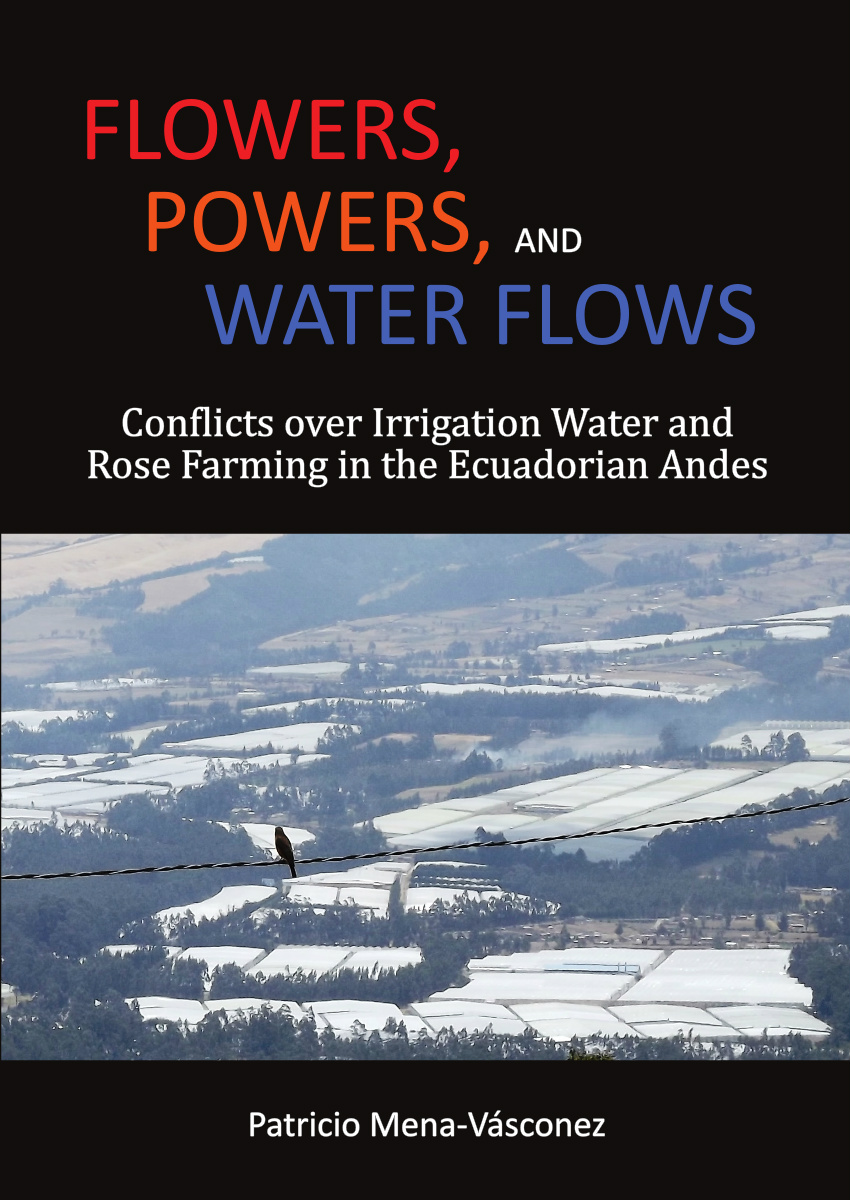


FLOWERS, POWERS, AND WATER FLOWS
The thesis research on flower production, power relations and water use in Ecuador aims at gaining comprehension about the situation of irrigation development, particularly about the competition and conflicts regarding the highly unequal access to water, rights of water control, and forms of water governance in the Pisque watershed of the Andes of Ecuador. During the last two decades Ecuador has become the third exporting country of roses worldwide. The Cayambe region in the Pisque watershed is the main production zone of the country. The high altitude, climate, relatively low wages, and proximity to the international airport of Quito make the zone perfect for export rose production. Flower business creates local jobs, but intense usage of pesticides contaminates the environment and poses health risks to workers. Water has become an increasingly contested resource in this semi-arid region. Most of the scarce irrigation water is used by the about one hundred large flower producers. The remainder is used for subsistence agriculture, feeding thousands of families, and cattle breeding by indigenous communities. Recently, hundreds of smallholders have taken up export-flower production in small greenhouses. This has led to increased water use, and tensions within communities and families over the authorized uses of water: “for food or flowers?” The research applied both contemporary and historical analyses. The latter lays the grounds to grasp the current situation in which the arrival of flower agribusinesses and its recent uptake by local inhabitants has added complexity to a longstanding dynamic social struggle. Through a series of focuses linked by a politico-ecological thread, several social dynamics and struggles related to Pisque’s water governance are addressed to answer the following main research question: What is the current situation and what are the perspectives of water management in the Pisque watershed, as part of a history of local inhabitants historically facing encroachment by and struggling against powerful external actors, the latest of which are flower agribusinesses? The four sub-questions arising from this main question are tackled in Chapters 2 to 5, which were published (3-5) or submitted (2) as articles in specialised scientific journals. Chapter 1 offers a general introduction where political ecology is explained as the backbone of the research. This is followed by an overview of the research sites within the Pisque River Watershed, which is given in greater detail in each of the following four chapters. In a similar manner, the research methodology used is presented, to finish with an analysis of the conceptual frameworks used in this thesis in relation to the political ecology approach, specifically regarding this four theoretical notions: (1) the relationships between nature and society, (2) power relationships, (3) materiality (geography, water, technology), (4) scale issues (time, geography) and (5) discourses and narratives. Five conceptual frameworks related to the political ecology approach are applied in the thesis: (1) The echelons of rights analysis (ERA), (2) Fraser’s three Locations of Struggle (3 Rs), (3) Valuation languages and framings, (4) Mimetic desire, and (5) Gaventa’s Power Cube. In relation to the ERA approach, the contestations at the four levels (struggles of resources, rules, authority and discourses) are not mere skirmishes over natural resources: they are confrontations over meaning, norms, knowledge, identity, authority and discourses. Pisque irrigation-water issues develop in different echelons over which actors struggle. The ERA approach helps unravelling the specificities of these echelons and their interrelations. The three locations of social struggle (representation, recognition and redistribution) proposed by Nancy Fraser are used to analyse three main events: the management takeover from a municipality by local water organised irrigators; the tensions around water for large flower agribusinesses or for traditional food crops in one of the main acequia’s irrigation sectors, and the emergence of small locally-managed export-oriented flower farms. In terms of recognition of valuation languages, the dominant ones do not recognise Andean communities’ land and water values as valid legitimation of their rights systems, nor their practices of management. However, the valuation division is not dichotomous; rather, existing practices create hybrid valuation languages. As concerns mimetic desire, in the case of Pisque the use of mimesis as a factor to explain the uptake of floriculture by local families is of added value to those political ecology approaches that consider structural positions and related interests of stakeholders. Using mimetic desire as a key concept puts the focus on the normalizing and moral-psychological reasons why a smallholder would want to change the mode of farming. Finally, assessing practices of flower certification in Pisque via the three power dimensions of Gaventa´s cube (levels, spaces and forms of power) aids in scrutinising the ways, the sites, and the reasons of the development and application of socio-environmental regulations. Chapter 2 aims at answering how socio-environmental conflicts related to irrigation water have developed throughout Pisque basin´s history and shaped the contemporary flower-dominated hydrosocial territory. The history of Pisque in the Ecuadorian Andes is one of local livelihoods and resources being usurped by external actors: Incas in Pre-Columbian times, Spaniards during Conquest and Colony, and white-mestizo elites, and later international businesses, during the Republican era. Local communities have suffered from, rebelled against, and adapted to adverse, ever-changing socioeconomic, environmental and political conditions. This chapter traces this chronicle from a politico-ecological standpoint, applying the Echelons of Rights Analysis framework and the hydrosocial territory concept to examine conflicts over resources, norms, authorities, and discourses related to irrigation water. The background of the centuries-old saga of water battles in Pisque provides contextual understanding of the latest episode: the onset of rose agribusiness, inheritors of the privileges of colonial haciendas. The most recent boom of locally managed, small greenhouses adds complexity to the “food vs. flowers” dichotomy and renders unpredictable the local population’s perspectives of regaining food security, water justice, and sovereignty. Chapter 3 faces the issue of how the recent appearance of small local floriculturists can be explained and how it fits into the food/water security-self-determination vs modernity-efficiency controversy in discursive, legal, and factual terms. Water management studies often overlook community diversity, different stakeholders´ values, and frames to claim water rights. Using a political ecology approach this chapter examines an irrigation system in Pisque, in Ecuador’s highlands via Fraser’s locations of justice struggle (recognition, representation, redistribution). Large flower companies and indigenous smallholders frame their arguments differently to legitimise water allocation claims. Framing is effective when it resonates with other stakeholders’ values. The chapter presents some unexpected findings: most of the water is still used by large companies after communities took over control of the irrigation system; rules regarding water use differ greatly among sectors within the system, and the recent appearance of small flower producers. Chapter 4 tackles the question of how the discursive framings used by two main current irrigation stakeholders – i.e. flower agribusinesses and local peasant and indigenous inhabitants – to defend and foster their values and practices on water allocation have developed in the Pisque watershed. During the past three decades, the Pisque watershed in Ecuador’s Northern Andes has become the country´s principal export-roses producing area. The recent boom of local smallholders established tiny rose greenhouses and joined this sector of the population to the flower-export business. This has intensified water scarcity and material/discursive conflicts over water use priorities: water to defend local-national food sovereignty or production for export. This chapter examines how including peasant flower farms in the capitalist dream – driven by a ‘mimetic desire’ and copying large-scale capitalist flower-farm practices and technologies – generates new intra-community conflicts over collective water rights, extending traditional class-based water conflicts. The new allocation principles in Ecuador’s progressive 2008 Constitution and 2014 Water Law prioritising food production over flowers’ industrial water use are unlikely to benefit smallholder communities. Instead, decision-making power for peasant communities and their water users’ associations on water use priority would enable water user prioritization according to smallholders’ own preferences. Chapter 5 analyses how agricultural certification schemes have influenced the socio-environmental conditions in Pisque floricultural practices. Private environmental standards certifications are increasingly used to set and monitor environmental and social standards for flower export companies worldwide. This chapter looks at the power relations that shape the different stakeholders’ practices in the case of flower production in Ecuador Flower companies have used toxic agrochemicals that affected workers health and contaminated water, which negatively altered ecosystems and human health. The growing flower export production has led to conflicts over water and contamination of the resource. Large rose producers have environmental, fair-trade and Corporate Social Responsibility certifications required by some flower traders and supermarket chains. However, most standards are permissive, and inspections and compliance were found to be flawed. Strong protests and campaigning by local environmental organizations and water users’ associations were needed to enforce environmental standards and practices. In this case the private certification itself was not sufficient to reduce water contamination; only after pressure by governmental agencies, local NGOs, and water users’ associations the flower companies started to comply to governmental and private certification standards. The last chapter presents general conclusions based on the research questions and their development in the different chapters, and it also links the different but related conceptual frameworks. The five conceptual frameworks regard power relationships in distinct ways. They have in common a focus on the unequal distribution of resources, the power relations in institutional dynamics, and the importance of the recognition of discourses. However, the conceptual frameworks each have their own focus, that deepen the political ecological analysis. An example is the ‘mimetic desire’ concept that adds a socio-psychological analysis to understand the motivations of actors. The present situation with floriculture as the newest powerful stakeholder in the conflicting politico-ecological scenario of Pisque irrigation is a corollary of a history in which local inhabitants have struggled against and challenged powerful external actors, and they have also adapted to the new circumstances with varied success. Two discursive framings have arisen and developed: that of local inhabitants claiming basically self-determination and resource sovereignty and defending ancestral territories, versus that of a diverse succession of foreigners that propose mostly modernity, prosperity, and efficiency. While the backbone of an unequal distribution and the need to contest and struggle seem to persist fundamentally unchanged, this dichotomy seems to be a generalisation of a complex set of intermingling discursive frames that started when wheat and cows entered the ancestral agricultural landscape, and which has become even more entangled with the advent of floricultural agribusinesses and the recent uptake of export flower production by local farmers. External actors have impinged on local rights and beliefs – the latest of which are large flower agribusinesses –, and intra-community clashes have developed, nowadays mainly related to the application of export-oriented floriculture by local families. Thus, a clear-cut division between ‘local’ and ‘foreign’ does not render an accurate picture of the situation. Local inhabitants show an increasing interest on developing flower farms and large flower farms have mellowed their unconstrained neoliberalism with a more socially and environmentally conscious position derived from the application of pressure from several fronts.
| Publicatiedatum | 22 april 2020 |
| Universiteit | Wageningen University |
| Auteur | Patricio Mena Vásconez |
| ISBN nummer | 978-94-6395-264-4 |