Marcel Boonen
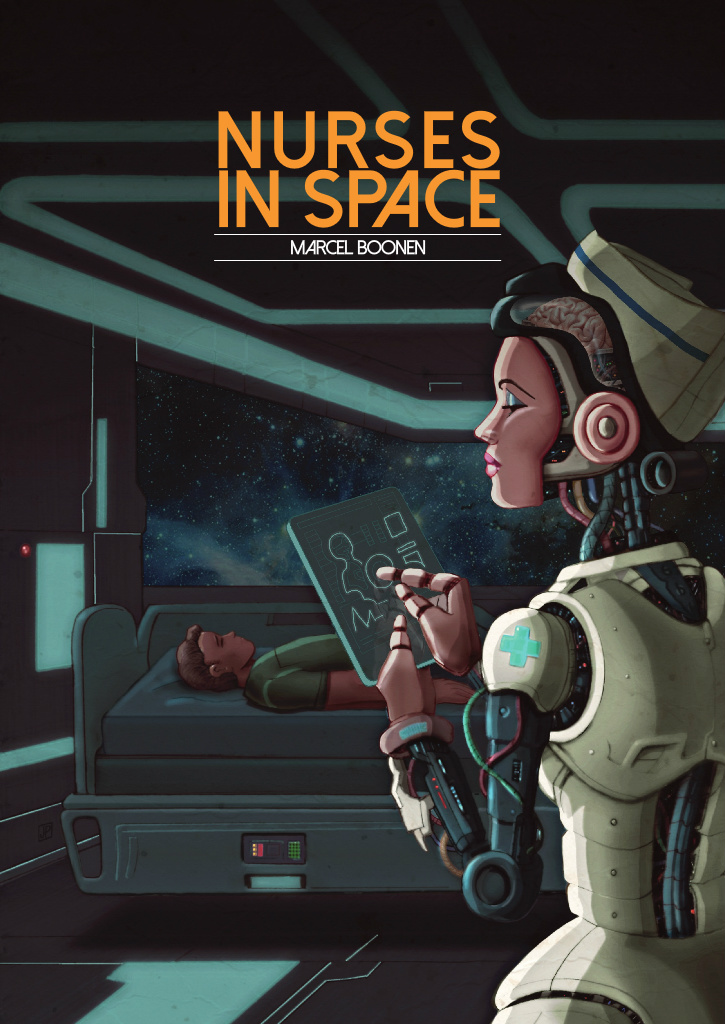


Nurses in Space
Technology in hospitals has expanded enormously. We see the rise and expiry of one technology, only to be replaced by another ‘improved technology’. Technological progress and economization give technology a double mission: it must increase safety of care, but must also contribute to the transparency, responsibility, and cost saving targets of the organization. The possibilities of technology seem boundless. The initial vocational purpose of nursing is drawn into the dominance of the technical and technological spectrum which has become a part of nursing. With the market oriented focus of the hospital, the core business of ‘delivering care’ is extended. Practical experiences and anecdotal evidence indicate that all of these developments create tension within the day-to-day practice of the care process. The introduction of a medication technology seems unproblematic. But the medication technology enters the caring relationship and forms a triangle when it becomes an actor in this relationship. The combination of nursing practices and medication technology adds tension to an already pre-existing charged relationship between nurses and their patients, a relationship that is characterized by uncertainty, dependency, and the vulnerability of that patient. From an organizational perspective, medication technology is viewed as unproblematic and is taken for granted. The question arises as to how nurses cope with these strong mediating organizational and technological rulings and still deliberate on how to deliver good and safe care to their patients. This thesis aims to contribute to a broader view of how medication technology intervenes in nursing practices. It shows how the spatial position of the nurses and the patients is altered in a literal and in a figurative sense. The purpose of this thesis is twofold: uncovering and describing (1) how medication technology rules nurses’ actions and how different types of knowledge play a role, and (2), how nurses deliberate in order to line up technology and knowledge with the practice of good care. This research is strongly empirically driven, and data has been obtained by participative observation. The observations are broken down and recorded in discrete ‘scenes’ that are then analyzed on the basis of a model. The questioning, as well as the choice of methodology and analysis, are supported with literature from the philosophy of technology, from ethnography and from practice theory. The source of the research question has autobiographical roots that prompted a search for points of reference in the literature, and occasioned preliminary observations and interviews with nurses, peers, and leading scientists in the field of technology, practice, theory, and ethnography. Two years of preliminary preparatory research preceded the formal start of the research project. In chapter 2, the heuristic lenses that were used to approach the research field are legitimized with reference to the literature. The initial technological perspective was combined with practice theory that enabled distinctions of temporality, physicality, and materiality to be made and offered us the opportunity to get close to the nursing practice. The final lens was needed to get a view of the different kinds of knowledge applied in working with a medication technology. Chapter 3 argues that the problem statement legitimizes an ethnographical approach which was provided by Institutional Ethnography focusing on institutional ruling. Because we were not only just curious about ‘institutional ruling’ but also about how nurses use different forms of knowledge in the care process while distributing medication, we used a research model that is informed by Institutional Ethnography and combined with practice theory. The data analysis is performed on the basis of a model of analysis that is derived from Smith’s model of the ‘small hero’. In this research, the nurse is the small hero. Chapter 4 focuses on the implementation and use of barcoded medication technology that presumes to increase safety in hospitals by lowering the risk of adverse events caused by the human factor in drug administration. Using heuristic lenses, this article shows this is too narrow a view because it ignores the relevance of nurse knowledge in the distribution of medication. Chapter 5 is a presentation of some of our results from this extended case study. With the benefit of the overlapping research methodologies, and on the basis of the data gathered, we will show how the use of medication technology creates new problems and causes the nurse to ‘tinker’ with the process. Chapter 6 of the thesis shows how the use of medication technology organizes and rules the daily activity of nurses. Although the technology is intended to improve the quality and safety of drug distribution, in a hospital little research is done on how this technology changes the human role. The observed blurring of boundaries and the direction of this vital aspect of nursing show how the logic of technology differs from the logic of care that is dictated by deliberation. Chapter 7 shows that barcoded medication technology changes the relation between nurse and patient. As well as the nurse, the patient is also incorporated in institutional ruling by the technology. Patients’ knowledge is invasively mediated by procedures and protocols and leaves no room for their personal input in the safe use of medication. Chapter 8 is the concluding chapter and discusses the significance of this research and the findings. Research on practice must be performed close to that practice, in this case the practices of nurses. In research model they are the ‘small heroes’ in the field, working with BCMA as a medication technology. Just as the main objective in my research strategy was to let ‘small heroes’ talk back to an organization, I will ‘talk back’ to the authors whose literature was important in this research. The mixed method used in this research lays a foundation for future research into practices. This thesis makes a plea that a multi-layered view of technology and nursing practice is taken. Technology and nursing in the near future will become increasingly intertwined and nurses will have an ongoing need to carve out space for their patients.
| Publicatiedatum | 13 november 2017 |
| Universiteit | Universiteit voor Humanistiek |
| Auteur | Marcel Boonen |