Ludo Cornelissen
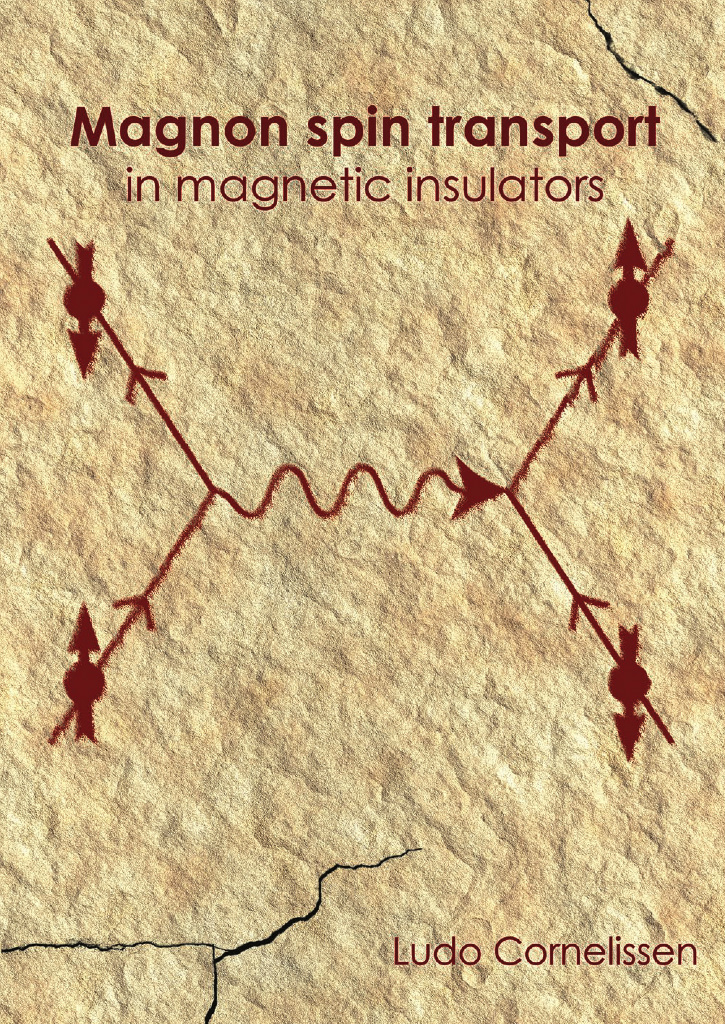


Magnon spin transport in magnetic insulators
The invention of the transistor in 1947 marked the start of the Information Age and brought information processing into the realm of condensed matter physics. While a multitude of variations in transistor design has been developed in the past decades, the operation principle of these devices has not changed fundamentally since the introduction of the MOSFET (metal-oxide-semiconductor field effect transistor) in 1959. Such a FET can be used to perform logic operations because the charge current between two of its terminals can be fully controlled by a voltage applied to its third terminal. The integration of many FET’s on a single silicon chip and the continuous downscaling of transistor dimensions have made computing technology fast, cheap, and therefore available to the masses. However, transistor miniaturization has hit its limits, mainly caused by excessive energy dissipation in the circuit. To maintain the pace of progress in computing power, research efforts are dedicated to the search for an alternative (or at least complementary) information processing technology that can overcome these issues. Spin-based electronics, or spintronics, is one of the candidates. In spintronics the spin of an electron, rather than its charge, plays a central role in achieving device functionality. The electron spin is a quantum mechanical property that is a measure for its intrinsic angular momentum and magnetic dipole moment. The spin and in particular the interaction between spins of different electrons are a key ingredient for ferromagnetism, and as such research in the field of spintronics often involves magnetically ordered materials. Spintronics usually employs conducting ferromagnets, which in equilibrium feature an imbalance of spin up and spin down electrons. This imbalance can be (partially) injected into an adjacent nonmagnetic metal or semiconductor by sending a charge current through the system. In the normal metal, the imbalance can propagate in the form of a spin current. A spin current is a flux of spin angular momentum, which can for instance be carried by conduction electrons: In a pure spin current, a certain amount of spin up electrons diffuse to the left and an equal amount of spin down electrons diffuse to the right. Note that in this case, no charge current arises because each electron carries the same charge, whereas they carry opposite spin. However, in this thesis we take a different approach and focus instead on magnetically ordered materials that are electrically insulating. Such a material can still support spin currents, albeit in different form. The spin current is not carried by conduction electrons, but by so-called magnons. Magnons are the quasiparticle representation of the low-energy excitations of magnetically ordered systems. These low-energy excitations are called spin waves. A spin wave in a magnetic crystal can be thought of as a distributed single spin flip of one of the crystals magnetic moments. However, instead of flipping one spin completely, the excitation is composed of a small reduction of the magnetic moment of many spins in the crystal. This reduction is achieved by the precession of individual moments around their equilibrium position at a small cone angle. Since the spins precess with equal frequency, but at a slight phase difference, this gives rise to a spin wave. Spin waves are responsible for the temperature dependence of the magnetization. Typically, at finite temperature the spin wave density in a ferromagnet is large and gradually reduces as the magnet is cooled down. Conversely, if the temperature rises and the spin wave density becomes larger than a certain critical value, the magnetic order is lost and the system no longer exhibits a net magnetization (until it is re-established by applying a sufficiently large external magnetic field). Spin waves can be described in terms of classical electromagnetism, but when the spin wave density and energy are large, they are more easily described quantum mechanically in a quasiparticle picture, which is where magnons come in. In some sense, magnons are similar to phonons: The vibrational modes in a crystal lattice can be described in terms of phonons. The underlying physical phenomenon is then the collective displacement of the atoms in the lattice. Similarly, magnons represent the collective precession of the localized spins in the magnetically ordered lattice. Magnons and phonons are both bosons, but behave very differently in terms of propagation and dispersion. The material of choice as far as magnetic insulators go is yttrium iron garnet (YIG), mainly because of its low intrinsic spin wave damping. We showed that a spin current generated in a conducting heavy metal (HM, we use platinum) layer can be directly transferred to an adjacent YIG film. At the HM|YIG interface, the spin current is converted from an electronic spin current to a magnonic spin current via interfacial spin-flip scattering. This happens because there exists a finite wavefunction overlap between the free s electrons in the HM and the localized d electrons in the YIG, which gives rise to an exchange interaction across the interface and enables spin angular momentum transfer between the two layers. The transport of spin by magnons in magnetic insulators such YIG is the central topic of this thesis. A nonlocal device geometry was developed to enable the systematic study of such transport. A very narrow and thin platinum (Pt) strip fabricated directly on top of an extended YIG film is used to generate the magnonic spin current. A certain distance (ranging from 200 nm to 40 µm) away, a parallel Pt strip of equal dimensions is patterned, which serves to detect the spin current. One elegant aspect of this technique is that magnons are generated via two different mechanisms, one which is linear in the applied charge current and one that is quadratic in the current. The linear mechanism relies on the spin Hall effect, and generates magnons according to the spin-flip scattering process outlined above. The quadratic mechanism relies on the spin Seebeck effect, which generates a magnon spin current in response to a thermal gradient over the magnet. The thermal gradient results from Joule heating in the injector. Magnon spin signals stemming from these two mechanisms can be readily separated based on their dependence on the charge current, as well as their angular dependence. For the linear mechanism, we found that the injection and detection processes are reciprocal to each other (as they should be), which means that interchanging injector and detector gives exactly the same result. From the nonlocal measurement results, we conclude that magnons excited via the mechanism outlined above propagate incoherently and in a diffusive manner, i.e. the magnonic mean free path is much shorter than the device dimensions and a magnon undergoes many collisions (for instance with phonons and crystal defects) on its way from injector to detector. The reason for this is their high average energy, since in this excitation scheme in principle magnons up to the thermal energy are excited. This means that their wavelength is short, and hence their scattering cross-section is large. This in contrast to the long-wavelength, low-frequency magnons which are excited via microwave frequency magnetic fields, another popular excitation technique in the field of magnonics. These magnons propagate through the film in a coherent manner, are characterized by a long mean free path and can travel over distances of several millimeters. In this thesis, we show that diffusive magnon spin transport can be described in a way very similar to the diffusive spin transport by electrons in conductors, despite the different nature of the spin carriers (fermionic vs bosonic). Essentially the same spin diffusion-relaxation equations can be used and several parameters familiar from electronic transport find their analogue in magnonic transport. Notable examples are the magnon spin conductivity σm (similar to the electrical conductivity) and the magnon spin diffusion length λm (similar to the spin relaxation length in conductors). σm governs the degree to which a certain material supports a magnonic spin current: A larger value means that spin is transported more efficiently. λm on the other hand characterizes the average distance a magnon can travel before it decays: A larger value means that a spin current can be transported over larger distances. Using our nonlocal measurement technique, we have measured how σm and λm depend on external parameters such as the magnetic field we apply to the system, or the ambient temperature. Such measurements are useful because they can help to identify flaws in our understanding of the magnon physics. For instance, we found that the temperature dependence of the linear magnon generation mechanism can be captured well by our theory and behaves more or less as expected. However, magnon spin signals generated via the spin Seebeck effect show a surprising increase as the temperature is decreased, which was not expected and is in fact still not well understood. To quantitatively compare our measurement results with theoretical predictions, we have developed a theoretical model of magnon spin transport and solved it for our precise device geometry using a finite-element approach. Our theory describes the magnon system in terms of two parameters: A magnon temperature and a magnon chemical potential. Normally, for a gas of bosons in thermal equilibrium the chemical potential is zero. However, we do not probe the equilibrium state, because we are continuously injecting a spin current (as well as an energy current) in the system. If energy exchanging magnon-phonon scattering occurs on a faster timescale than magnon relaxation, the magnon chemical potential can no longer be disregarded but has to be included in the model. This is the key premise underlying our description, and we estimate the corresponding scattering times to argue that this premise is indeed valid in YIG. The inclusion of the magnon chemical potential is the main difference between our theoretical framework and the literature and is therefore one of the key results of this thesis. In addition to the transport of ordinary magnons, we also investigate magnon-polaron transport in our nonlocal devices. Magnon-polarons are coherently mixed quasiparticles, half magnon, half phonon, and are generated by magnetoelasticity. Though already predicted by Kittel long ago, their effect on spin transport was discovered only recently in YIG using optical and local spin Seebeck effect experiments. In the latter, magnon-polarons are manifest as resonant peaks in the spin Seebeck signal as a function of magnetic field. In this thesis, we show that they also play a role in the nonlocal spin Seebeck effect, with a surprising twist: Measured nonlocally, the magnon-polaron peak turns into a dip. This crossover turns out to be a consequence of the magnon physics underlying the spin Seebeck effect. Thermal generation and diffusive backflow of magnons in YIG compete, which can generate any sign for the magnon-polaron anomaly in nonlocal experiments. Furthermore, coming back to the motivation for this research from an information technology point of view given above, we have investigated the possibility of locally manipulating the magnon spin transport in YIG in an attempt to obtain transistor-like functionality in our devices. Efficient manipulation of magnon spin transport is crucial for developing magnon-based spintronic devices, because it enables logic operations to be performed. In this thesis, we provide proof-of-principle of a method for modulating the diffusive transport of thermal magnons in a YIG channel between injector and detector contacts. The magnon spin conductance of the channel is altered by increasing or decreasing the magnon chemical potential via the linear injection of magnons by a third modulator electrode. While the modulation efficiency which we obtained is very small, in the order of 1 %, our finite element model shows that this could be increased to well above 10 % by simply reducing the thickness of the YIG channel. Although still far below the efficiency of a modern-day FET, further device optimization with respect to for instance the interface between the contacts and the YIG could bring further efficiency boosts, thereby providing interesting prospects for the development of magnon-based logic circuits. Finally, we identify promising experimental directions that can be pursued in the coming years. Magnon transport in different classes of materials such as paramagnets and antiferromagnets will undoubtedly see interesting developments in the near future. Additionally, transport in the nonlinear regime in very thin, yet high quality, YIG films will be of great interest because it could possibly lead to the formation of a room temperature, current-driven Bose-Einstein condensate of magnons if saturation effects can be circumvented. Moreover, the interaction between magnon spin currents in YIG and the magnetization of adjacent nanoscale conducting ferromagnets holds promise because it could allow the read-out, or even altering of the state, of a magnetic memory element with a magnon spin current and as such provide buffer functionality to a magnonic circuit. All in all, the developments in magnon spintronics certainly do not stop at the end of this thesis and the field is set to see some exciting developments in the years to come.
| Publicatiedatum | 8 juni 2018 |
| Universiteit | Rijksuniversiteit Groningen |
| Auteur | Ludo Cornelissen |
| ISBN nummer | 978-94-034-0505-6 |