Hatem Al Farra
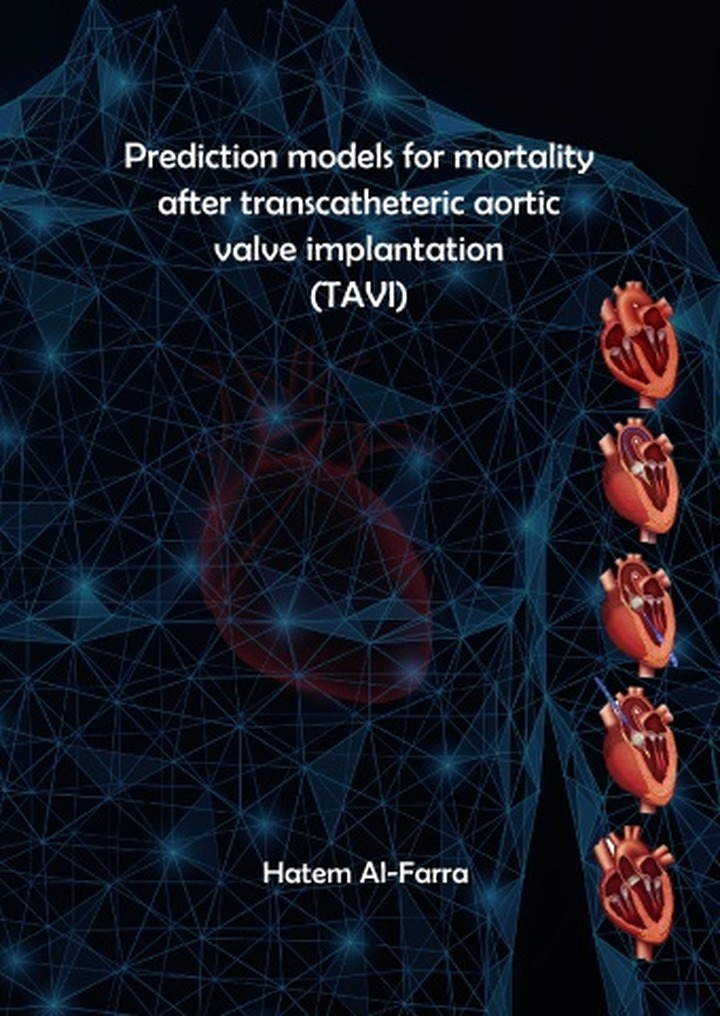


Prediction models for mortality after transcatheteric aortic valve implantation (TAVI)
Chapter 1 describes the objectives and problems addressed in this thesis. Specifically, despite the availability of TAVI data in the National Heart Registration (NHR), no studies have been conducted on how existing models predict mortality and morbidity in terms of validity and reliable clinical use in The Netherlands. In addition, it is unknown whether adjustments and regular updates should be pursued for these models or whether a redesigned model based on NHR data yields better results for the Dutch population. Finally, it is unknown what IT challenges heart centers to face, and how establishing their strategic information plans are aided by a given guideline for creating them. In chapter 2, the performance of existing prediction models of mortality including the ACC-TAVI model and the FRANCE-2 model was assessed with TAVI data from NHR. The ability to discriminate between survivors and non-survivors by means of the AU-ROC metric was between 0.58 and 0.64. It was inferred that externally validated TAVI models showed an inadequate and suboptimal predictive performance on the external Dutch population dataset. Chapter 3 showed that an updated revised version of the ACC-TAVI should be the better currently available prediction model for TAVI-related early-mortality in the Dutch population. The predictive ability of the updated ACC-TAVI model was still suboptimal. It was recommended that other countries consider model updates in their populations. Moreover, the study recommended the development of a new validated TAVI-specific prediction model with the use of NHR data. In chapter 4, data of 9144 TAVI patients from the NHR were used to develop and internally validate a new TAVI-specific model. The final model (TAVI-NHR) has ten variables, including age (in years), serum creatinine, left ventricular ejection fraction, body surface area, NYHA class, procedure-acuteness status, chronic lung disease, critical-preoperative state, diabetes-mellitus, and TAVI access-routes. Body surface area and diabetes mellitus emerged as new predictors that were not used in the currently available TAVI-specific models. The AU-ROC of the TAVI-NHR model was 0.69 (IQR 0.646-0.75). There have been no signs of miscalibration observed. In chapter 5, it was additionally found that in spite of the significant expansion of the performed TAVI procedures over the years, the mortality rates significantly dropped. The majority of serious complications still occur in elderly patients and patients at higher surgical risk. Chapter 6 advocates the establishment of a strategic information management plan (SIM-plan) for organizing the necessary data management infrastructure in a heart center. Implementing a SIM plan for a heart center aided the identification of 15 business goals and 6 IT goals. Moreover, the activities enabled describing and assessing the current HIS situation and identifying the IT problems and issues, which could form priorities to be addressed. Maintenance of SIM-plans by means of regular updates due to increasing demands and changes in the hospital information system (HIS) infrastructure is necessary. Chapter 7 provides a wrap-up of the findings and suggestions for the future are given. The most relevant recommendation is to consider how to maintain the NHR-TAVI model and to organize optimal data collection to meet ambitions in modeling and applications of Artificial Intelligence.
| Publicatiedatum | 4 juli 2023 |
| Universiteit | Universiteit van Amsterdam |
| Auteur | Hatem Al Farra |
| ISBN nummer | 978-94-6469-344-7 |